Mavrina Ekaterina, Kimble Leighann, Waury Katharina, Gogishvili Dea, Gómez de San José Nerea, Das Shreyasee, Coppens Salomé, Fernandes Gomes Bárbara, Mravinacová Sára, Wojdała Anna Lidia, Bolsewig Katharina, Bayoumy Sherif, Burtscher Felicia, Mohaupt Pablo, Willemse Eline, Teunissen Charlotte
MIRIADE Consortium: Multiomics Interdisciplinary Research Integration to Address DEmentia Diagnosis.
KIN Center for Digital Innovation, Vrije Universiteit Amsterdam, Amsterdam, Netherlands.
Front Neurol. 2022 Jul 12;13:890638. doi: 10.3389/fneur.2022.890638. eCollection 2022.
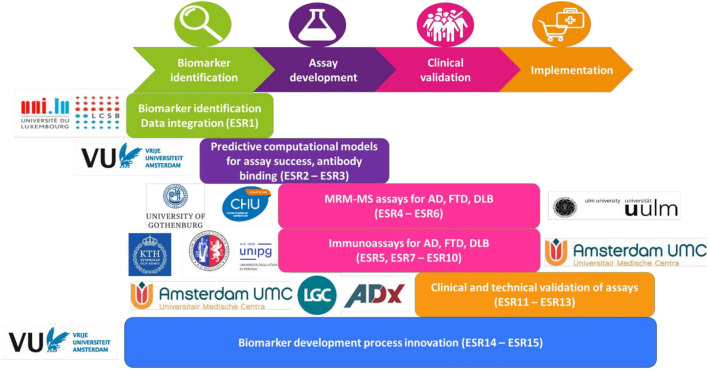
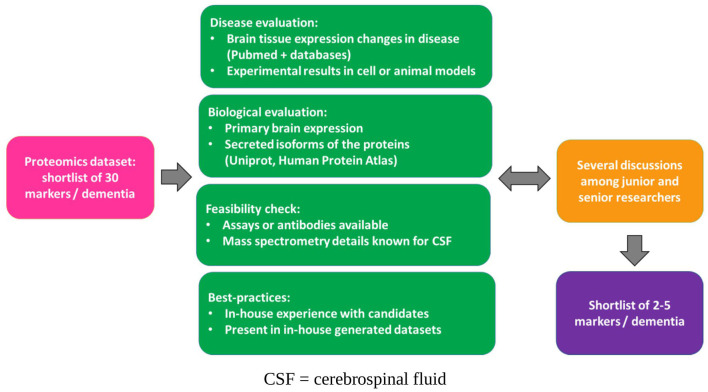
Proteomics studies have shown differential expression of numerous proteins in dementias but have rarely led to novel biomarker tests for clinical use. The Marie Curie MIRIADE project is designed to experimentally evaluate development strategies to accelerate the validation and ultimate implementation of novel biomarkers in clinical practice, using proteomics-based biomarker development for main dementias as experimental case studies. We address several knowledge gaps that have been identified in the field. First, there is the technology-translation gap of different technologies for the discovery (e.g., mass spectrometry) and the large-scale validation (e.g., immunoassays) of biomarkers. In addition, there is a limited understanding of conformational states of biomarker proteins in different matrices, which affect the selection of reagents for assay development. In this review, we aim to understand the decisions taken in the initial steps of biomarker development, which is done via an interim narrative update of the work of each ESR subproject. The results describe the decision process to shortlist biomarkers from a proteomics to develop immunoassays or mass spectrometry assays for Alzheimer's disease, Lewy body dementia, and frontotemporal dementia. In addition, we explain the approach to prepare the market implementation of novel biomarkers and assays. Moreover, we describe the development of computational protein state and interaction prediction models to support biomarker development, such as the prediction of epitopes. Lastly, we reflect upon activities involved in the biomarker development process to deduce a best-practice roadmap for biomarker development.
蛋白质组学研究表明,痴呆症中有多种蛋白质存在差异表达,但很少能产生可用于临床的新型生物标志物检测方法。玛丽·居里MIRIADE项目旨在通过将基于蛋白质组学的主要痴呆症生物标志物开发作为实验案例研究,对加速新型生物标志物在临床实践中的验证和最终应用的开发策略进行实验评估。我们解决了该领域已发现的几个知识空白。首先,存在生物标志物发现(如质谱分析)和大规模验证(如免疫测定)的不同技术之间的技术转化差距。此外,对于不同基质中生物标志物蛋白质的构象状态了解有限,这会影响检测方法开发中试剂的选择。在本综述中,我们旨在了解生物标志物开发初始阶段所做的决策,这是通过对每个早期阶段研究人员(ESR)子项目的工作进行中期叙述性更新来完成的。结果描述了从蛋白质组学中筛选生物标志物以开发阿尔茨海默病、路易体痴呆和额颞叶痴呆的免疫测定或质谱分析方法的决策过程。此外,我们解释了为新型生物标志物和检测方法的市场应用做准备的方法。而且,我们描述了用于支持生物标志物开发的计算蛋白质状态和相互作用预测模型的开发,如抗原表位预测。最后,我们思考生物标志物开发过程中涉及的活动,以推导出生物标志物开发的最佳实践路线图。