Liang Ze-Yan, Xu Xiong-Jie, Rao Jian, Yang Zhe-Lun, Wang Chun-Hua, Chen Chun-Mei
Department of Neurosurgery, Fujian Medical University Union Hospital, Fuzhou, China.
Front Mol Neurosci. 2022 Jul 12;15:926928. doi: 10.3389/fnmol.2022.926928. eCollection 2022.
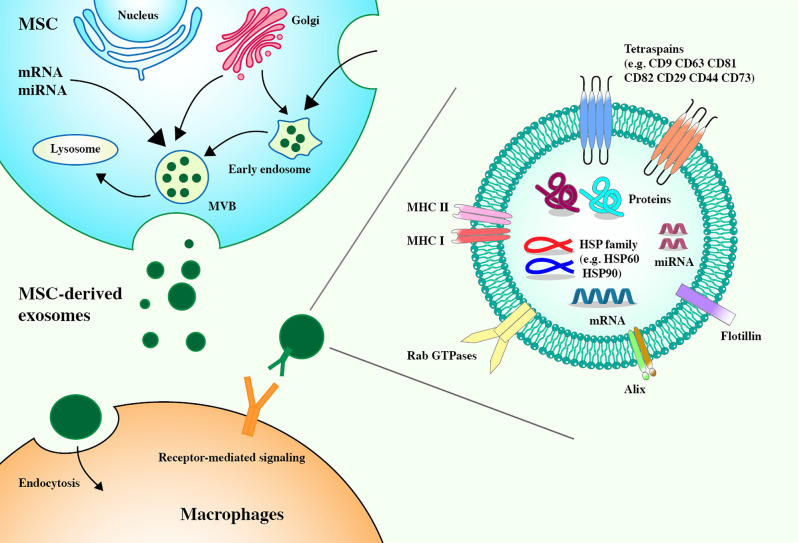
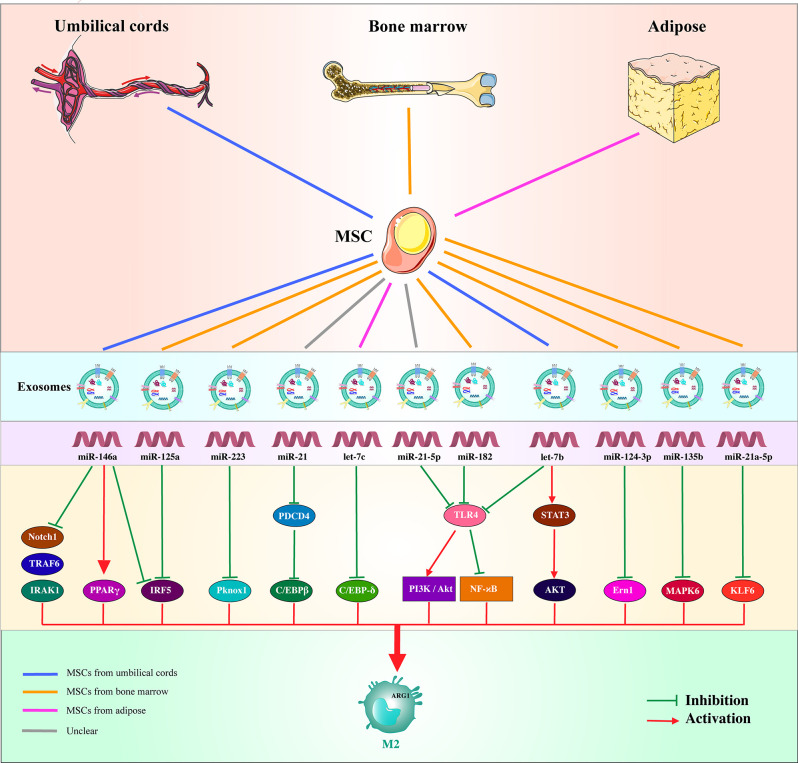
Spinal cord injury (SCI) is an enormous public health concern affecting approximately 250,000-500,000 people worldwide each year. It is mostly irreversible considering the limitations of currently available treatments, and its prevention and management have been the prime focus of many studies. Mesenchymal stem cell (MSC) transplantation is one of the most promising treatments for SCI. The role of MSCs in SCI has been studied extensively, and MSCs have been shown to have many limitations. Moreover, the therapeutic effects of MSCs are more likely related to paracrine effects. In SCIs, macrophages from peripheral sources differentiate into M1 macrophages, promoting inflammation and aggravating neuronal damage; however, studies have shown that MSC-derived exosomes can induce the polarization of macrophages from the M1 to the M2 phenotype, thereby promoting nerve function recovery in patients with SCI. In this review, we discussed the research progress of MSC-derived exosomal miRNAs in promoting M2 macrophage differentiation in the SCI, and introduced some exosomal miRNAs that can regulate the differentiation of M2 macrophages in non-SCI; it is hoped that the regulatory role of these exosome-derived miRNAs can be confirmed in SCI.
脊髓损伤(SCI)是一个重大的公共卫生问题,每年影响着全球约25万至50万人。考虑到现有治疗方法的局限性,脊髓损伤大多是不可逆的,其预防和管理一直是许多研究的主要重点。间充质干细胞(MSC)移植是治疗脊髓损伤最有前景的方法之一。间充质干细胞在脊髓损伤中的作用已得到广泛研究,并且已显示间充质干细胞存在许多局限性。此外,间充质干细胞的治疗效果更可能与旁分泌作用有关。在脊髓损伤中,外周来源的巨噬细胞分化为M1巨噬细胞,促进炎症反应并加重神经元损伤;然而,研究表明,间充质干细胞衍生的外泌体可诱导巨噬细胞从M1表型向M2表型极化,从而促进脊髓损伤患者的神经功能恢复。在本综述中,我们讨论了间充质干细胞衍生的外泌体微小RNA在促进脊髓损伤中M2巨噬细胞分化方面的研究进展,并介绍了一些可在非脊髓损伤中调节M2巨噬细胞分化的外泌体微小RNA;希望这些外泌体衍生的微小RNA的调节作用能在脊髓损伤中得到证实。