Emergency Department, The Third People's Hospital of Chengdu, The Affiliated Hospital of Southwest Jiaotong University, The Second Affiliated Hospital Chengdu Clinical College of Chongqing Medical University, Chengdu, China.
Front Public Health. 2022 Jul 12;10:914950. doi: 10.3389/fpubh.2022.914950. eCollection 2022.
The coronavirus disease 2019 (COVID-19) vaccines are considered to be an effective way to prevent the spread of the infection. Our previous study has shown that about 75% of healthcare workers (HCWs) in China were willing to receive the vaccine when it became available. Here, we examined the acceptance of a third booster dose among Chinese people and identified the influencing factors.
A cross-sectional online survey was conducted and the snowball sampling method was utilized. An online questionnaire was provided to all the participants in the form of a quick response (QR) code. The questionnaire included general demographic information, views on vaccines, the General Health Questionnaire-12 (GHQ-12), and the Depression, Anxiety, and Stress Scale-21 (DASS-21). The univariate analysis was done between all the variables and our dependent variable. Then, we used the multivariate logistic regression model to examine the influencing factors of the third booster dose acceptance.
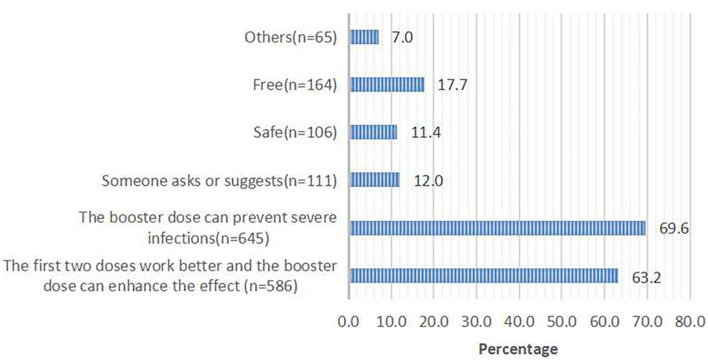
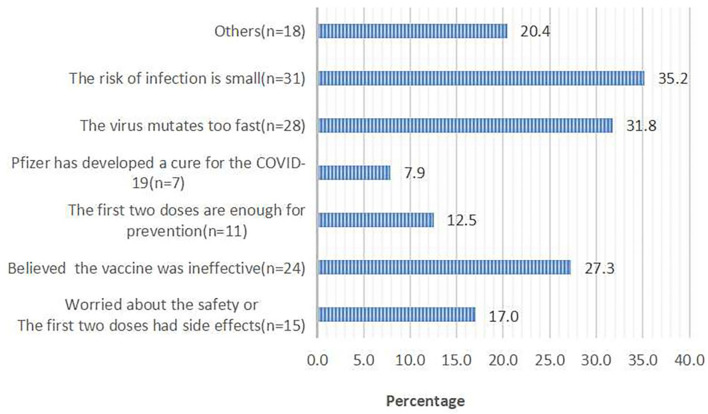
We collected 1,062 complete answers. Of these, 90.39% ( = 960) declared that they would accept the booster dose. Knowing more about the vaccine and recognizing the efficacy of vaccines were significantly associated with greater acceptance of the booster dose. People willing to take the booster dose had better psychological health. A belief that the booster dose could prevent severe infection caused by COVID-19 and enhance the effectiveness of the first two doses were the main contributing factors to vaccine acceptance. Vaccine hesitancy was mainly due to a low perceived risk of severe acute respiratory syndrome coronavirus 2 (SARS-CoV-2) infection and rapid mutation of SARS-CoV-2.
This study revealed that Chinese people were very receptive to the third booster dose, which is an inspiring result. More positive attitudes regarding COVID-19 vaccination were supported by its efficacy and few side effects.
新型冠状病毒病 2019(COVID-19)疫苗被认为是预防感染传播的有效方法。我们之前的研究表明,中国约有 75%的医护人员(HCWs)在疫苗可用时愿意接种。在这里,我们研究了中国人对第三剂加强针的接受程度,并确定了影响因素。
采用横断面在线调查和雪球抽样方法。以快速反应(QR)码的形式向所有参与者提供在线问卷。问卷包括一般人口统计学信息、疫苗观点、一般健康问卷-12(GHQ-12)和抑郁、焦虑和压力量表-21(DASS-21)。在单变量分析中,我们对所有变量和我们的因变量进行了分析。然后,我们使用多变量逻辑回归模型来检验第三剂加强针接种接受的影响因素。
我们共收集了 1062 份完整的回答。其中,90.39%(=960)的人表示他们将接受加强针。更多地了解疫苗和认识到疫苗的疗效与更高的加强针接种意愿显著相关。愿意接种加强针的人心理健康状况更好。认为加强针可以预防 COVID-19 引起的严重感染并增强前两剂疫苗的效果是疫苗接种接受的主要因素。疫苗犹豫主要是由于对严重急性呼吸综合征冠状病毒 2(SARS-CoV-2)感染的感知风险低和 SARS-CoV-2 的快速突变。
本研究表明,中国人对第三剂加强针非常接受,这是一个令人鼓舞的结果。对 COVID-19 疫苗接种的更积极态度得到了其疗效和很少的副作用的支持。