Choudhary Tarun Shankar, Kumar Mohan, Sinha Bireshwar, Shaikh Saijuddin, Mazumder Sarmila, Taneja Sunita, Bhandari Nita
Knowledge Integration and Transformation Platform at Centre for Health Research and Development, Society for Applied Studies, New Delhi, India.
Department of Global Public Health and Primary Care, University of Bergen, Bergen, Norway.
Front Nutr. 2022 Jul 12;9:884207. doi: 10.3389/fnut.2022.884207. eCollection 2022.
Low birthweight (LBW) babies (<2.5 kg) are at higher risk of mortality and weight for height score is currently recommended for identifying infants at risk of mortality.
To compare different anthropometric measures at 28-day of age in a cohort of LBW Indian infants for predicting mortality between 28-day and 180-day of age.
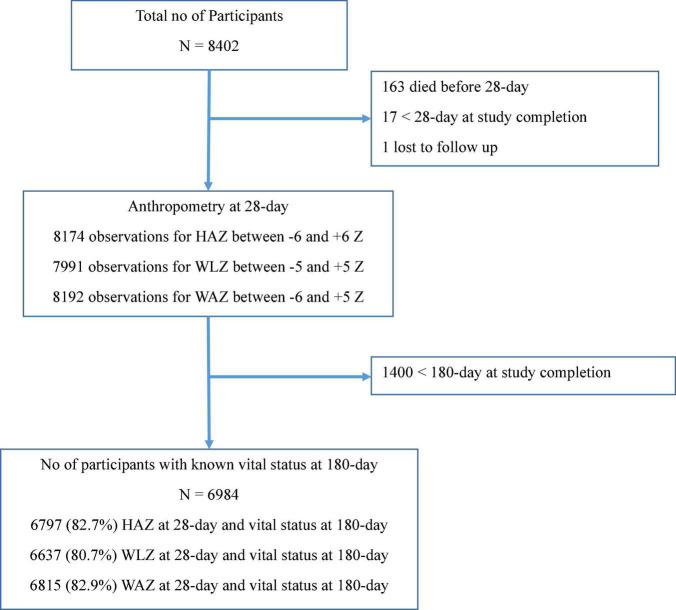
We used data from an individually randomized controlled trial of LBW infants weighing between 1,500 and 2,250 g. Sensitivity, specificity, positive, and negative likelihood ratios, positive and negative predictive values, and area under receiver operating characteristics curves (AUC) were used to estimate the discrimination of mortality risk. The Cox regression was used to estimate hazard ratios and population attributable fraction for each anthropometric indicator. These estimates were calculated for individual as well as combinations of anthropometric indicators at the cut-off of -2 and -3 of the WHO 2006 growth standards.
Severe underweight (weight-for-age z-scores [WAZ] < -3) had a sensitivity of 75.0%, specificity of 68.0% with an AUC of 0.72. The risk of death was higher ( 6.18; 95% 4.29-8.90) with a population attributable fraction of 0.63 (95% 0.52-0.72) for infants severely underweight at 28-day of age. Combination of different anthropometric measures did not perform better than individual measures.
Severe underweight (WAZ < -3) better discriminated deaths among LBW infants < 6 months of age. It can be considered for diagnosis of nutritionally at-risk infants in this age group.
[ClinicalTrials.gov], identifier [NCT02653534].
低出生体重(LBW)婴儿(<2.5千克)的死亡风险较高,目前建议建议推荐建议使用身高别体重评分来识别有死亡风险的婴儿。
比较印度低出生体重婴儿队列在28日龄时的不同人体测量指标,以预测28日龄至180日龄之间的死亡率。
我们使用了一项针对体重在1500至2250克之间的低出生体重婴儿的个体随机对照试验的数据。使用敏感性、特异性、阳性和阴性似然比、阳性和阴性预测值以及受试者工作特征曲线下面积(AUC)来估计死亡风险的辨别能力。使用Cox回归来估计每个人体测量指标的风险比和人群归因分数。这些估计值是针对世界卫生组织2006年生长标准中-2和-3切点处的个体以及人体测量指标组合计算得出的。
重度体重不足(年龄别体重Z评分[WAZ]<-3)的敏感性为75.0%,特异性为68.0%,AUC为0.72。28日龄时重度体重不足的婴儿死亡风险更高(6.18;95% 4.29 - 8.90),人群归因分数为0.63(95% 0.52 - 0.72)。不同人体测量指标的组合并不比单个指标表现更好。
重度体重不足(WAZ<-3)能更好地辨别6个月以下低出生体重婴儿的死亡情况。可考虑将其用于该年龄组营养风险婴儿的诊断。
[ClinicalTrials.gov],标识符[NCT02653534]。