Department of Radiology and Imaging Sciences, Emory University School of Medicine, Atlanta, Georgia, USA.
Department of Biomedical Engineering, Georgia Institute of Technology and Emory University, Atlanta, Georgia, USA.
J Magn Reson Imaging. 2023 Apr;57(4):1222-1228. doi: 10.1002/jmri.28376. Epub 2022 Jul 29.
While fluctuations in healthy brain temperature have been investigated over time periods of weeks to months, dynamics over shorter time periods are less clear.
To identify physiological fluctuations in brain temperature in healthy volunteers over time scales of approximately 1 hour.
Prospective.
A total of 30 healthy volunteers (15 female; 26 ± 4 years old).
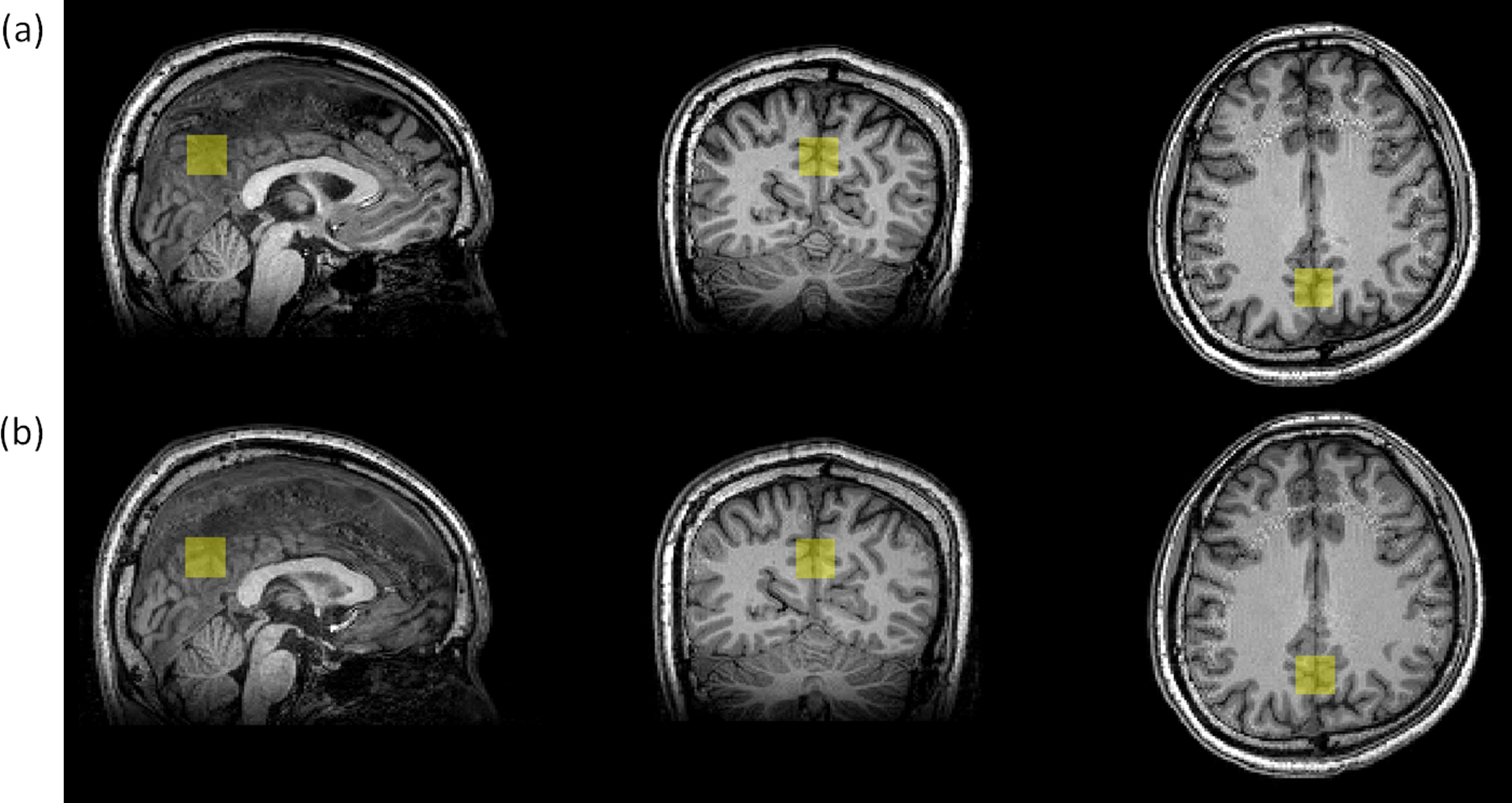
3 T; T1-weighted magnetization-prepared rapid gradient-echo (MPRAGE) and semi-localized by adiabatic selective refocusing (sLASER) single-voxel spectroscopy.
Brain temperature was calculated from the chemical shift difference between N-acetylaspartate and water. To evaluate within-scan repeatability of brain temperature and the brain-body temperature difference, 128 spectral transients were divided into two sets of 64-spectra. Between-scan repeatability was evaluated using two time periods, ~1-1.5 hours apart.
A hierarchical linear mixed model was used to calculate within-scan and between-scan correlations (R and R , respectively). Significance was determined at P ≤ .05. Values are reported as the mean ± standard deviation.
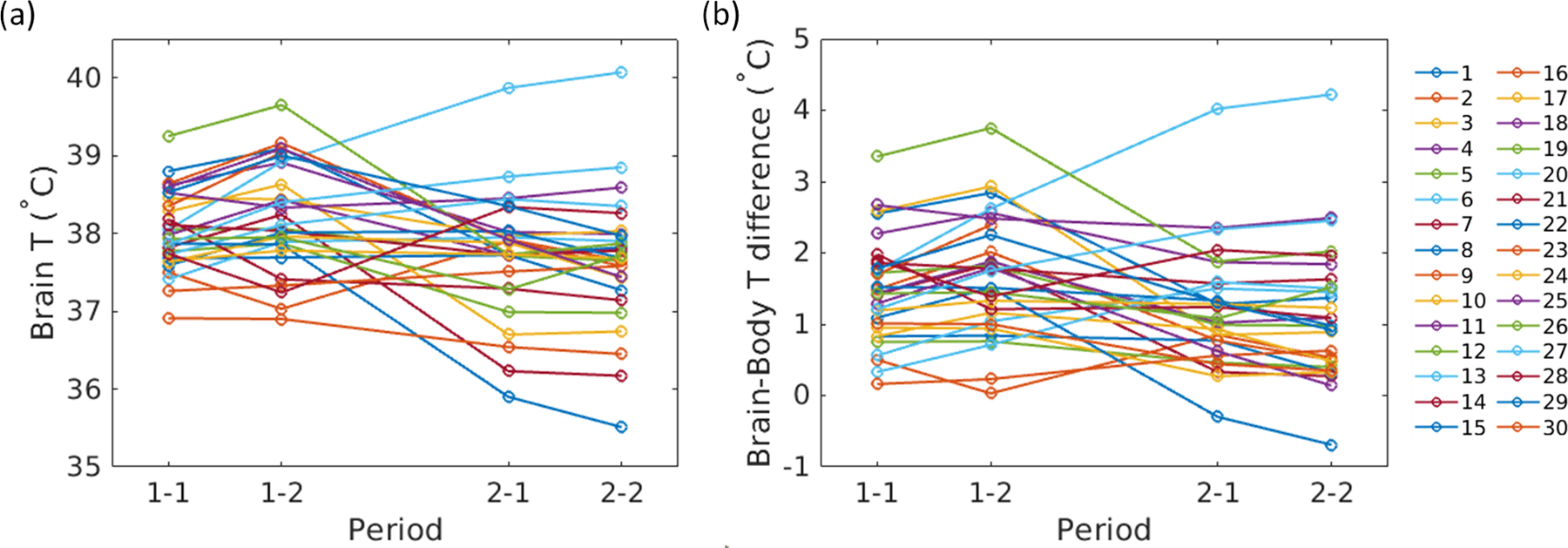
A significant difference in brain temperature was observed between scans (-0.4 °C) but body temperature was stable (P = .59). Brain temperature (37.9 ± 0.7 °C) was higher than body temperature (36.5 ± 0.5 °C) for all but one subject. Within-scan correlation was high for brain temperature (R = 0.95) and brain-body temperature differences (R = 0.96). Between scans, variability was high for both brain temperature (R = 0.30) and brain-body temperature differences (R = 0.41).
Significant changes in brain temperature over time scales of ~1 hour were observed. High short-term repeatability suggests temperature changes appear to be due to physiology rather than measurement error.
2 TECHNICAL EFFICACY: Stage 1.
虽然健康大脑温度的波动已经在数周到数月的时间范围内进行了研究,但在较短的时间内的动态变化还不太清楚。
确定健康志愿者在大约 1 小时的时间尺度内大脑温度的生理波动。
前瞻性。
共 30 名健康志愿者(15 名女性;26 ± 4 岁)。
3T;T1 加权磁化准备快速梯度回波(MPRAGE)和半局部绝热选择性重聚焦(sLASER)单体素波谱。
从 N-乙酰天冬氨酸和水之间的化学位移差计算大脑温度。为了评估大脑温度和脑体温度差的扫描内重复性,将 128 个光谱瞬变分为两组,每组 64 个光谱。使用两个时间间隔(间隔约 1-1.5 小时)评估扫描间重复性。
使用分层线性混合模型计算扫描内和扫描间的相关性(R 和 R ,分别)。在 P ≤.05 时确定显著性。值以平均值 ± 标准差报告。
扫描之间的大脑温度存在显著差异(-0.4°C),但体温稳定(P =.59)。除了一名受试者外,所有受试者的大脑温度(37.9 ± 0.7°C)均高于体温(36.5 ± 0.5°C)。大脑温度(R = 0.95)和脑体温度差(R = 0.96)的扫描内相关性较高。两次扫描之间,大脑温度(R = 0.30)和脑体温度差(R = 0.41)的变异性均较高。
在大约 1 小时的时间尺度上观察到大脑温度的显著变化。高短期重复性表明温度变化似乎是由于生理原因而不是测量误差所致。
2 级技术功效:1 级。