Human Performance and Sports Science Laboratory, Faculty of Sport Sciences, University of Murcia, 30730, San Javier, Murcia, Spain.
Department of Infectious Diseases, Hospital Universitario Santa Lucía, 30202, Cartagena, Murcia, Spain.
Intern Emerg Med. 2022 Nov;17(8):2199-2208. doi: 10.1007/s11739-022-03039-0. Epub 2022 Jul 29.
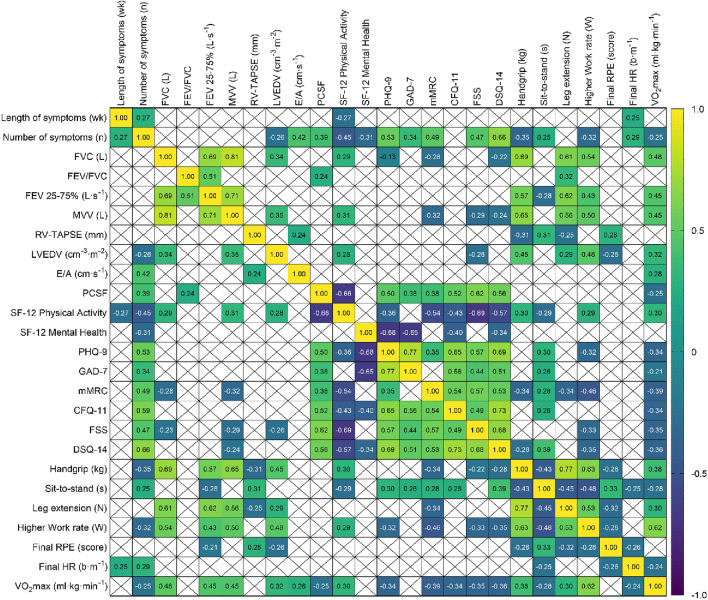
The aim of this study was to determine the relationship between physical fitness, cardiopulmonary function and patient-reported severity of symptoms in people with post-COVID-19 condition. We examined ambulatory patients (n = 72) with post-COVID-19 condition who had a chronic symptomatic phase lasting > 12 weeks from the onset of symptoms, but had not been hospitalized for acute COVID-19. A comprehensive medical screening was conducted, including clinical history, symptomatology, comorbidities, body composition and physical activity levels. We then identified the relationship between physical fitness (cardiorespiratory fitness and muscular strength), cardiopulmonary function (echocardiographic and spirometry parameters) and patient-reported severity of symptoms (fatigue, dyspnea, health-related quality of life, anxiety, and depression). Age, body mass index, sex, number of comorbidities and duration of symptoms were included as potential confounders. Results showed that greater physical fitness and cardiopulmonary function were associated with lower severity of symptoms in people with post-COVID-19 condition. Cardiorespiratory fitness, lower-limb muscle strength, maximal voluntary ventilation and left ventricular ejection fraction account for reducing fatigue and dyspnea. Greater physical activity levels were associated with fewer symptoms and less-severe fatigue and dyspnea. In conclusion, preserving better cardiopulmonary health and physical condition during the course of the disease-even in mild cases-was related to a lower intensity of symptoms in non-hospitalized people with post-COVID-19 condition. It is probable that exercise and physical conditioning are valuable pre- and post-COVID-19 countermeasures that could help decrease the severity, not only of acute infection, but of post-COVID-19 persistent symptoms and prognosis.
本研究旨在确定身体适应性、心肺功能与新冠后症状患者报告的严重程度之间的关系。我们检查了 72 名患有新冠后症状的门诊患者,这些患者的症状持续时间超过 12 周,且症状出现后未因急性 COVID-19 住院。进行了全面的医学筛查,包括临床病史、症状、合并症、身体成分和身体活动水平。然后,我们确定了身体适应性(心肺适应性和肌肉力量)、心肺功能(超声心动图和肺功能参数)和患者报告的严重程度(疲劳、呼吸困难、健康相关生活质量、焦虑和抑郁)之间的关系。年龄、体重指数、性别、合并症数量和症状持续时间被纳入潜在的混杂因素。结果表明,身体适应性和心肺功能较好的新冠后症状患者症状严重程度较低。心肺适应性、下肢肌肉力量、最大自主通气量和左心室射血分数与疲劳和呼吸困难的减轻有关。更高的身体活动水平与更少的症状和更轻的疲劳和呼吸困难有关。总之,在疾病过程中保持更好的心肺健康和身体状况——即使是在轻度病例中——与非住院新冠后症状患者症状强度降低有关。运动和身体锻炼可能是新冠前和新冠后的有价值的预防和治疗措施,不仅可以减轻急性感染的严重程度,还可以减轻新冠后持续症状和预后的严重程度。