Department of Humanities and Social Sciences, National Institute of Technology, Rourkela, India.
PLoS One. 2022 Jul 29;17(7):e0271806. doi: 10.1371/journal.pone.0271806. eCollection 2022.
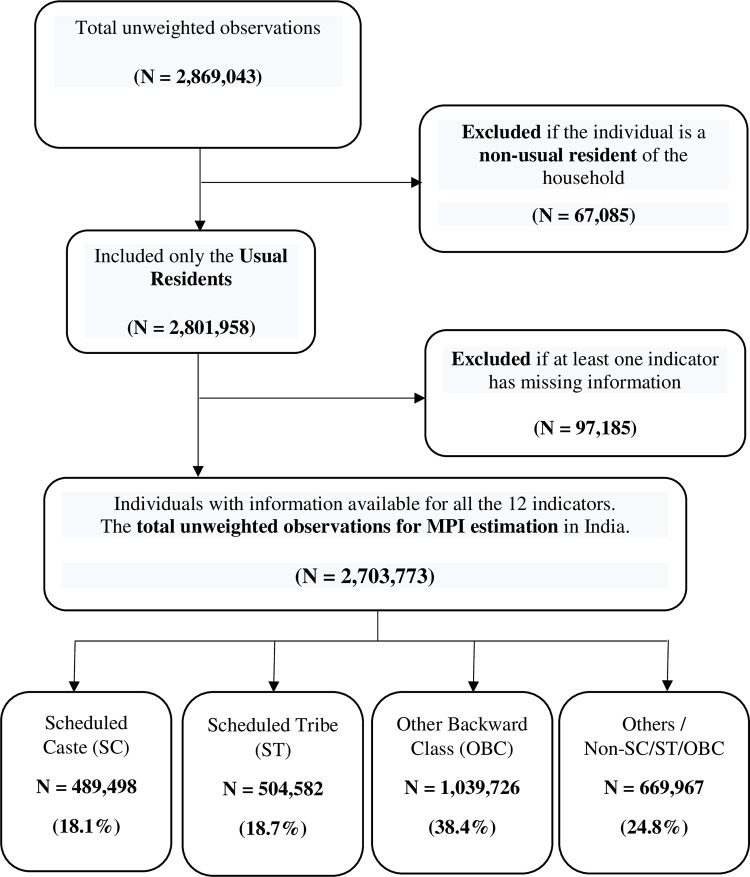
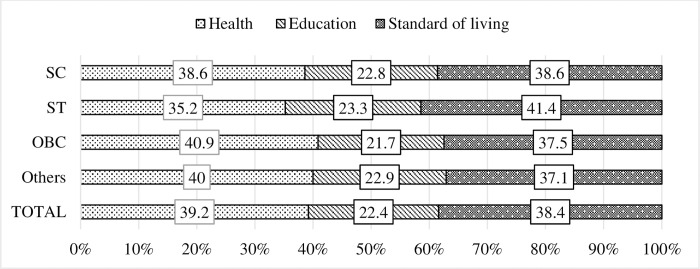
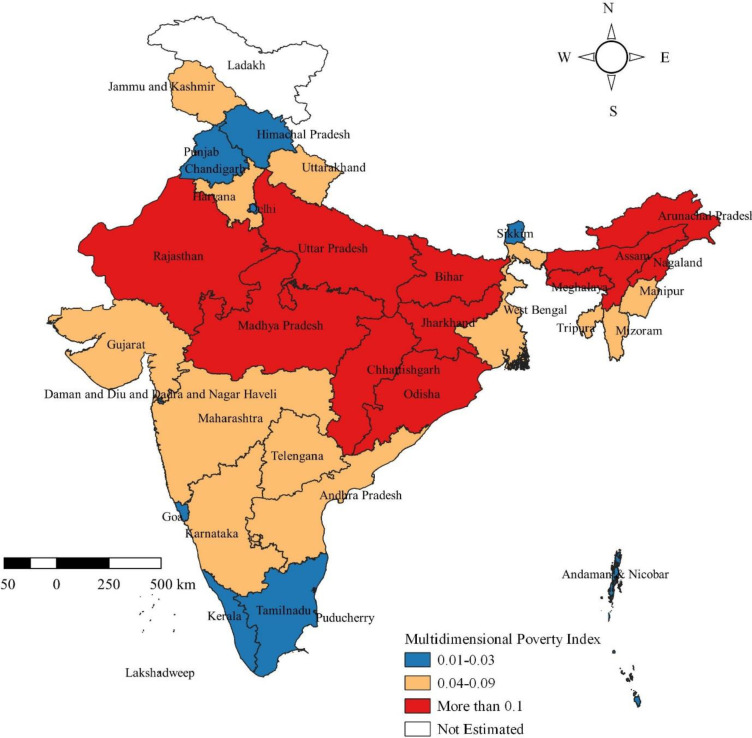
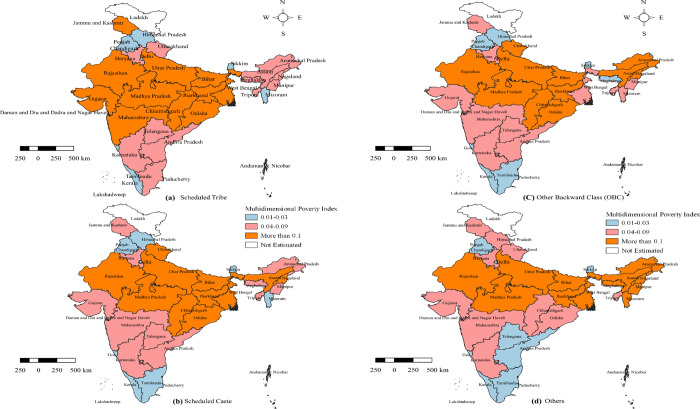
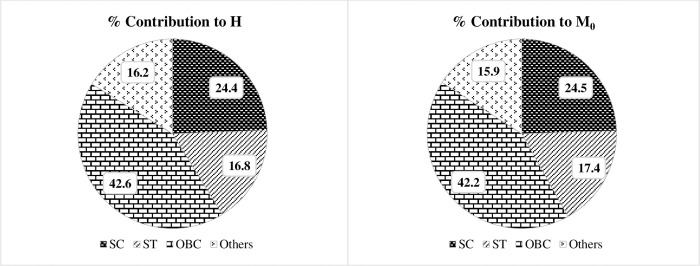
Poverty is multifaceted. The global poverty profile shows 41% of multidimensionally poor people living in South Asian countries. Though castes and tribes are a more prevalent line of social stratification in India, and their socio-economic characteristics also vary remarkably, hardly any study has explored these dimensions while analysing multidimensional poverty in India. Hence, this study attempts to assess the multidimensional status of poverty among the social groups in India. National Family Health Survey, 2015-16 (NFHS-4) is a source of rich information on 579,698 households' well-being for this analysis. Alkire- Foster technique was applied to decompose the Multidimensional Poverty Index (M0) across its dimensions and indicators for all the social groups. Three broad dimensions of deprivation-Health, Education and Standard of Living-include 12 indicators, guided by the poverty literature, data availability and the country's sustainable Development Goals (SDGs). There were three main findings in this study: (1) Scheduled Tribes (STs) are the most disadvantaged subgroup in India with remarkably high values of headcount (H = 0.444;), intensity (A = 0.486), and M0 (0.216), followed by Scheduled Castes (SCs) (H = 0.292; A = 0.473; M0 = 0.138), and Other Backward Classes (OBCs) (H = 0.245; A = 0.465; M0 = 0.114); and Others category is the most privileged with very low values of H = 0.149, A = 0.463, and M0 = 0.069; (2) STs contribute nearly twice their population share for both H and M0, and the SCs contribution is also noticeably higher than their population share; (3) States located in the central and eastern regions of India have the higher H, A and M0 for all the social groups. This suggests that there is a need for a thorough assessment of poverty at specific levels to uncover the poverty situation in society, improve the effectiveness of evidence-based planning and effective policymaking.
贫困是多方面的。全球贫困状况显示,41%的多维贫困人口生活在南亚国家。尽管种姓和部落是印度更为普遍的社会分层线,而且他们的社会经济特征也有很大差异,但几乎没有任何研究在分析印度多维贫困时探讨这些方面。因此,本研究试图评估印度社会群体的多维贫困状况。2015-16 年全国家庭健康调查(NFHS-4)是分析中关于 579698 户家庭福祉的丰富信息来源。应用阿尔克里-福斯特技术(Alkire-Foster technique)对多维贫困指数(M0)的各个维度和指标进行分解,用于所有社会群体。三个广泛的剥夺维度——健康、教育和生活水平——包括 12 个指标,这些指标是根据贫困文献、数据可用性和国家可持续发展目标(SDGs)确定的。本研究有三个主要发现:(1)在册部落(STs)是印度最弱势的群体,其贫困发生率(H = 0.444)、贫困强度(A = 0.486)和多维贫困指数(M0 = 0.216)均显著较高,其次是在册种姓(SCs)(H = 0.292;A = 0.473;M0 = 0.138)和其他落后阶层(OBCs)(H = 0.245;A = 0.465;M0 = 0.114);而其他类别则是最享有特权的,其 H 值非常低,为 0.149,A 值为 0.463,M0 值为 0.069;(2)STs 在 H 和 M0 方面的贡献几乎是其人口份额的两倍,SCs 的贡献也明显高于其人口份额;(3)位于印度中部和东部地区的邦对所有社会群体的 H、A 和 M0 都较高。这表明,需要在特定层面上对贫困进行全面评估,以揭示社会中的贫困状况,提高基于证据的规划和有效决策的效果。