Department of Humanities and Social Sciences, National Institute of Technology (NIT), Rourkela, Odisha, 769008, India.
BMC Public Health. 2023 Oct 17;23(1):2024. doi: 10.1186/s12889-023-16869-0.
Empirically, the official measurement of multidimensional poverty often shows children as the poorest age group. According to Global Multidimensional Poverty Index report, Africa and South Asia bear the highest burden multidimensional child poverty (MCP). Around one-third of children aged 0-4 are multidimensionally poor in India. Policymakers in India must have appropriate information on child poverty to alleviate poverty. The purpose of this paper is to examine MCP trends and track efforts to reduce child poverty at the national level across geographic regions, castes, and religious groups.
We used the Alkire-Foster method to calculate the MCP index (MCPI) among children aged 0-4 using the latest two rounds of National Family Health Survey data (2015-16 and 2019-21). We applied the Shapley decomposition method to analyse the marginal contribution of incidence and intensity that lead to changes in MCPI.
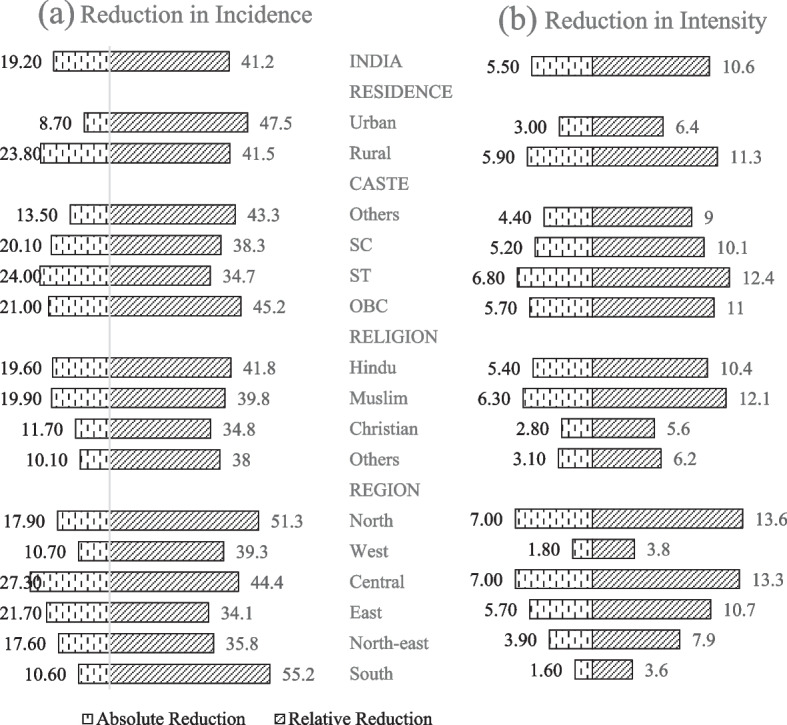
In India, the incidence of child poverty reduced by more than 40% between 2015-16 and 2019-21 (46.6-27.4%) and the MCPI reduced by half (24.2-12.6%). The relative decline in MCPI has been largest for urban areas, northern regions, Other Backward Classes (OBCs) and Hindus. Children from rural areas, Scheduled Castes (SCs), Scheduled Tribes (STs), and Muslim households are the poor performers. When focusing exclusively on the poor child, we found all the population subgroups and geographic locations reduced the censored headcount ratios in all 14 indicators. Across places of residence, castes, religions, and regions the, indicators like electricity, birth registration, drinking water, assisted delivery, sanitation and cooking fuel made significant improvements between 2015-16 to 2019-21.
The study indicates that by studying the MCPI over time, one can identify the priorities in policy development to achieve the Sustainable Development Goals.
经验表明,多维贫困的官方衡量标准往往显示儿童是最贫困的年龄组。根据全球多维贫困指数报告,非洲和南亚承受着多维儿童贫困(MCP)的最高负担。印度有三分之一的 0-4 岁儿童多维贫困。印度的政策制定者必须掌握有关儿童贫困的适当信息,以减轻贫困。本文旨在研究 MCP 趋势,并跟踪国家一级在地理区域、种姓和宗教群体中减少儿童贫困的努力。
我们使用 Alkire-Foster 方法,使用最新两轮全国家庭健康调查数据(2015-16 年和 2019-21 年)计算 0-4 岁儿童的多维贫困指数(MCPI)。我们应用 Shapley 分解方法来分析导致 MCPI 变化的发生率和强度的边际贡献。
在印度,2015-16 年至 2019-21 年间,儿童贫困发生率下降了 40%以上(46.6-27.4%),MCPI 下降了一半(24.2-12.6%)。城市地区、北部地区、其他落后阶层(OBC)和印度教徒的 MCPI 相对下降幅度最大。来自农村地区、在册种姓(SCs)、在册部落(STs)和穆斯林家庭的儿童表现不佳。当只关注贫困儿童时,我们发现所有人口亚组和地理位置都减少了所有 14 项指标中的截尾人口比例。在所有居住地、种姓、宗教和地区,电力、出生登记、饮用水、辅助分娩、卫生和烹饪燃料等指标在 2015-16 年至 2019-21 年间都有显著改善。
该研究表明,通过研究随时间推移的 MCPI,可以确定政策制定的优先事项,以实现可持续发展目标。