Grieco Giuseppina E, Brusco Noemi, Fignani Daniela, Nigi Laura, Formichi Caterina, Licata Giada, Marselli Lorella, Marchetti Piero, Salvini Laura, Tinti Laura, Po Agnese, Ferretti Elisabetta, Sebastiani Guido, Dotta Francesco
Diabetes Unit, Department of Medicine, Surgery and Neurosciences, University of Siena, Fondazione Umberto Di Mario ONLUS c/o Toscana Life Science, Siena, Italy.
Department of Clinical and Experimental Medicine, Islet Cell Laboratory, University of Pisa, Pisa, Italy.
Cell Death Discov. 2022 Jul 29;8(1):340. doi: 10.1038/s41420-022-01142-x.
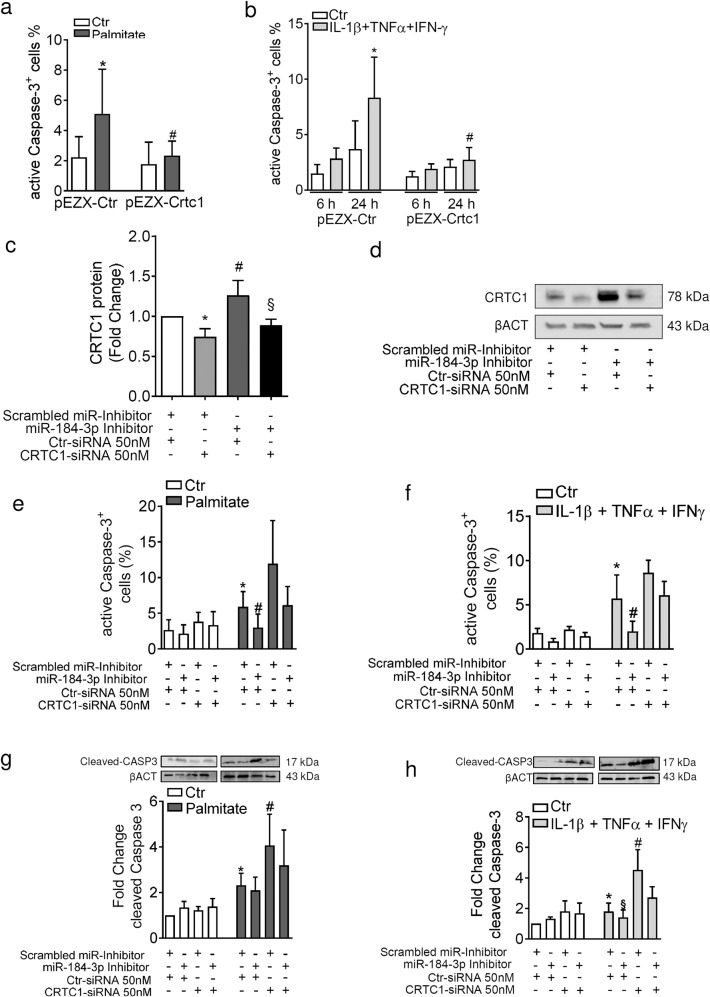
The loss of functional β-cell mass in type 2 diabetes (T2D) is associated with molecular events that include β-cell apoptosis, dysfunction and/or dedifferentiation. MicroRNA miR-184-3p has been shown to be involved in several β-cell functions, including insulin secretion, proliferation and survival. However, the downstream targets and upstream regulators of miR-184-3p have not been fully elucidated. Here, we show reduced miR-184-3p levels in human T2D pancreatic islets, whereas its direct target CREB regulated transcription coactivator 1 (CRTC1) was increased and protects β-cells from lipotoxicity- and inflammation-induced apoptosis. Downregulation of miR-184-3p in β-cells leads to upregulation of CRTC1 at both the mRNA and protein levels. Remarkably, the protective effect of miR-184-3p is dependent on CRTC1, as its silencing in human β-cells abrogates the protective mechanism mediated by inhibition of miR-184-3p. Furthermore, in accordance with miR-184-3p downregulation, we also found that the β-cell-specific transcription factor NKX6.1, DNA-binding sites of which are predicted in the promoter sequence of human and mouse MIR184 gene, is reduced in human pancreatic T2D islets. Using chromatin immunoprecipitation analysis and mRNA silencing experiments, we demonstrated that NKX6.1 directly controls both human and murine miR-184 expression. In summary, we provide evidence that the decrease in NKX6.1 expression is accompanied by a significant reduction in miR-184-3p expression and that reduction of miR-184-3p protects β-cells from apoptosis through a CRTC1-dependent mechanism.
2型糖尿病(T2D)中功能性β细胞数量的减少与包括β细胞凋亡、功能障碍和/或去分化在内的分子事件有关。微小RNA miR-184-3p已被证明参与多种β细胞功能,包括胰岛素分泌、增殖和存活。然而,miR-184-3p的下游靶点和上游调节因子尚未完全阐明。在此,我们发现人类T2D胰岛中miR-184-3p水平降低,而其直接靶点CREB调节转录共激活因子1(CRTC1)增加,并保护β细胞免受脂毒性和炎症诱导的凋亡。β细胞中miR-184-3p的下调导致CRTC1在mRNA和蛋白质水平上均上调。值得注意的是,miR-184-3p的保护作用依赖于CRTC1,因为其在人类β细胞中的沉默消除了由抑制miR-184-3p介导的保护机制。此外,与miR-184-3p下调一致,我们还发现β细胞特异性转录因子NKX6.1在人类T2D胰岛中减少,其DNA结合位点在人类和小鼠MIR184基因的启动子序列中被预测。通过染色质免疫沉淀分析和mRNA沉默实验,我们证明NKX6.1直接控制人类和小鼠miR-184的表达。总之,我们提供的证据表明,NKX6.1表达的降低伴随着miR-184-3p表达的显著降低,并且miR-184-3p的降低通过CRTC1依赖性机制保护β细胞免于凋亡。