Epidemiology Research Unit, Cardiovascular Analytics Group, China-UK Collaboration, Hong Kong, China.
Kent and Medway Medical School, Canterbury Christ Church University, Canterbury, UK.
Clin Res Cardiol. 2022 Oct;111(10):1161-1173. doi: 10.1007/s00392-022-02070-7. Epub 2022 Jul 30.
Coronavirus Disease-2019 (COVID-19) vaccination has been associated with the development of carditis, especially in children and adolescent males. However, the rates of these events in the global setting have not been explored in a systematic manner. The aim of this systematic review and meta-analysis is to investigate the rates of carditis in children and adolescents receiving COVID-19 vaccines.
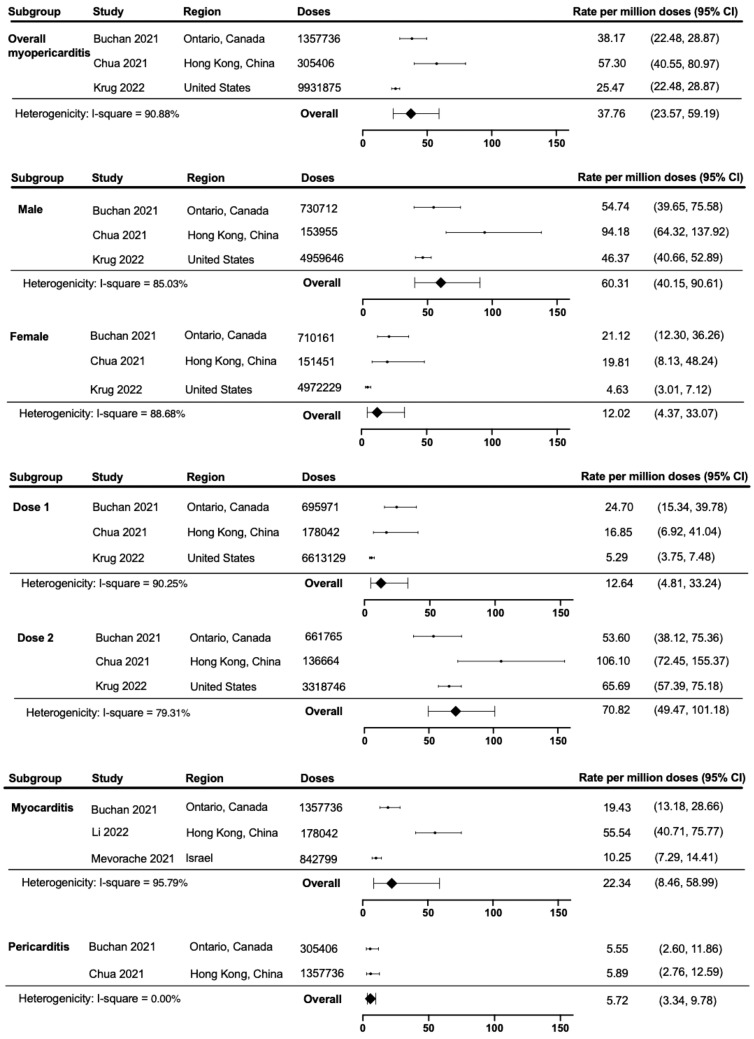
PubMed, Embase and several Latin American databases were searched for studies. The number of events, and where available, at-risk populations were extracted. Rate ratios were calculated and expressed as a rate per million doses received. Subgroup analysis based on the dose administered was performed. Subjects ≤ 19 years old who developed pericarditis or myocarditis following COVID-19 vaccination were included.
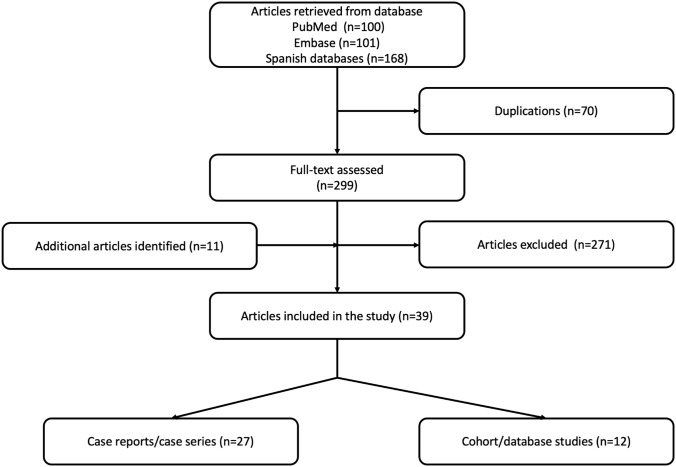
A total of 369 entries were retrieved. After screening, 39 articles were included. Our meta-analysis found that 343 patients developed carditis after the administration of 12,602,625 COVID-19 vaccination doses (pooled rate per million: 37.76; 95% confidence interval [CI] 23.57, 59.19). The rate of carditis was higher amongst male patients (pooled rate ratio: 5.04; 95% CI 1.40, 18.19) and after the second vaccination dose (pooled rate ratio: 5.60; 95% CI 1.97, 15.89). In 301 cases of carditis (281 male; mean age: 15.90 (standard deviation [SD] 1.52) years old) reported amongst the case series/reports, 261 patients were reported to have received treatment. 97.34% of the patients presented with chest pain. The common findings include ST elevation and T wave abnormalities on electrocardiography. Oedema and late gadolinium enhancement in the myocardium were frequently observed in cardiac magnetic resonance imaging (CMR). The mean length of hospital stay was 3.91 days (SD 1.75). In 298 out of 299 patients (99.67%) the carditis resolved with or without treatment.
Carditis is a rare complication after COVID-19 vaccination across the globe, but the vast majority of episodes are self-limiting with rapid resolution of symptoms within days. Central illustration. Balancing the benefits of vaccines on COVID-19-caused carditis and post-vaccination carditis.
COVID-19 疫苗接种与心肌炎的发生有关,尤其是在儿童和青少年男性中。然而,在全球范围内,这些事件的发生率尚未通过系统的方式进行探索。本系统评价和荟萃分析旨在调查 COVID-19 疫苗接种儿童和青少年心肌炎的发生率。
在 PubMed、Embase 和几个拉丁美洲数据库中搜索研究。提取事件数量,以及在有风险的人群中可用的信息。计算率比值并表示为每百万剂接受剂量的比率。根据给予的剂量进行亚组分析。纳入在 COVID-19 疫苗接种后出现心包炎或心肌炎的年龄≤19 岁的受试者。
共检索到 369 项条目。筛选后,纳入 39 篇文章。我们的荟萃分析发现,在接种了 12602625 剂 COVID-19 疫苗后,共有 343 例患者发生心肌炎(汇总每百万剂的发生率:37.76;95%置信区间 [CI] 23.57-59.19)。男性患者(汇总率比值:5.04;95% CI 1.40-18.19)和接种第二剂疫苗后(汇总率比值:5.60;95% CI 1.97-15.89)心肌炎的发生率更高。在病例系列报告中报告的 301 例心肌炎(281 例男性;平均年龄:15.90(标准差 [SD] 1.52)岁)中,有 261 例患者接受了治疗。97.34%的患者有胸痛。常见表现包括心电图上 ST 段抬高和 T 波异常。心脏磁共振成像(CMR)中经常观察到心肌水肿和晚期钆增强。住院平均时间为 3.91 天(SD 1.75)。在 298 例患者中(99.67%),心肌炎未经治疗或经治疗后自行缓解。
在全球范围内,COVID-19 疫苗接种后心肌炎是一种罕见的并发症,但绝大多数病例是自限性的,症状在数天内迅速缓解。中心插图。权衡 COVID-19 引起的心肌炎和疫苗接种后心肌炎的疫苗益处。