Holmes Jain Anne, Fletcher-Smith Joanna Clare, Merchán-Baeza Jose Antonio, Phillips Julie, Radford Kathryn
Faculty of Medicine and Health Sciences, Centre for Rehabilitation and Ageing Research, B Floor, Medical School, Queen's Medical Centre, The University of Nottingham, Nottingham, NG7 2UH, UK.
Faculty of Health Science and Welfare, University of Vic-Central University of Catalonia (UVIC-UCC), 08500, Vic, Spain.
Pilot Feasibility Stud. 2022 Jul 29;8(1):160. doi: 10.1186/s40814-022-01111-2.
Determining whether complex rehabilitation interventions are delivered with fidelity is important. Implementation fidelity can differ between sites, therapists delivering interventions and, over time, threatening trial outcomes and increasing the risk of type II and III errors. This study aimed to develop a method of assessing occupational therapists' fidelity to deliver a complex, individually tailored vocational rehabilitation (VR) intervention to people with traumatic brain injury (TBI) and assess the feasibility of its use in a randomised controlled trial.
Using mixed methods and drawing on the intervention logic model, we developed data collection tools to measure fidelity to early specialist TBI VR (ESTVR). Fidelity was measured quantitatively using intervention case report forms (CRF), fidelity checklists and clinical records. Qualitative data from mentoring records, interviews with intervention therapists, participants with TBI, employers and NHS staff at trial sites explored moderators of implementation fidelity. The conceptual framework of implementation fidelity (CFIF) guided measurement and analysis of and factors affecting fidelity. Data were triangulated and benchmarked against an earlier cohort study.
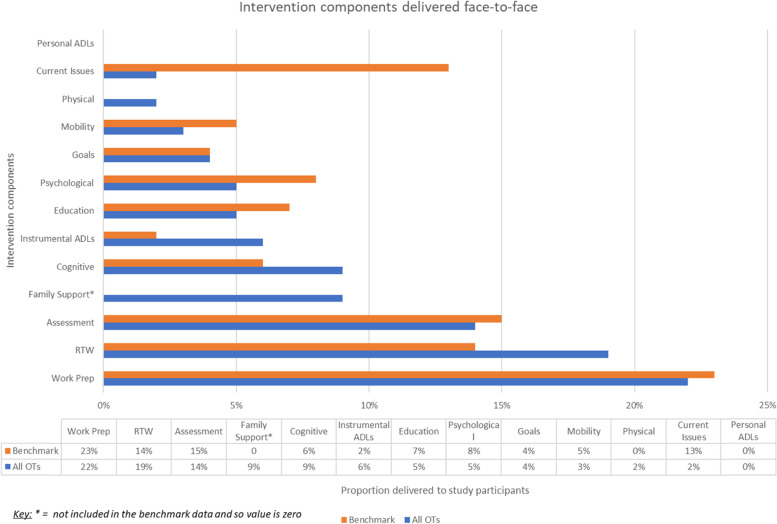
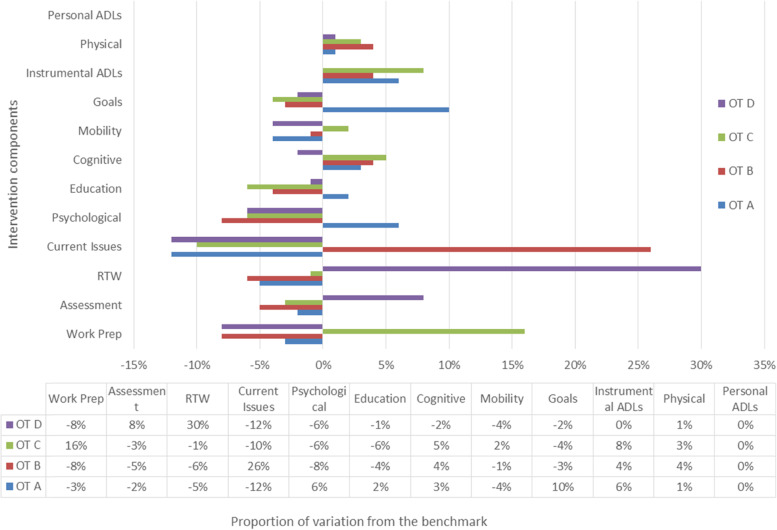
Fidelity to a complex individually tailored VR intervention could be measured. Overall, OTs delivered ESTVR with fidelity. Different fidelity measures answered different questions, offering unique insights into fidelity. Fidelity was best assessed using a fidelity checklist, intervention CRFs and clinical notes. The OT clinical notes and mentoring records were best at identifying fidelity moderating factors. Interviews added little insight into fidelity moderating factors over and above mentoring or clinical records. Data triangulation offered a comprehensive assessment of fidelity, highlighting limitations of measurement methods and learning for future trials but was resource intensive. Interviews, fidelity visits and analysing clinical notes were also resource intense. Comparing fidelity data to a benchmark and using CFIF as a framework for organising the fidelity assessment helped.
OTs delivered the VR intervention with fidelity. A fidelity checklist and benchmark plus mentoring may offer a practical and effective way of measuring fidelity and identifying fidelity moderating factors in trials of complex individually-tailored rehabilitation interventions. Mentoring provided real-time indicators of and reasons for fidelity deviations. These methods require further evaluation.
ISRCTN Registry, ISRCTN38581822 (Registered: 02/01/2014).
确定复杂的康复干预措施是否得以保真实施非常重要。实施保真度可能因地点、实施干预的治疗师不同而有所差异,并且随着时间推移,会对试验结果构成威胁,增加II类和III类错误的风险。本研究旨在开发一种方法,以评估职业治疗师在为创伤性脑损伤(TBI)患者提供复杂的、个性化定制的职业康复(VR)干预措施时的保真度,并评估其在随机对照试验中使用的可行性。
我们采用混合方法并借鉴干预逻辑模型,开发了数据收集工具来衡量对早期专科TBI VR(ESTVR)的保真度。使用干预病例报告表(CRF)、保真度检查表和临床记录对保真度进行定量测量。来自指导记录、对干预治疗师、TBI患者、雇主以及试验地点的国民保健服务(NHS)工作人员的访谈的定性数据,探究了实施保真度的调节因素。实施保真度概念框架(CFIF)指导了对保真度及其影响因素的测量和分析。对数据进行了三角验证,并与早期队列研究进行了对比。
可以对复杂的个性化定制VR干预措施的保真度进行测量。总体而言,职业治疗师忠实地实施了ESTVR。不同的保真度测量方法回答了不同的问题,提供了关于保真度的独特见解。使用保真度检查表、干预CRF和临床记录来评估保真度最为合适。职业治疗师的临床记录和指导记录最有助于识别保真度调节因素。除了指导或临床记录之外,访谈对保真度调节因素的洞察作用不大。数据三角验证提供了对保真度的全面评估,突出了测量方法的局限性以及对未来试验的借鉴意义,但资源需求较大。访谈、保真度访问和分析临床记录也都资源需求较大。将保真度数据与基准进行比较,并使用CFIF作为组织保真度评估的框架会有所帮助。
职业治疗师忠实地实施了VR干预措施。保真度检查表、基准以及指导可能提供了一种实用且有效的方法,用于在复杂的个性化定制康复干预试验中测量保真度并识别保真度调节因素。指导提供了保真度偏差的实时指标及原因。这些方法需要进一步评估。
国际标准随机对照试验编号注册库,ISRCTN38581822(注册时间:2014年1月2日)。