Department of Applied Health Research, University College London, UK.
Department of Clinical, Educational and Health Psychology, University College London, UK.
Br J Health Psychol. 2020 Feb;25(1):39-60. doi: 10.1111/bjhp.12394. Epub 2019 Nov 6.
To understand whether interventions are effective, we need to know whether the interventions are delivered as planned (with fidelity) and engaged with. To measure fidelity and engagement effectively, high-quality measures are needed. We outline a five-step method which can be used to develop quality measures of fidelity and engagement for complex health interventions. We provide examples from a fidelity study conducted within an evaluation of an intervention aimed to increase independence in dementia.
We propose five steps that can be systematically used to develop fidelity checklists for researchers, providers, and participants to measure fidelity and engagement. These steps include the following: (1) reviewing previous measures, (2) analysing intervention components and developing a framework outlining the content of the intervention, (3) developing fidelity checklists and coding guidelines, (4) obtaining feedback about the content and wording of checklists and guidelines, and (5) piloting and refining checklists and coding guidelines to assess and improve reliability.
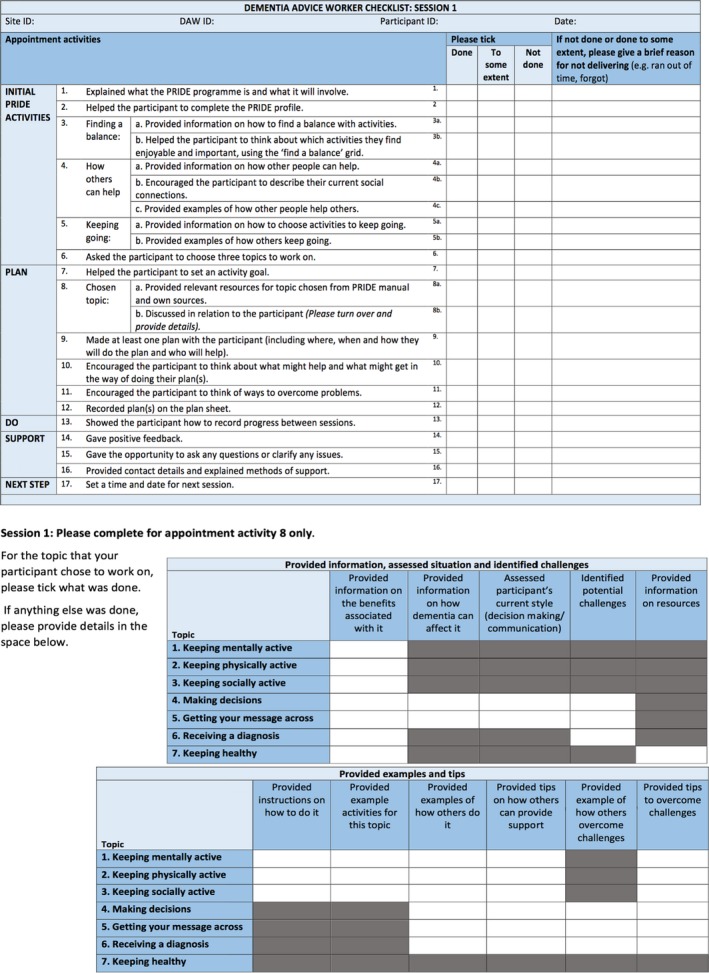
Three fidelity checklists that can be used reliably were developed to measure fidelity of and engagement with, the Promoting Independence in Dementia (PRIDE) intervention. As these measures were designed to be used by researchers, providers, and participants, we developed two versions of the checklists: one for participants and one for researchers and providers.
The five steps that we propose can be used to develop psychometrically robust and implementable measures of fidelity and engagement for complex health interventions that can be used by different target audiences. By considering quality when developing measures, we can be more confident in the interpretation of intervention outcomes drawn from fidelity and engagement studies. Statement of contribution What is already known on the subject? Fidelity and engagement can be measured using a range of methods, such as observation and self-report. Studies seldom report psychometric and implementation qualities of fidelity measures. What does this study add? A method for developing fidelity and engagement measures for complex health interventions. Guidance on how to consider quality when developing fidelity and engagement measures.
为了了解干预措施是否有效,我们需要知道干预措施是否按照计划(具有保真度)实施并得到了参与。为了有效地衡量保真度和参与度,需要高质量的衡量标准。我们概述了一种五步方法,可用于为复杂的健康干预措施开发保真度和参与度的高质量衡量标准。我们从一项旨在提高痴呆症独立性的干预措施评估中进行的保真度研究中提供了一些示例。
我们提出了五个步骤,可以系统地用于为研究人员、提供者和参与者制定保真度检查表,以衡量保真度和参与度。这些步骤包括:(1)审查以前的措施,(2)分析干预措施的组成部分并制定一个概述干预内容的框架,(3)制定保真度检查表和编码指南,(4)获得关于检查表和指南内容和措辞的反馈,以及(5)试用和完善检查表和编码指南,以评估和提高可靠性。
为了可靠地衡量和参与促进痴呆症独立性(PRIDE)干预措施的保真度,开发了三个保真度检查表。由于这些措施旨在供研究人员、提供者和参与者使用,因此我们开发了两种版本的检查表:一种供参与者使用,另一种供研究人员和提供者使用。
我们提出的五个步骤可以用于为复杂的健康干预措施开发心理测量学上可靠且可实施的保真度和参与度衡量标准,这些措施可由不同的目标受众使用。通过在开发措施时考虑质量,我们可以更有信心地解释从保真度和参与度研究中得出的干预结果。
关于这个主题,目前已经知道什么?
保真度和参与度可以使用多种方法进行衡量,例如观察和自我报告。
研究很少报告保真度衡量标准的心理测量和实施质量。
这项研究增加了什么?
一种用于开发复杂健康干预措施的保真度和参与度衡量标准的方法。
关于在开发保真度和参与度衡量标准时如何考虑质量的指南。