Zoology Department, Faculty of Science, Cairo University, Giza, Egypt.
Faculty of Biotechnology, October University for Modern Sciences and Arts, 6Th of October City, Egypt.
Biol Trace Elem Res. 2023 May;201(5):2311-2318. doi: 10.1007/s12011-022-03354-9. Epub 2022 Jul 30.
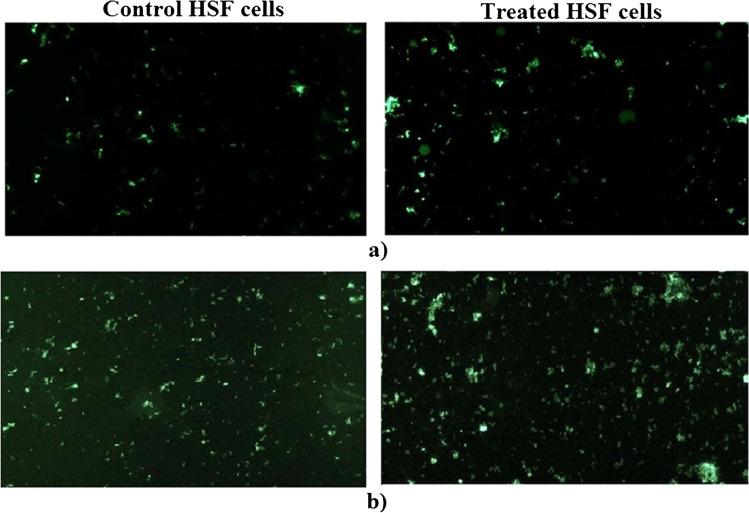
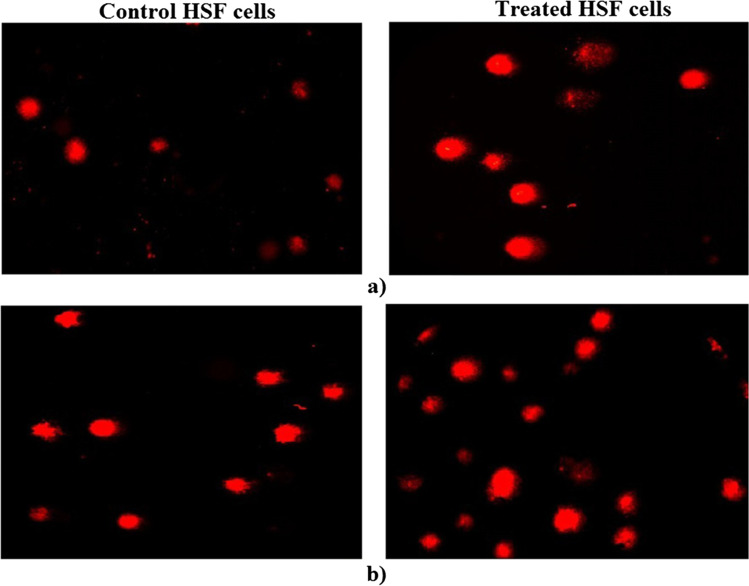
Extensive uses of calcium titanate nanoparticles (CaTiO-NPs) and erbium oxide nanoparticles (ErO-NPs) increase their release into the environment and human exposure, particularly through skin contact. However, there are almost no studies available on the effect of these nanoparticles on skin integrity. Therefore, this study was undertaken to estimate CaTiO-NP- or ErO-NP-induced cytotoxicity and genotoxicity in normal human skin fibroblast (HSF) cells. Cell viability was measured using sulforhodamine B (SRB) assay, while the level of DNA damage was detected using the alkaline comet assay. The intracellular levels of reactive oxygen species (ROS) as well as the expression level of p53, Bax, and Bcl2 genes were detected. Although the viability of HSF cells was non-markedly changed after 24 h, prolonged treatment with CaTiO3-NPs or Er2O3-NPs for 72 h induced concentration-dependent death of HSF cells. Treatment of normal HSF cells with IC50/72 h of CaTiO3-NPs or Er2O3-NPs did not cause marked changes in the intracellular level of ROS, DNA damage parameters, and expression levels of apoptosis genes compared to their values in the untreated HSF cells. We thus concluded that CaTiO3-NPs or Er2O3-NPs cause time- and concentration-dependent cytotoxicity toward normal HSF cells. However, safe and non-genotoxic effects were demonstrated by the apparent non-significant changes in intracellular ROS level, DNA integrity, and apoptotic genes' expression after exposure of normal HSF cells to nanoparticles. Thus, it is recommended that further studies be conducted to further understand the toxic and biological effects of CaTiO-NPs and Er2O3-NPs.
钛酸钙纳米粒子(CaTiO-NPs)和氧化铒纳米粒子(ErO-NPs)的广泛应用会导致它们释放到环境中并增加人体接触,尤其是通过皮肤接触。然而,目前几乎没有研究报道这些纳米粒子对皮肤完整性的影响。因此,本研究旨在评估正常人类皮肤成纤维细胞(HSF)中 CaTiO-NP 或 ErO-NP 诱导的细胞毒性和遗传毒性。使用磺酰罗丹明 B(SRB)测定法测量细胞活力,而使用碱性彗星试验检测 DNA 损伤水平。检测细胞内活性氧(ROS)水平以及 p53、Bax 和 Bcl2 基因的表达水平。虽然 HSF 细胞在 24 小时后活力没有明显变化,但长时间(72 小时)用 CaTiO3-NPs 或 Er2O3-NPs 处理会导致 HSF 细胞浓度依赖性死亡。与未经处理的 HSF 细胞相比,用 IC50/72 小时的 CaTiO3-NPs 或 Er2O3-NPs 处理正常 HSF 细胞不会导致细胞内 ROS 水平、DNA 损伤参数和凋亡基因表达水平发生明显变化。因此,我们得出结论,CaTiO3-NPs 或 Er2O3-NPs 会导致正常 HSF 细胞产生时间和浓度依赖性细胞毒性。然而,正常 HSF 细胞暴露于纳米粒子后,细胞内 ROS 水平、DNA 完整性和凋亡基因表达无明显变化,表明其具有安全的非遗传毒性作用。因此,建议进一步开展研究以进一步了解 CaTiO-NPs 和 Er2O3-NPs 的毒性和生物学效应。