Department of Cardiology, the Second Affiliated Hospital of Harbin Medical University, Harbin, Nangang, 150001, China.
Key Laboratory of Myocardial Ischemia, Ministry of Education, Harbin Medical University, Harbin, Nangang, 150001, China.
J Clin Endocrinol Metab. 2022 Sep 28;107(10):2822-2832. doi: 10.1210/clinem/dgac429.
There is little evidence regarding the association between serum vitamin B6 status and catabolism and all-cause mortality in patients with type-2 diabetes mellitus (T2DM).
We aimed to ascertain if the serum level of vitamin B6 and catabolism, including pyridoxal 5'-phosphate (PLP) and 4-pyridoxic acid (4-PA), were associated with risk of all-cause mortality in T2DM patients.
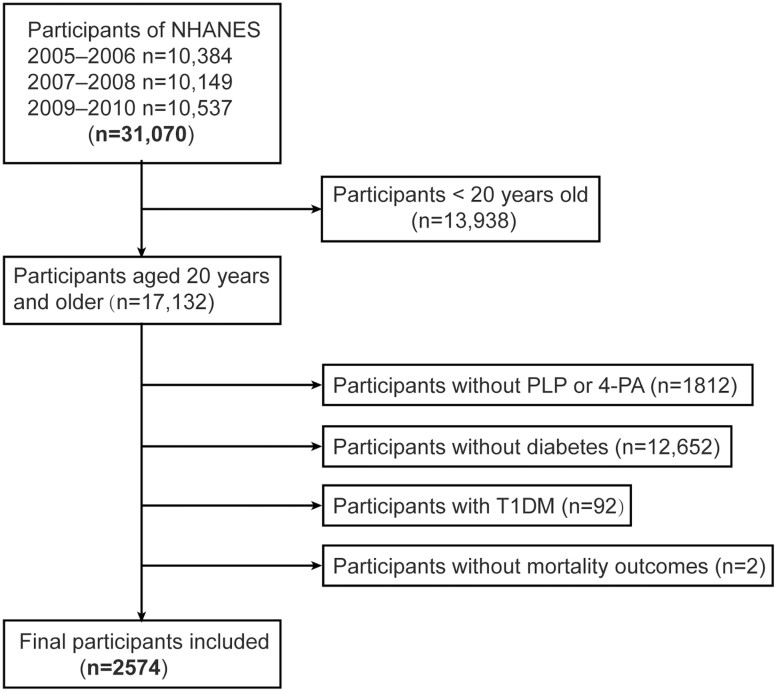
This prospective cohort study involved 2574 patients with T2DM who participated in the National Health and Nutrition Examination Survey (NHANES) from 2005 to 2010. The serum concentrations of PLP and 4-PA were used to assess the serum level of vitamin B6. Mortality status was determined by routine follow-up using the National Death Index through December 31, 2015.
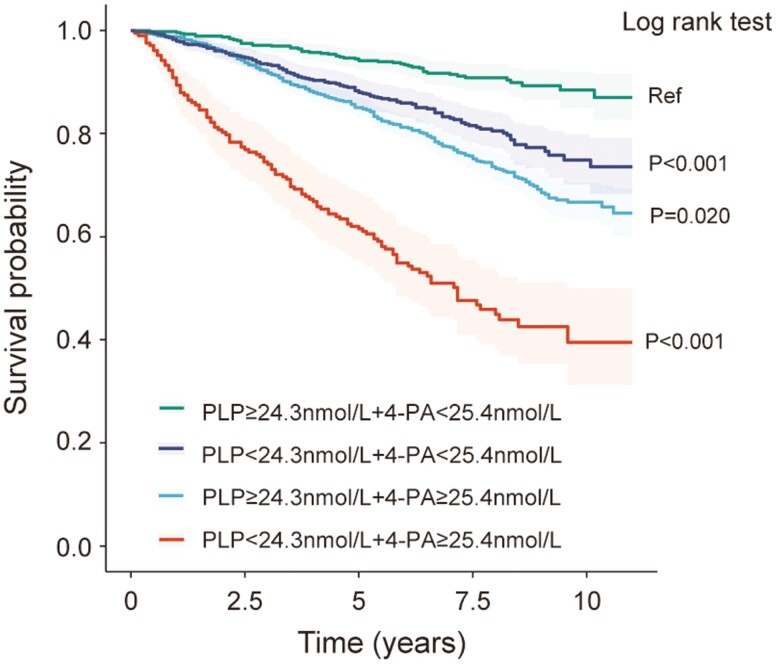
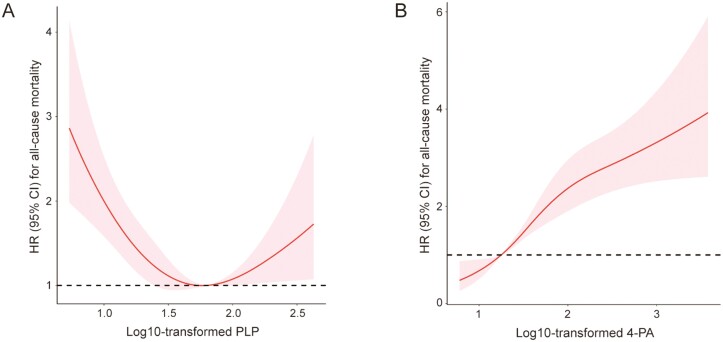
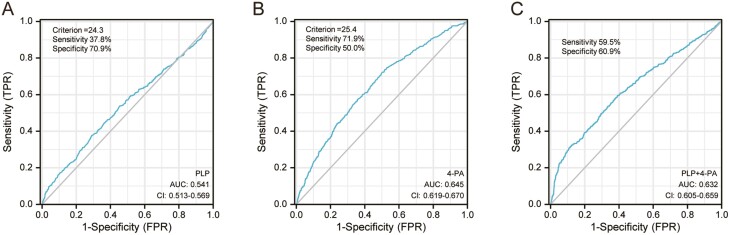
Over a median follow-up of 85 months, there were 588 deaths. The fully adjusted Cox model indicated that the highest serum PLP concentrations (> 63.6 nmol/L) were associated with a decrease in all-cause mortality (hazard ratio [HR], 0.74; 95% CI, 0.55-0.99, P trend = .035). The risk for all-cause mortality was 59% higher for participants with the highest quartile of 4-PA level compared with the lowest quartile (HR, 1.62; 95% CI, 1.12-2.35; P trend = .003). The sensitivity and specificity of the combination of PLP and 4-PA levels for the prediction of all-cause mortality were 59.5% and 60.9%, respectively (area under the receiver operating characteristic curve = 0.632). The Kaplan-Meier method was used to estimate overall survival for patients based on different combinations of PLP level and 4-PA level. Patients with PLP less than 24.3 nmol/L and 4-PA greater than or equal to 25.4 nmol/L had the worst outcomes (log-rank P < .001).
Overall, our data suggest that a low serum level of PLP and high serum level of 4-PA, which represent the serum level of vitamin B6, increases the risk of all-cause mortality significantly in patients with T2DM.
关于血清维生素 B6 状态与 2 型糖尿病(T2DM)患者的分解代谢和全因死亡率之间的关系,证据很少。
我们旨在确定维生素 B6 的血清水平和分解代谢,包括吡哆醛 5'-磷酸(PLP)和 4-吡啶羧酸(4-PA),是否与 T2DM 患者的全因死亡率风险相关。
本前瞻性队列研究纳入了 2005 年至 2010 年参加国家健康和营养检查调查(NHANES)的 2574 名 T2DM 患者。PLP 和 4-PA 的血清浓度用于评估维生素 B6 的血清水平。通过国家死亡指数进行常规随访,直至 2015 年 12 月 31 日确定死亡率状况。
中位随访 85 个月期间,发生了 588 例死亡。完全调整的 Cox 模型表明,最高的血清 PLP 浓度(>63.6 nmol/L)与全因死亡率降低相关(风险比[HR],0.74;95%CI,0.55-0.99,P 趋势=0.035)。与最低四分位数相比,最高四分位数的 4-PA 水平的参与者发生全因死亡的风险高 59%(HR,1.62;95%CI,1.12-2.35;P 趋势=0.003)。PLP 和 4-PA 水平联合预测全因死亡率的敏感性和特异性分别为 59.5%和 60.9%(接受者操作特征曲线下面积[AUROC]为 0.632)。Kaplan-Meier 方法用于根据不同的 PLP 水平和 4-PA 水平组合估算患者的总生存情况。PLP 小于 24.3 nmol/L 且 4-PA 大于或等于 25.4 nmol/L 的患者预后最差(对数秩 P<0.001)。
总体而言,我们的数据表明,T2DM 患者血清 PLP 水平低和血清 4-PA 水平高(代表维生素 B6 水平)显著增加全因死亡率的风险。