Huang Alexander A, Huang Samuel Y
Cornell University, Ithaca, New York.
Northwestern University Feinberg School of Medicine, Chicago, Illinois.
Curr Dev Nutr. 2023 Jul 13;7(8):100078. doi: 10.1016/j.cdnut.2023.100078. eCollection 2023 Aug.
There has been evidence to suggest associations between vitamins and lung function.
This study aimed to examine the association between vitamin B6 and spirometry values.
A cross-sectional study was done using National Health and Nutritional Examination Surveys (NHANES) 2007-2012, which is a nationally representative, modern cohort. Spirometry, a clinical pulmonary function test, measured the amount and speed of air a person could exhale after taking the deepest possible breath after forceful expiratory volume at 1 s (FEV1) and forced vital capacity (FVC). After determination of the relationship of the linearity of variables, univariable and multivariable models were fitted to investigate the effect of vitamin B6 on FEV1 and FVC. The National Center for Health Statistics Ethics Review Board granted permission for the study's data collection and analysis.
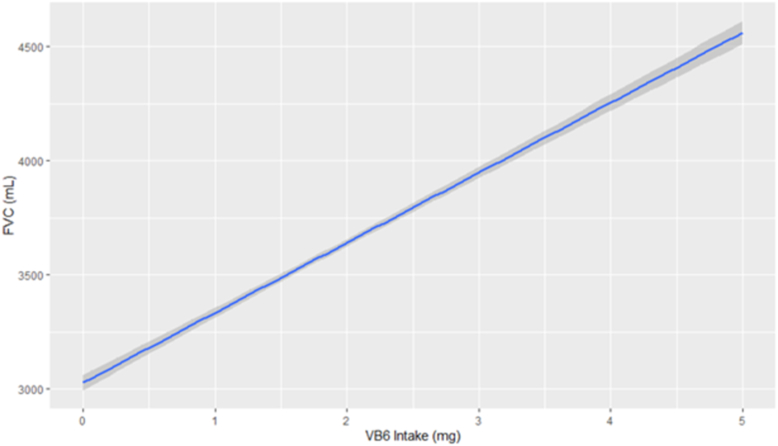
Of 19,160 individuals who had complete information on vitamin B6 intake, FEV1, and FVC, it was found each mg of vitamin B6 intake was associated with increase in 166.41 mL of FEV1 (95% CI: 156.71, 176.12; 0.01) and 221.6 mL of FVC (95% CI: 209.62, 233.57; 0.01). After controlling for potential confounders (age, race, sex, body mass index, education, and income), multiple linear regression found that each mg of vitamin B6 was associated with increase in 25.98 mL of FEV1 (95% CI: 19.15, 32.80, 0.01) and 38.97 mL of FVC (95% CI: 30.65, 47.30, 0.01).
Increased vitamin B6 intake is associated with improvement in lung function. Further prospective studies are required to ascertain whether increased vitamin B6 can lead to increased long-term spirometry measurements and the specific therapeutic dose-response relationship.
有证据表明维生素与肺功能之间存在关联。
本研究旨在探讨维生素B6与肺活量测定值之间的关联。
采用2007 - 2012年美国国家健康与营养检查调查(NHANES)进行了一项横断面研究,该调查是一个具有全国代表性的现代队列。肺活量测定是一种临床肺功能测试,测量一个人在尽可能深吸气后用力呼气1秒时的用力呼气量(FEV1)和用力肺活量(FVC)后能够呼出的空气量和速度。在确定变量的线性关系后,拟合单变量和多变量模型以研究维生素B6对FEV1和FVC的影响。美国国家卫生统计中心伦理审查委员会批准了该研究的数据收集和分析。
在19160名拥有维生素B6摄入量、FEV1和FVC完整信息的个体中,发现每摄入1毫克维生素B6与FEV1增加166.41毫升(95%置信区间:156.71,176.12;P < 0.01)和FVC增加221.6毫升(95%置信区间:209.62,233.57;P < 0.01)相关。在控制潜在混杂因素(年龄、种族、性别、体重指数、教育程度和收入)后,多元线性回归发现每毫克维生素B6与FEV1增加25.98毫升(95%置信区间:19.15,32.80;P < 0.01)和FVC增加38.97毫升(95%置信区间:30.65,47.30;P < 0.01)相关。
维生素B6摄入量增加与肺功能改善相关。需要进一步的前瞻性研究来确定维生素B6摄入量增加是否能导致长期肺活量测定值增加以及具体的治疗剂量 - 反应关系。