Department of Pediatrics, The Affiliated Hospital of Qingdao University, Qingdao, China.
J Clin Lab Anal. 2022 Sep;36(9):e24488. doi: 10.1002/jcla.24488. Epub 2022 Jul 31.
C-Jun N-terminal kinase pathway-associated phosphatase (JKAP) modulates the T cell receptor and mitogen-activated protein kinase pathway-mediated autoimmunity, thus participating in the pathogenesis of autoimmune diseases. This study aimed to explore the clinical implication of JKAP in inflammatory bowel disease (IBD) children.
C-Jun N-terminal kinase pathway-associated phosphatase, tumor necrosis factor-α (TNF-α), interleukin-23, interferon-γ (T-helper 1 secreted cytokine), and interleukin-17A (T-helper 17 secreted cytokine) in serum samples from 140 IBD children (including 60 Crohn's disease (CD) children and 80 ulcerative colitis (UC) children) were detected by ELISA. Meanwhile, JKAP from serum samples of 10 healthy controls (HCs) was also detected by ELISA.
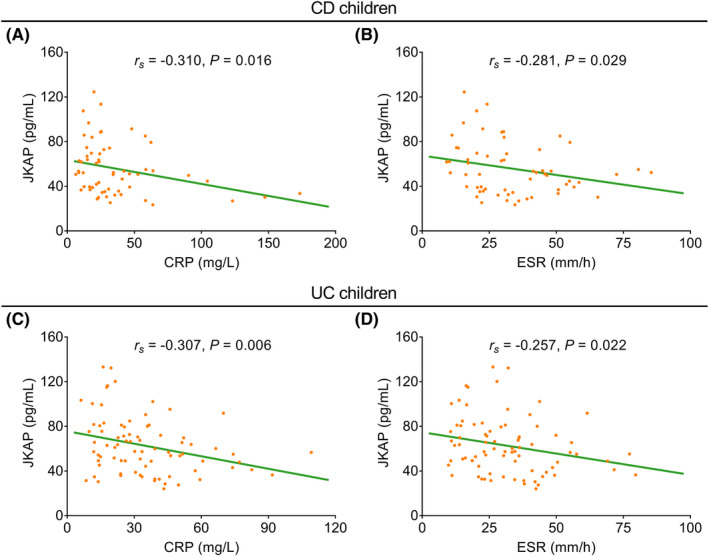
C-Jun N-terminal kinase pathway-associated phosphatase was reduced in CD children (median (interquartile range (IQR)): 51.6 (36.8-69.5) pg/ml) and UC children (median (IQR): 57.5 (43.4-78.5) pg/ml) compared with HCs (median (IQR): 101.8 (70.0-143.2) pg/ml) (both p < 0.05). In CD children, JKAP was negatively correlated with C-reactive protein (CRP) (p = 0.016) and erythrocyte sedimentation rate (ESR) (p = 0.029); while in UC children, JKAP was also negatively correlated with CRP (p = 0.006) and ESR (p = 0.022). Regarding the correlation of JKAP with disease activity, it presented negative correlations with PCDAI (p = 0.001) and PUCAI (p = 0.002). Besides, JKAP was negatively related to TNF-α (both p < 0.05) but not interleukin-23 (both p>0.05) in CD and UC children. Additionally, JKAP was not correlated with interferon-γ in CD or UC children (both p>0.05), while negatively correlated with interleukin-17A in CD and UC children (both p < 0.05).
C-Jun N-terminal kinase pathway-associated phosphatase shows low expression and negative correlations with inflammation, disease activity, and T-helper 17 cells in IBD children.
C-Jun N-末端激酶途径相关磷酸酶(JKAP)调节 T 细胞受体和丝裂原活化蛋白激酶途径介导的自身免疫,从而参与自身免疫性疾病的发病机制。本研究旨在探讨 JKAP 在炎症性肠病(IBD)患儿中的临床意义。
采用酶联免疫吸附试验(ELISA)检测 140 例 IBD 患儿(包括 60 例克罗恩病(CD)患儿和 80 例溃疡性结肠炎(UC)患儿)血清中 JKAP、肿瘤坏死因子-α(TNF-α)、白细胞介素-23、干扰素-γ(辅助性 T 细胞 1 分泌的细胞因子)和白细胞介素-17A(辅助性 T 细胞 17 分泌的细胞因子)。同时,采用 ELISA 法检测 10 例健康对照(HC)者血清中 JKAP。
与 HC 者(中位数(四分位数间距(IQR)):101.8(70.0-143.2)pg/ml)相比,CD 患儿(中位数(IQR):51.6(36.8-69.5)pg/ml)和 UC 患儿(中位数(IQR):57.5(43.4-78.5)pg/ml)的 JKAP 降低(均 P<0.05)。在 CD 患儿中,JKAP 与 C 反应蛋白(CRP)(P=0.016)和红细胞沉降率(ESR)(P=0.029)呈负相关;而在 UC 患儿中,JKAP 也与 CRP(P=0.006)和 ESR(P=0.022)呈负相关。关于 JKAP 与疾病活动度的相关性,它与 PCDAI(P=0.001)和 PUCAI(P=0.002)呈负相关。此外,JKAP 与 CD 和 UC 患儿的 TNF-α呈负相关(均 P<0.05),但与白细胞介素-23 无关(均 P>0.05)。此外,JKAP 与 CD 或 UC 患儿的干扰素-γ无相关性(均 P>0.05),但与 CD 和 UC 患儿的白细胞介素-17A 呈负相关(均 P<0.05)。
JKAP 在 IBD 患儿中表达水平较低,与炎症、疾病活动度和辅助性 T 细胞 17 细胞呈负相关。