Key Laboratory of Environmental Medicine and Engineering of Ministry of Education, Department of Epidemiology and Health Statistics, School of Public Health, Southeast University, No. 87 Dingjiaqiao Rd., Gulou District, Nanjing, Jiangsu, China.
National Research Institute for Family Planning, Beijing, China.
BMC Med. 2022 Aug 1;20(1):246. doi: 10.1186/s12916-022-02437-7.
Although sexually transmitted infections are regarded as the main cause of tubal infertility, the association between the common vaginal microbiome and female fecundability has yet to be determined. The objective of this study was to find convincing evidence relating to the impact of the vaginal bacterial structure on the fecundability of women planning pregnancy.
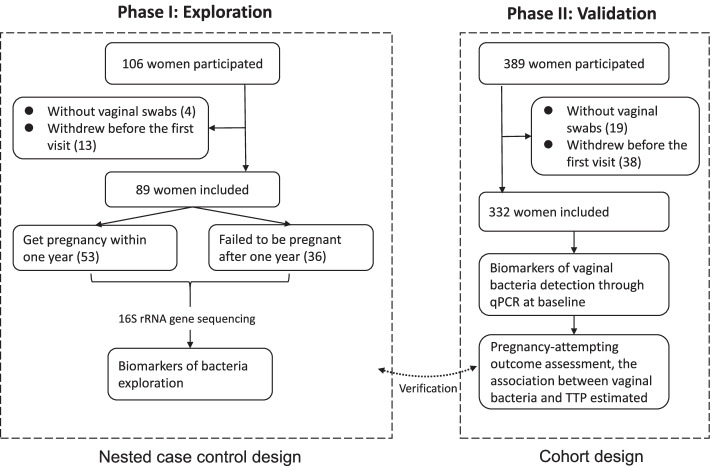
We recruited women who took part in the Free Pre-pregnancy Health Examination Project from 13 June 2018 to 31 October 2018 (n = 89, phase I) and from 1 November 2018 to 30 May 2020 (n = 389, phase II). We collected pre-pregnancy vaginal swabs from each subject; then, we followed up each subject to acquire the pregnancy-planning outcome in 1 year. In phase I, 16S rRNA gene sequencing was performed to investigate the vaginal bacterial content between the pregnancy and non-pregnancy groups. These findings were verified in phase II by applying a quantitative real-time polymerase chain reaction for the measurement of the absolute abundance of specific species. Cox models were used to estimate fecundability ratios (FR) for each vaginal microbiome type.
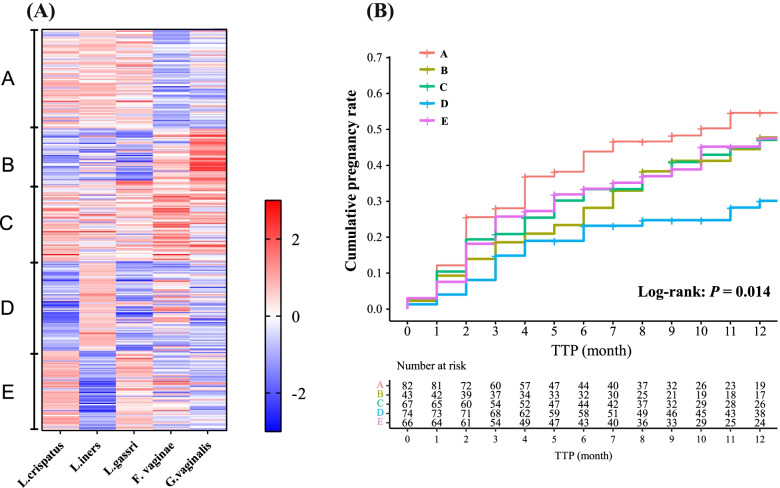
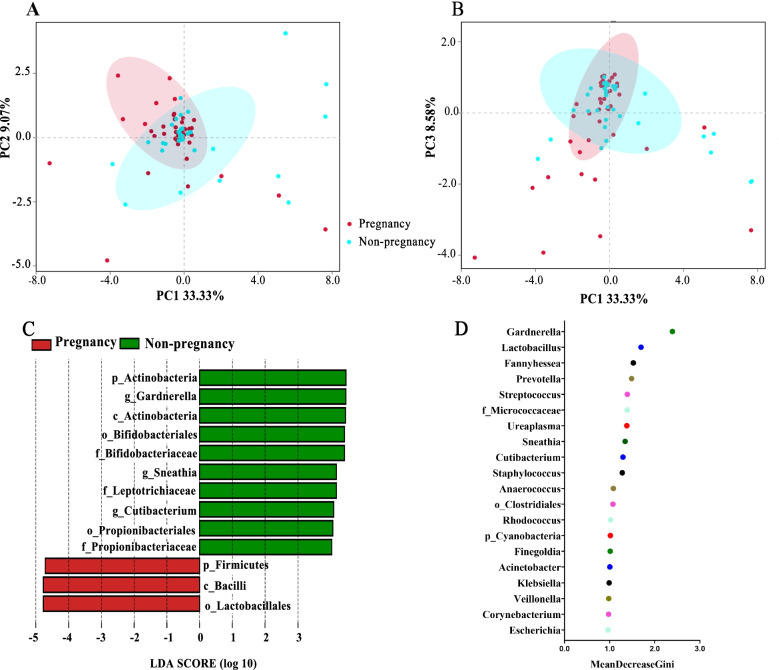
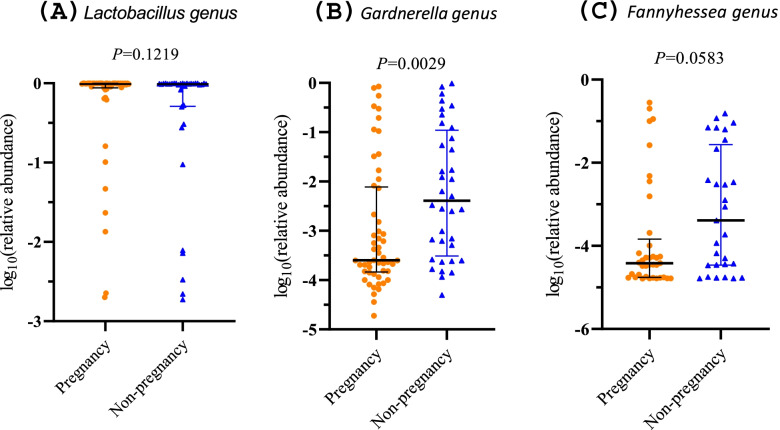
In phase I, 59.6% (53/89) of women became pregnant within 1 year. The principal coordinate analysis showed that the pre-pregnancy vaginal microbial community structures of the pregnant and non-pregnant groups were significantly different (PERMANOVA test, R = 0.025, P = 0.049). The abundance of the genus Lactobacillus in the pregnancy group was higher than that of the non-pregnant group (linear discriminant analysis effect size (LDA) > 4.0). The abundance of the genus Gardnerella in the non-pregnant group was higher than those in the pregnant group (LDA > 4.0). In phase II, female fecundability increased with higher absolute loads of Lactobacillus gasseri (quartile Q4 vs Q1, FR = 1.71, 95%CI 1.02-2.87) but decreased with higher absolute loads of Fannyhessea vaginae (Q4 vs Q1, FR = 0.62, 95%CI 0.38-1.00). Clustering analysis showed that the vaginal microbiome of type D (characterized by a higher abundance of Lactobacillus iners, a lower abundance of Lactobacillus crispatus and Lactobacillus gassri) was associated with a 55% reduction of fecundability (FR = 0.45, 95%CI 0.26-0.76) compared with type A (featuring three Lactobacillus species, low Gardnerella vaginalis and Fannyhessea vaginae abundance).
This cohort study demonstrated an association between the pre-pregnancy vaginal microbiome and female fecundability. A vaginal microbiome characterized by a higher abundance of L. iners and lower abundances of L. crispatus and L. gasseri appeared to be associated with a lower fecundability. Further research now needs to confirm whether manipulation of the vaginal microenvironment might improve human fecundability.
虽然性传播感染被认为是导致输卵管性不孕的主要原因,但常见阴道微生物群与女性生育能力之间的关系尚未确定。本研究的目的是寻找令人信服的证据,证明阴道细菌结构对计划怀孕的女性生育能力的影响。
我们招募了参加 2018 年 6 月 13 日至 10 月 31 日(第 I 期)和 2018 年 11 月 1 日至 2020 年 5 月 30 日(第 II 期)免费孕前健康检查项目的女性。我们从每位受试者中采集孕前阴道拭子;然后,我们对每位受试者进行随访,以在 1 年内获得妊娠计划结果。在第 I 期,我们通过 16S rRNA 基因测序来研究妊娠组和非妊娠组之间的阴道细菌含量。在第 II 期,我们通过应用定量实时聚合酶链反应测量特定物种的绝对丰度来验证这些发现。Cox 模型用于估计每种阴道微生物组类型的生育能力比(FR)。
在第 I 期,59.6%(53/89)的女性在 1 年内怀孕。主坐标分析表明,妊娠组和非妊娠组的孕前阴道微生物群落结构差异显著(PERMANOVA 检验,R=0.025,P=0.049)。妊娠组乳酸杆菌属的丰度高于非妊娠组(线性判别分析效应量(LDA)>4.0)。非妊娠组加德纳菌属的丰度高于妊娠组(LDA>4.0)。在第 II 期,女性生育能力随乳酸杆菌属加斯勒菌(Gasseri)的绝对负荷增加而增加(四分位 Q4 与 Q1 相比,FR=1.71,95%CI 1.02-2.87),但随 Fannyhessea vaginae 的绝对负荷增加而降低(Q4 与 Q1 相比,FR=0.62,95%CI 0.38-1.00)。聚类分析显示,阴道微生物组类型 D(以乳杆菌属 iners 丰度较高、乳杆菌属 crispatus 和 Lactobacillus gassri 丰度较低为特征)与生育能力降低 55%相关(FR=0.45,95%CI 0.26-0.76)与类型 A(以三种乳杆菌属、低加德纳菌属和 Fannyhessea vaginae 丰度为特征)相比。
这项队列研究表明,孕前阴道微生物群与女性生育能力之间存在关联。以 L. iners 丰度较高和 L. crispatus 和 L. gasseri 丰度较低为特征的阴道微生物群似乎与生育能力较低有关。现在需要进一步研究证实阴道微环境的干预是否可以提高人类的生育能力。