Bhinder Gurleen, Sharma Sanjula, Kaur Harjeevan, Akhatar Javed, Mittal Meenakshi, Sandhu Surinder
Oilseeds Section, Department of Plant Breeding and Genetics, Punjab Agricultural University, Ludhiana, India.
Front Plant Sci. 2022 Jul 14;13:882766. doi: 10.3389/fpls.2022.882766. eCollection 2022.
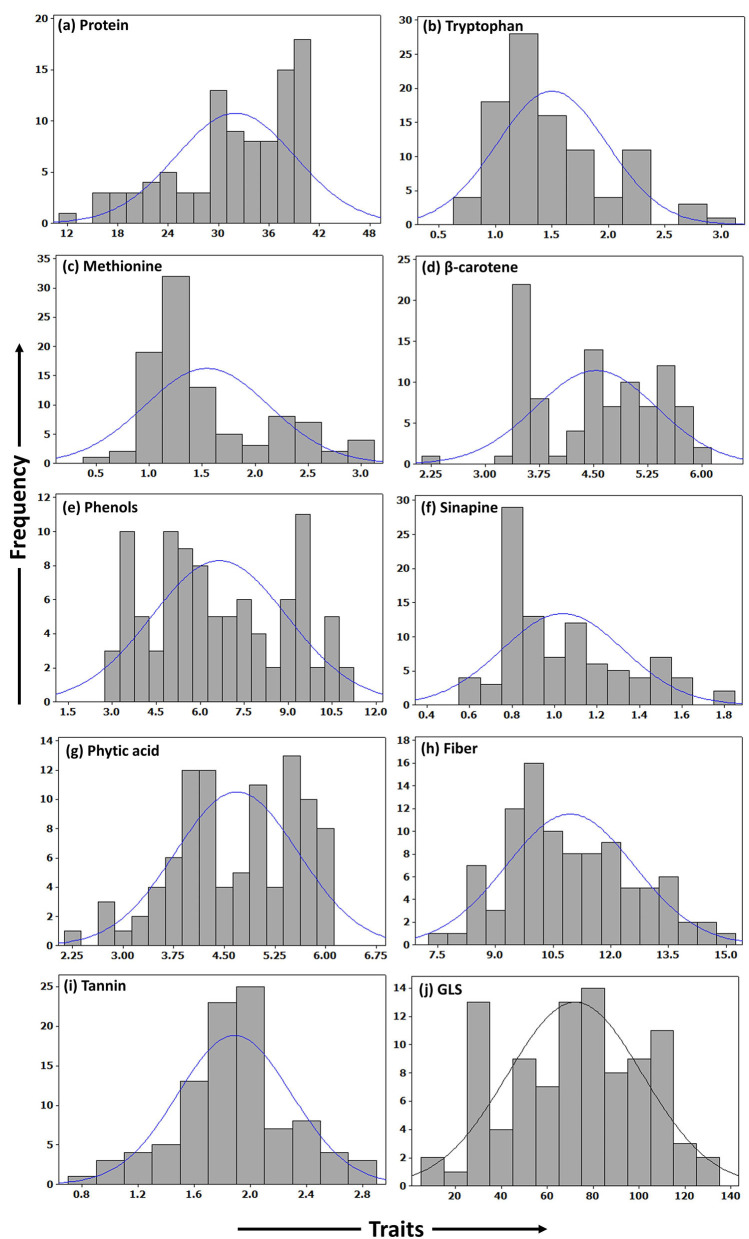
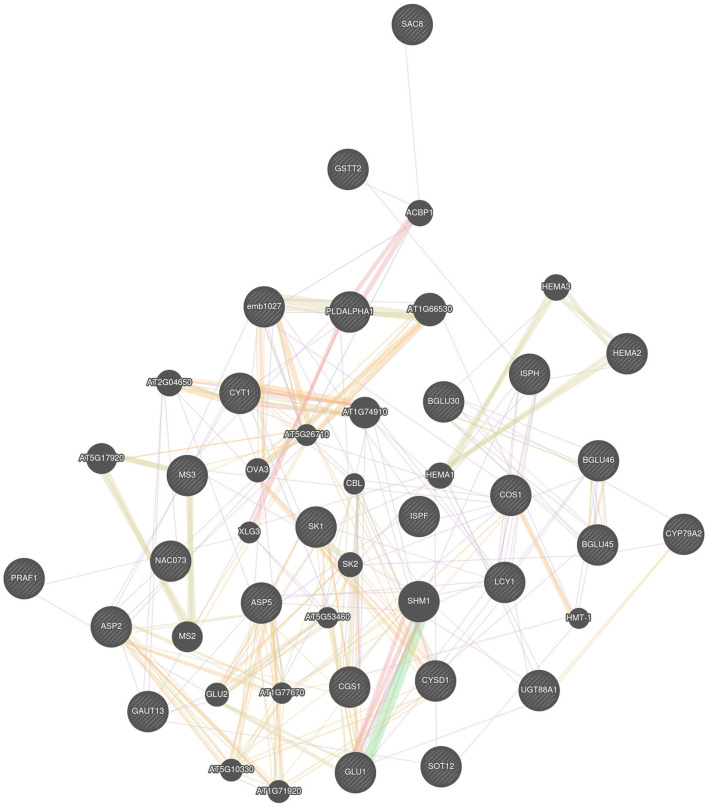
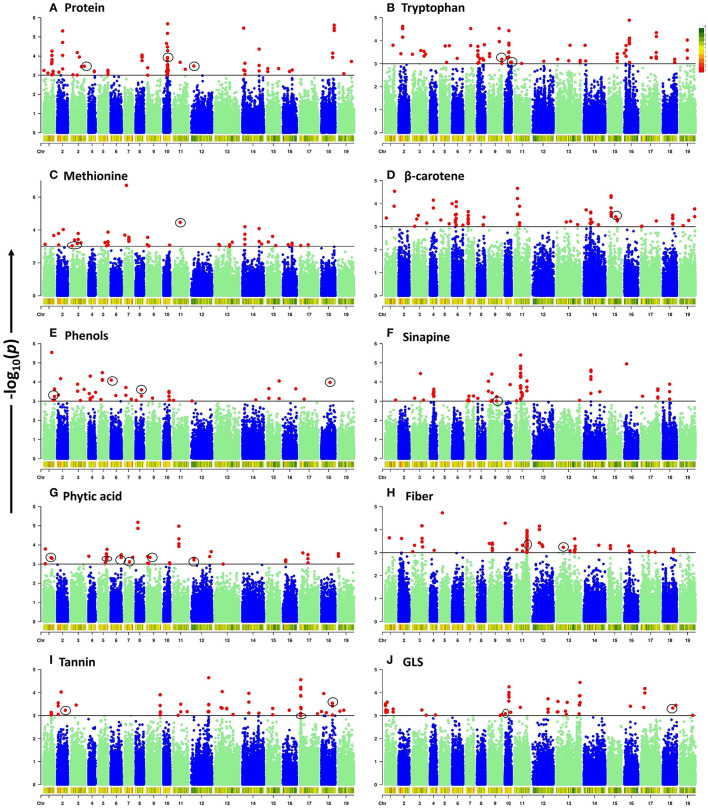
The defatted (rapeseed) meal can be high-protein feed for livestock as the protein value of rapeseed meal is higher than that of the majority of other vegetable proteins. Extensive work has already been carried out on developing canola rapeseed where the focus was on reducing erucic acid and glucosinolate content, with less consideration to other antinutritional factors such as tannin, phytate, sinapine, crude fiber, etc. The presence of these antinutrients limits the use and marketing of rapeseed meals and a significant amount of it goes unused and ends up as waste. We investigated the genetic architecture of crude protein, methionine, tryptophan, total phenols, β-carotene, glucosinolates (GLSs), phytate, tannins, sinapine, and crude fiber content of defatted seed meal samples by conducting a genome-wide association study (GWAS), using a diversity panel comprising 96 genotypes. Genotyping by sequencing was used to identify 77,889 SNPs, spread over 19 chromosomes. Genetic diversity and phenotypic variations were generally high for the studied traits. A total of eleven genotypes were identified which showed high-quality protein, high antioxidants, and lower amount of antinutrients. A significant negative correlation between protein and limiting amino acids and a significant positive correlation between GLS and phytic acid were observed. General and mixed linear models were used to estimate the association between the SNP markers and the seed quality traits and quantile-quantile (QQ) plots were generated to allow the best-fit algorithm. Annotation of genomic regions around associated SNPs helped to predict various trait-related candidates such as and (amino acid biosynthesis); , and (tryptophan biosynthesis); , and (methionine biosynthesis); (β-carotene biosynthesis); and (MEP pathway); (riboflavin synthesis); (phenolics biosynthesis); (cellulose and hemicellulose biosynthesis); (cellulose biosynthesis); and (lignin biosynthesis); and (flavonoid pathway); and , and (GLS metabolism), etc. The functional validation of these candidate genes could confirm key seed meal quality genes for germplasm enhancement programs directed at improving protein quality and reducing the antinutritional components in .
脱脂(油菜籽)粕可作为牲畜的高蛋白饲料,因为油菜籽粕的蛋白质价值高于大多数其他植物蛋白。在开发低芥酸菜籽油用油菜籽方面已经开展了大量工作,重点是降低芥酸和硫代葡萄糖苷含量,而较少考虑其他抗营养因子,如单宁、植酸、芥子碱、粗纤维等。这些抗营养物质的存在限制了油菜籽粕的使用和销售,大量油菜籽粕未被利用,最终成为废弃物。我们通过全基因组关联研究(GWAS),使用由96个基因型组成的多样性群体,对脱脂籽粕样品的粗蛋白、蛋氨酸、色氨酸、总酚、β-胡萝卜素、硫代葡萄糖苷(GLS)、植酸、单宁、芥子碱和粗纤维含量的遗传结构进行了研究。通过测序进行基因分型,以识别分布在19条染色体上的77,889个单核苷酸多态性(SNP)。所研究性状的遗传多样性和表型变异一般较高。共鉴定出11个基因型,其表现为优质蛋白、高抗氧化剂和较低含量的抗营养物质。观察到蛋白质与限制性氨基酸之间存在显著负相关,硫代葡萄糖苷与植酸之间存在显著正相关。使用一般线性模型和混合线性模型来估计SNP标记与种子品质性状之间的关联,并生成分位数-分位数(QQ)图以确定最佳拟合算法。对相关SNP周围基因组区域的注释有助于预测各种与性状相关的候选基因,如和(氨基酸生物合成);、和(色氨酸生物合成);、和(蛋氨酸生物合成);(β-胡萝卜素生物合成);和(MEP途径);(核黄素合成);(酚类生物合成);(纤维素和半纤维素生物合成);(纤维素生物合成);和(木质素生物合成);和(类黄酮途径);以及、和(硫代葡萄糖苷代谢)等。这些候选基因的功能验证可以确认用于种质改良计划的关键籽粕品质基因,旨在提高蛋白质质量并减少中的抗营养成分。