Yue Ting, Li Jingjing, Liang Manguang, Yang Jiaman, Ou Zhiwen, Wang Shuchen, Ma Wuhua, Fan Dehui
The Fifth Clinical Medical School, Guangzhou University of Chinese Medicine, Guangzhou, China.
Department of Oncology Rehabilitation, Jincheng People's Hospital, Jincheng, China.
Front Genet. 2022 Jul 14;13:928754. doi: 10.3389/fgene.2022.928754. eCollection 2022.
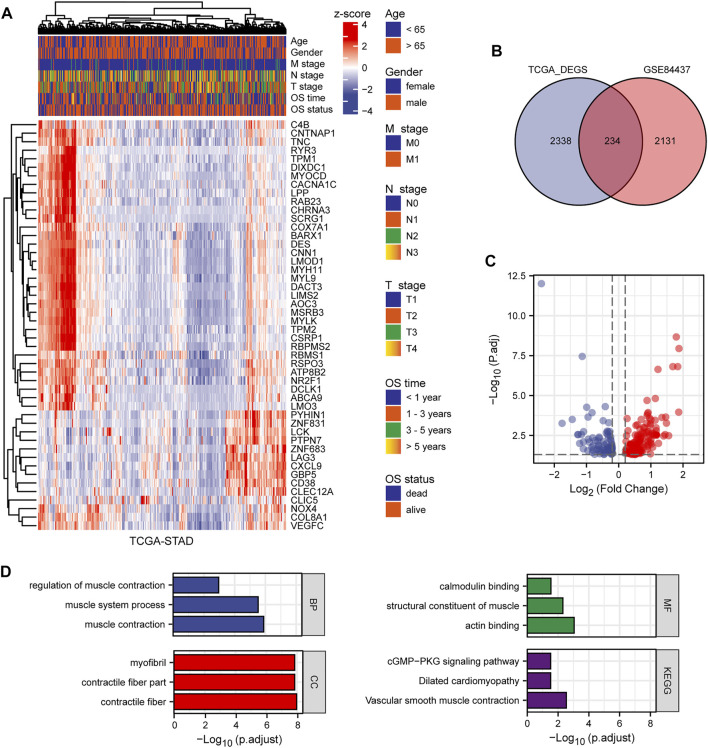
Gastric cancer (GC) is the second leading cause of cancer-related mortality and the fifth most common cancer worldwide. However, the underlying mechanisms of competitive endogenous RNAs (ceRNAs) in GC are unclear. This study aimed to construct a ceRNA regulation network in correlation with prognosis and explore a prognostic model associated with GC. In this study, 1,040 cases of GC were obtained from TCGA and GEO datasets. To identify potential prognostic signature associated with GC, Cox regression analysis and the least absolute shrinkage and selection operator (LASSO) regression were employed. The prognostic value of the signature was validated in the GEO84437 training set, GEO84437 test set, GEO15459 set, and TCGA-STAD. Based on the public databases, TargetScan and starBase, an mRNA-miRNA-lncRNA regulatory network was constructed, and hub genes were identified using the CytoHubba plugin. Furthermore, the clinical outcomes, immune cell infiltration, genetic variants, methylation, and somatic copy number alteration (sCNA) associated with the ceRNA network were derived using bioinformatics methods. A total of 234 prognostic genes were identified. GO and GSEA revealed that the biological pathways and modules related to immune response and fibroblasts were considerably enriched in GC. A nomogram was generated to provide accurate prognostic outcomes and individualized risk estimates, which were validated in the training, test dataset, and two independent validation datasets. Thereafter, an mRNA-miRNA-lncRNA regulatory network containing 4 mRNAs, 22 miRNAs, 201 lncRNAs was constructed. The KCNQ1OT1/hsa-miR-378a-3p/RBMS1 ceRNA network associated with the prognosis was obtained by hub gene analysis and correlation analysis. Importantly, we found that the KCNQ1OT1/miR-378a-3p/RBMS1 axis may play a vital role in the diagnosis and prognosis of GC patients based on Cox regression analyses. Furthermore, our findings demonstrated that mutations and sCNA of the KCNQ1OT1/miR-378a-3p/RBMS1 axis were associated with increased immune infiltration, while the abnormal upregulation of the axis was primarily a result of hypomethylation. Our findings suggest that the KCNQ1OT1/miR-378a-3p/RBMS1 axis may be a potential prognostic biomarker and therapeutic target for GC. Moreover, such findings provide insights into the molecular mechanisms of GC pathogenesis.
胃癌(GC)是癌症相关死亡的第二大主要原因,也是全球第五大常见癌症。然而,竞争性内源性RNA(ceRNA)在GC中的潜在机制尚不清楚。本研究旨在构建与预后相关的ceRNA调控网络,并探索与GC相关的预后模型。在本研究中,从TCGA和GEO数据集中获取了1040例GC病例。为了识别与GC相关的潜在预后特征,采用了Cox回归分析和最小绝对收缩和选择算子(LASSO)回归。该特征的预后价值在GEO84437训练集、GEO84437测试集、GEO15459集和TCGA-STAD中得到验证。基于公共数据库TargetScan和starBase,构建了一个mRNA-miRNA-lncRNA调控网络,并使用CytoHubba插件识别了枢纽基因。此外,使用生物信息学方法得出了与ceRNA网络相关的临床结局、免疫细胞浸润、基因变异、甲基化和体细胞拷贝数改变(sCNA)。共鉴定出234个预后基因。GO和GSEA显示,与免疫反应和成纤维细胞相关的生物学途径和模块在GC中显著富集。生成了一个列线图,以提供准确的预后结局和个性化风险估计,并在训练集、测试数据集和两个独立验证数据集中进行了验证。此后,构建了一个包含4个mRNA、22个miRNA、201个lncRNA的mRNA-miRNA-lncRNA调控网络。通过枢纽基因分析和相关性分析获得了与预后相关的KCNQ1OT1/hsa-miR-378a-3p/RBMS1 ceRNA网络。重要的是,基于Cox回归分析,我们发现KCNQ1OT1/miR-378a-3p/RBMS1轴可能在GC患者的诊断和预后中起关键作用。此外,我们的研究结果表明,KCNQ1OT1/miR-378a-3p/RBMS1轴的突变和sCNA与免疫浸润增加相关,而该轴的异常上调主要是低甲基化的结果。我们的研究结果表明,KCNQ1OT1/miR-378a-3p/RBMS1轴可能是GC的潜在预后生物标志物和治疗靶点。此外,这些发现为GC发病机制的分子机制提供了见解。