Department of Public Health and Preventive Medicine, School of Medicine, Jinan University, Guangzhou, China.
Division of Medical Psychology and Behavior Science, School of Medicine, Jinan University, Guangzhou, China.
Front Public Health. 2022 Jul 13;10:917022. doi: 10.3389/fpubh.2022.917022. eCollection 2022.
Emerging research has identified health literacy as an important resource for individual health care and disease prevention. In the context of COVID-19, People with limited HL are less likely to follow preventive measures such as wearing masks, social isolation, or taking the vaccination. However, the pathways of how health literacy affects decision-making have remained unclear.
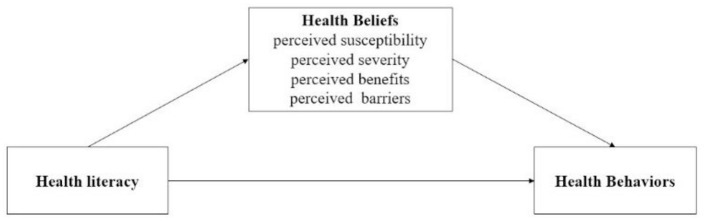
With a cross-sectional study, a total of 613 responses (mean age is 25.64 ± 6.46 years) were collected. The relationship between health literacy and health behaviors under COVID-19 was examined, and the potential mediation pathways were assessed based on the health belief model.
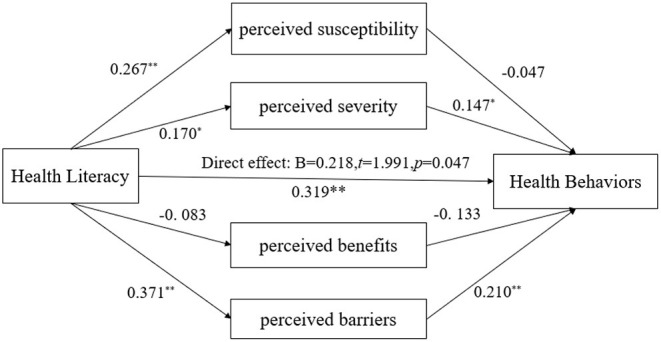
With linear regression, it was found that health literacy has a direct effect on health behaviors and three constructs in the health belief model, i.e., perceived susceptibility, perceived severity, perceived barriers, as well as an indirect effect on health behaviors via increasing perceived barriers related with COVID-19 preventive measures. The results showed that health literacy only goes through the pathway of perceived barriers to influence health behaviors, and the indirect effects via other pathways were not significant.
The research addressed the mediation model underlying the effects of health literacy on health behaviors and identified a partial mediation role of perceived barriers. Health literacy could promote individual health behavior by reducing the perceived barriers to forming a healthy lifestyle and making health decisions. Future health promotion interventions increasing people's health literacy should be advocated to promote health initiatives in the whole population.
新兴研究将健康素养确定为个人医疗保健和疾病预防的重要资源。在 COVID-19 背景下,健康素养有限的人不太可能遵循预防措施,例如戴口罩、社会隔离或接种疫苗。然而,健康素养如何影响决策的途径仍不清楚。
采用横断面研究,共收集 613 份回复(平均年龄为 25.64 ± 6.46 岁)。检验了健康素养与 COVID-19 下健康行为之间的关系,并基于健康信念模型评估了潜在的中介途径。
线性回归发现,健康素养对健康行为以及健康信念模型中的三个结构(即感知易感性、感知严重性、感知障碍)有直接影响,以及通过增加与 COVID-19 预防措施相关的感知障碍对健康行为有间接影响。结果表明,健康素养仅通过感知障碍途径影响健康行为,其他途径的间接影响不显著。
该研究解决了健康素养对健康行为影响的中介模型问题,并确定了感知障碍的部分中介作用。健康素养可以通过减少形成健康生活方式和做出健康决策的感知障碍来促进个体健康行为。未来应倡导增加人们健康素养的健康促进干预措施,以促进整个人口的健康倡议。