Department of Economics, Sejong University, Seoul, South Korea.
School of Economics and Management, Binzhou University, Binzhou, China.
Front Public Health. 2021 Sep 16;9:748048. doi: 10.3389/fpubh.2021.748048. eCollection 2021.
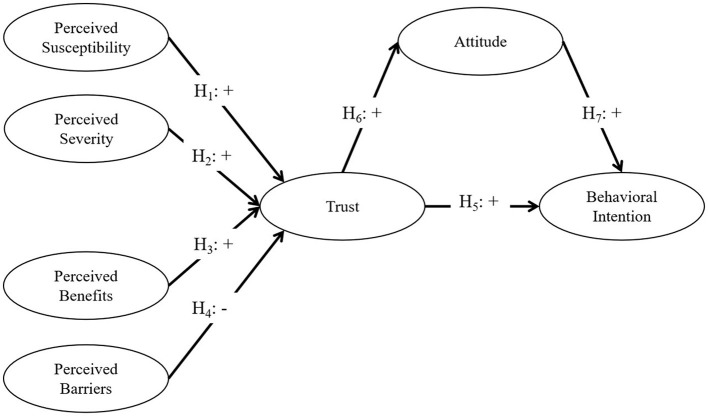
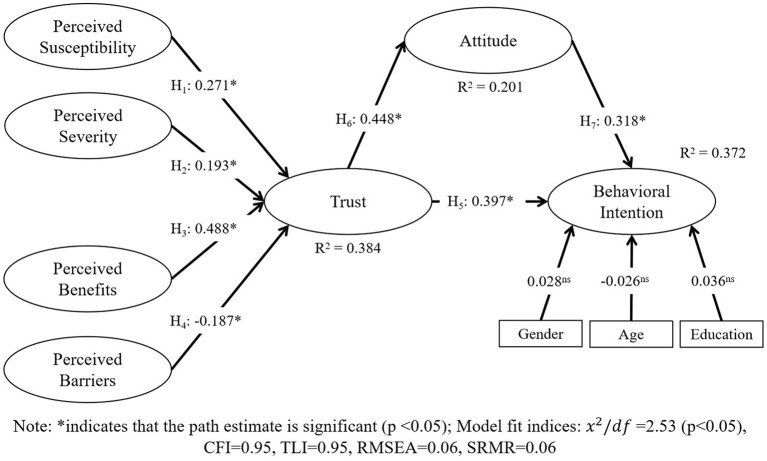
During the COVID-19 pandemic, livestream shopping has provided consumers with a way to maintain social distancing while offering an alternative to offline shopping. This study aims to understand the impact of COVID-19 and other public health crises on the behavioral intentions of consumers using livestream shopping technology. A theoretical model was designed that combines the health belief model, trust theory, and the theory of planned behavior. Empirical data were collected from 358 residents in China and then analyzed using structural equation modeling. The results showed that perceived susceptibility, perceived severity, perceived benefits, and perceived obstacles had a significant impact on consumer trust. Consumer trust in turn had a direct impact on behavioral intention and an indirect impact on behavioral intention attitude. These research results have practical implications for livestream shopping merchants, platform decision-makers, and service designers.
在新冠疫情期间,直播购物为消费者提供了一种在保持社交距离的同时替代线下购物的方式。本研究旨在了解新冠疫情和其他公共卫生危机对消费者使用直播购物技术的行为意图的影响。设计了一个理论模型,该模型结合了健康信念模型、信任理论和计划行为理论。实证数据来自中国的 358 名居民,然后使用结构方程模型进行分析。结果表明,感知易感性、感知严重性、感知收益和感知障碍对消费者信任有显著影响。消费者信任反过来又对行为意图有直接影响,对行为意图态度有间接影响。这些研究结果对直播购物商家、平台决策者和服务设计师具有实际意义。