Wang Xue, Ni Qingwei, Wang Jie, Wu Shujie, Chen Peng, Xing Dawei
Department of Cardiology, The Second Affiliated Hospital and Yuying Children's Hospital, Wenzhou Medical University, Wenzhou, China.
Front Cardiovasc Med. 2022 Jul 14;9:871031. doi: 10.3389/fcvm.2022.871031. eCollection 2022.
Heart failure (HF) is a clinical syndrome caused by ventricular dysfunction, which leads to the decline of activity tolerance and repeated hospitalization, which seriously affects the quality of life and is the main cause of death of the elderly. It has long been observed that the pathophysiological mechanism of HF is associated with systemic inflammation. This study aims to explore the association between the systemic inflammation response index (SIRI), a novel biomarker of inflammation, and outcomes in elderly patients with HF.
Data was extracted from the Medical Information Mart data for Intensive Care III (MIMIC-III) database and the Second Affiliated Hospital of Wenzhou Medical University. The primary outcome was 90-day all-cause mortality. The secondary outcomes included 1-year all-cause mortality, the length of hospital or intensive care unit (ICU) stay, and the need for renal replacement therapy (RRT). Cox proportional hazards regression, linear regression, and logistic regression models were used to assess the association between SIRI levels and all-cause mortality, the length of hospital or ICU stay, the need for RRT, respectively. Moreover, Pearson correlation analysis was conducted to evaluate the correlation between SIRI and C-reactive protein (CRP).
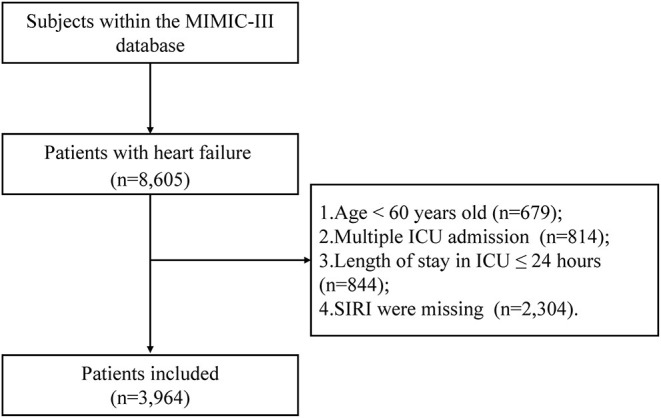
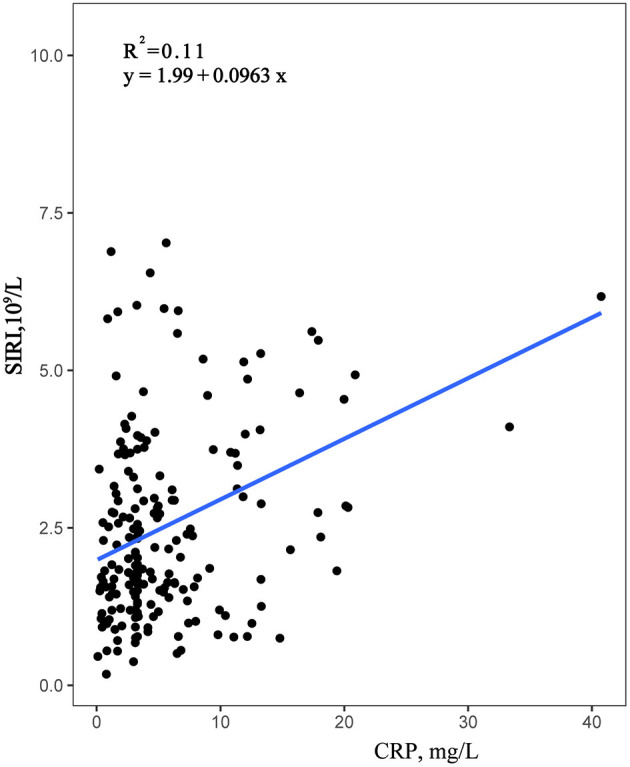
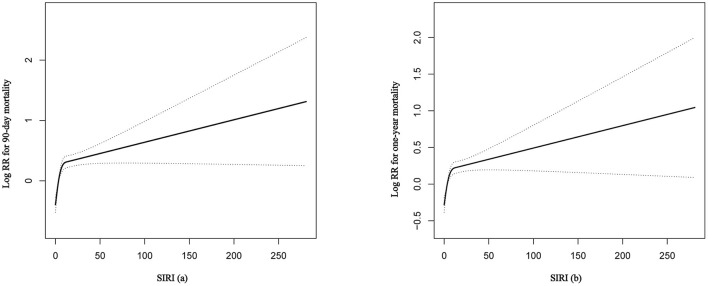
This study cohort included 3,964 patients from the MIMIC-III database and 261 patients from the Second Affiliated Hospital of Wenzhou Medical University. The result suggested that SIRI was independently associated with the 90-day, and 1-year all-cause mortality in elderly patients with HF (tertile 3 vs. tertile 1: adjusted HR, 95% CI: 1.41 (1.18, 1.68), 1.19 (1.03, 1.37); trend = 0.0013, 0.0260; respectively). Elevated SIRI was associated with increased the length of hospital or ICU stay after adjusting for multiple confounders (tertile 3 vs. tertile 1: , 95% CI: 0.85 (0.16, 1.54); 0.62 (0.18, 1.06); trend = 0.0095, 0.0046; respectively). Furthermore, we found that patients with higher SIRI levels were more likely to require RRT (tertile 3 vs. tertile 1: OR, 95% CI: 1.55 (1.06, 2.28); trend = 0.0459). Moreover, we confirmed that SIRI was statistically positively correlated with CRP (correlation coefficient = 0.343, <0.001).
SIRI could be a novel promising inflammatory biomarker for predicting all-cause mortality in elderly patients with HF. And the patients with higher SIRI values had the longer length of hospital or ICU stay and were more likely to require for RRT. Of note, this study also verified a statistically significant positive correlation between SIRI and the inflammatory marker CRP, highlighting the importance of systemic inflammation as a determinant of outcome in patients with HF.
心力衰竭(HF)是一种由心室功能障碍引起的临床综合征,导致活动耐量下降和反复住院,严重影响生活质量,是老年人死亡的主要原因。长期以来人们观察到,HF的病理生理机制与全身炎症有关。本研究旨在探讨新型炎症生物标志物全身炎症反应指数(SIRI)与老年HF患者预后之间的关联。
从重症监护医学信息集市数据库III(MIMIC-III)和温州医科大学附属第二医院提取数据。主要结局为90天全因死亡率。次要结局包括1年全因死亡率、住院或重症监护病房(ICU)住院时间以及肾脏替代治疗(RRT)需求。采用Cox比例风险回归、线性回归和逻辑回归模型分别评估SIRI水平与全因死亡率、住院或ICU住院时间、RRT需求之间的关联。此外,进行Pearson相关分析以评估SIRI与C反应蛋白(CRP)之间的相关性。
本研究队列包括来自MIMIC-III数据库的3964例患者和温州医科大学附属第二医院的261例患者。结果表明,SIRI与老年HF患者的90天和1年全因死亡率独立相关(三分位数3与三分位数1:调整后HR,95%CI:1.41(1.18,1.68),1.19(1.03,1.37);趋势 = 0.0013,0.0260;分别)。在调整多个混杂因素后,SIRI升高与住院或ICU住院时间延长相关(三分位数3与三分位数1: ,95%CI:0.85(0.16,1.54);0.62(0.18,1.06);趋势 = 0.0095,0.0046;分别)。此外,我们发现SIRI水平较高的患者更有可能需要RRT(三分位数3与三分位数1:OR,95%CI:1.55(1.06,2.28);趋势 = 0.0459)。此外,我们证实SIRI与CRP在统计学上呈正相关(相关系数 = 0.343,<0.001)。
SIRI可能是预测老年HF患者全因死亡率的一种新型有前景的炎症生物标志物。SIRI值较高的患者住院或ICU住院时间更长,且更有可能需要RRT。值得注意的是,本研究还证实了SIRI与炎症标志物CRP之间在统计学上有显著正相关,突出了全身炎症作为HF患者预后决定因素的重要性。