Department of Hematology and Oncology, Beilun Branch of the First Affiliated Hospital of Medical College of Zhejiang University, Ningbo, China.
Department of Global Health, Ningbo Institute of Life and Health Industry, University of Chinese Academy of Sciences, Ningbo, China.
Front Immunol. 2022 Jul 14;13:874677. doi: 10.3389/fimmu.2022.874677. eCollection 2022.
No comprehensive studies have been published on the global burden of alopecia areata since 2010.
We aimed to measure the global, regional, and national incidence of alopecia areata and disability-adjusted life-years (DALYs) by age, sex, and socio-demographic index (SDI) value from 1990 to 2019.
Data were extracted from the Global Burden of Disease Study 2019. Estimated annual percentage changes (EAPCs) were calculated to quantify temporal trends in the age-standardized rates of alopecia areata incidence and DALYs. The correlations between EAPCs in the age-standardized rates and SDI values were also analyzed.
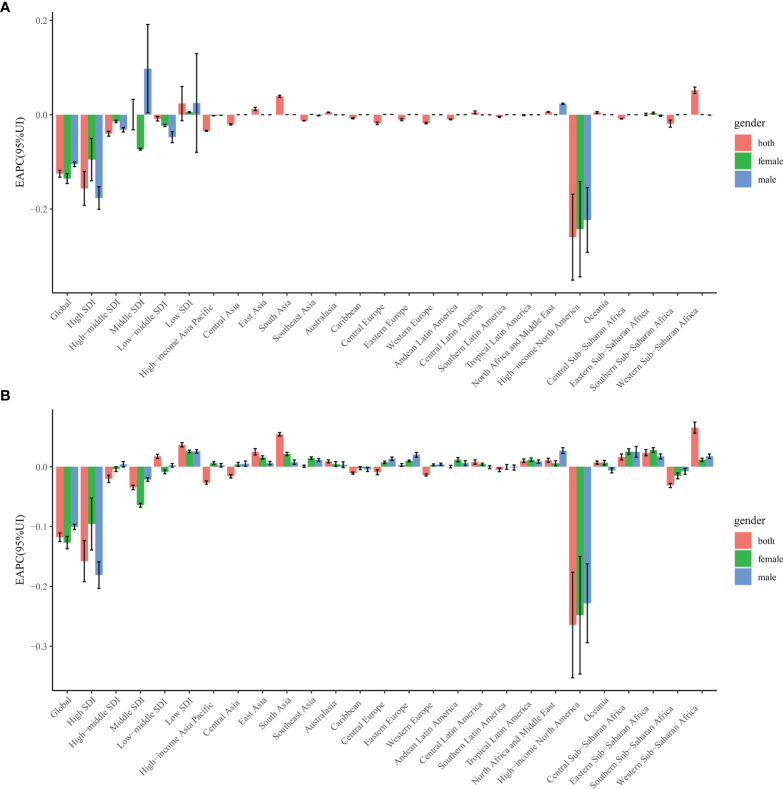
From 1990 to 2019, the alopecia areata incidence number and the associated number of DALYs increased globally by 49.14%, and 49.51%, respectively. The global age-standardized incidence rate decreased (EAPC, -0.13; 95% confidence interval [CI], -0.13 to -0.12) and the age-standardized DALY rate showed a downward trend (EAPC, -0.12; 95% CI, -0.13 to -0.11). The largest increases in the age-standardized incidence rate and age-standardized DALY rate were observed in Low SDI quintile and Western Sub-Saharan Africa regions. The regions with the greatest changes in the incidence of alopecia areata were Central Sub-Saharan Africa and Western Sub-Saharan Africa. The three countries with the largest increases in alopecia areata incidence from 1990 to 2019 were Kuwait (EAPC, 0.15), South Sudan (EAPC, 0.12), and Nigeria (EAPC, 0.11). The age-standardized incidence rate was higher in females than in males.
Globally, both the age-standardized incidence rate and age-standardized DALY rate of alopecia areata showed decreasing trends. Future preventive strategies should focus on low-income countries, Central Sub-Saharan Africa, Western Sub-Saharan Africa, Kuwait, South Sudan, Nigeria.
自 2010 年以来,尚无关于斑秃全球负担的综合研究。
本研究旨在测量 1990 年至 2019 年期间按年龄、性别和社会人口指数(SDI)值划分的斑秃发病率和残疾调整生命年(DALY)的全球、区域和国家发病率。
数据来自 2019 年全球疾病负担研究。计算了年估计百分比变化(EAPC),以量化斑秃发病率和 DALY 的年龄标准化率的时间趋势。还分析了年龄标准化率的 EAPC 与 SDI 值之间的相关性。
1990 年至 2019 年期间,斑秃发病率和相关 DALY 分别在全球范围内增加了 49.14%和 49.51%。全球年龄标准化发病率呈下降趋势(EAPC,-0.13;95%置信区间[CI],-0.13 至-0.12),年龄标准化 DALY 率呈下降趋势(EAPC,-0.12;95%CI,-0.13 至-0.11)。SDI 五分位数最低和撒哈拉以南非洲西部地区的年龄标准化发病率和年龄标准化 DALY 率增幅最大。斑秃发病率变化最大的地区是中非和撒哈拉以南非洲西部。1990 年至 2019 年斑秃发病率增加最多的三个国家是科威特(EAPC,0.15)、南苏丹(EAPC,0.12)和尼日利亚(EAPC,0.11)。女性的年龄标准化发病率高于男性。
全球范围内,斑秃的年龄标准化发病率和年龄标准化 DALY 率均呈下降趋势。未来的预防策略应侧重于低收入国家、中非、撒哈拉以南非洲西部、科威特、南苏丹和尼日利亚。