Department of Immunology, Genetics and Pathology, Science for Life Laboratory, Uppsala University, Uppsala, Sweden.
Department of Surgery, Korle-Bu Teaching Hospital, Accra, Ghana.
Target Oncol. 2022 Sep;17(5):507-515. doi: 10.1007/s11523-022-00901-1. Epub 2022 Aug 1.
Both randomized controlled trials (RCTs) and real-world evidence (RWE) studies provide results regarding the efficacy and toxicity of checkpoint inhibitors in cancer patients. The results from these two sources are considered complementary but whether they are comparable remains unknown.
The aim of this study was to compare the efficacy and toxicity of checkpoint inhibitors between RCTs and RWE studies in patients with advanced non-small cell lung cancer (NSCLC) or melanoma.
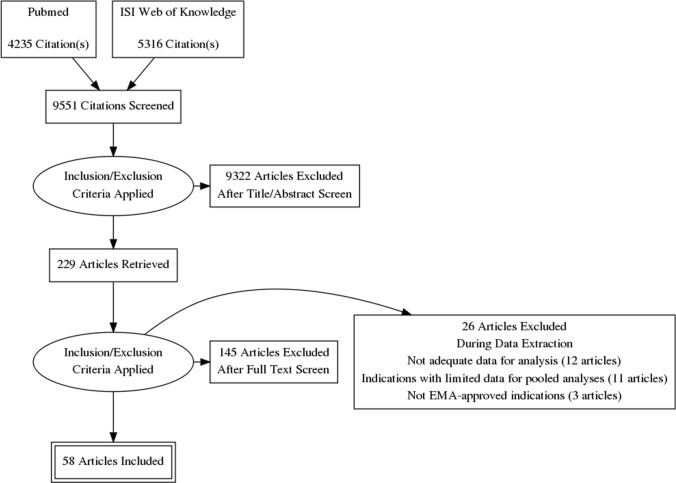
Two electronic databases were searched to identify eligible studies, either RCTs or RWE studies, investigating the efficacy or toxicity of checkpoint inhibitors given for indications that were approved by the European Medicines Agency (EMA) at the date of the last search. A meta-analysis was performed and the pooled estimates of objective response rates (ORR), progression-free survival (PFS), overall survival (OS), and toxicity and treatment discontinuation between RCTs and RWE studies were compared.
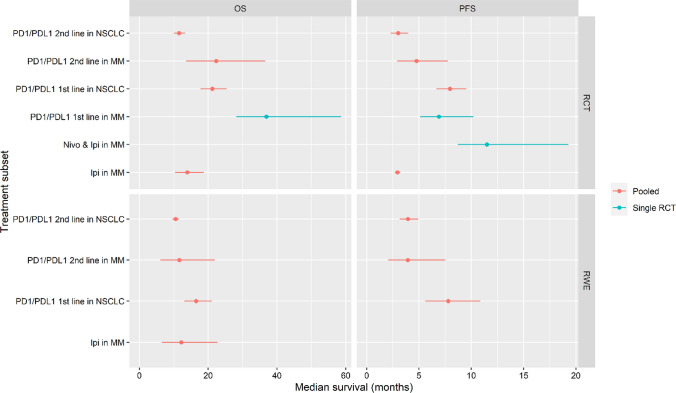
In total, 43 RWE studies and 15 RCTs were eligible, with adequate data for pooled estimates for immunotherapy indications regarding NSCLC and melanoma. No statistically significant or clinically meaningful differences in terms of pooled PFS, OS, or rates of treatment discontinuation due to toxicity between RCTs and RWE studies were observed. In some indications, a higher rate of response rates and lower rate of toxicity in favor of RWE was observed.
In patients with melanoma or NSCLC, the clinical value of checkpoint inhibitors is evident in both RCTs and real-world settings. Some differences in response or toxicity rates in favor of RWE mainly reflects the inherent difficulties in evaluating these outcomes in RWE studies.
随机对照试验(RCT)和真实世界证据(RWE)研究都提供了关于癌症患者的检查点抑制剂疗效和毒性的结果。这两种来源的结果被认为是互补的,但它们是否具有可比性尚不清楚。
本研究旨在比较 RCT 和 RWE 研究中晚期非小细胞肺癌(NSCLC)或黑色素瘤患者检查点抑制剂的疗效和毒性。
检索了两个电子数据库,以确定符合条件的研究,这些研究是 RCT 或 RWE 研究,调查了在最后一次检索日期前获得欧洲药品管理局(EMA)批准的适应证下使用检查点抑制剂的疗效或毒性。进行了荟萃分析,并比较了 RCT 和 RWE 研究中客观缓解率(ORR)、无进展生存期(PFS)、总生存期(OS)以及毒性和治疗中断的汇总估计值。
共有 43 项 RWE 研究和 15 项 RCT 符合条件,对于 NSCLC 和黑色素瘤的免疫治疗适应证有足够的数据进行汇总估计。在 RCT 和 RWE 研究之间,PFS、OS 或因毒性而导致的治疗中断率的汇总估计值没有统计学意义或临床意义上的差异。在某些适应证中,观察到 RWE 中反应率较高和毒性率较低的趋势。
在黑色素瘤或 NSCLC 患者中,检查点抑制剂在 RCT 和真实世界环境中都具有明显的临床价值。一些有利于 RWE 的反应率或毒性率的差异主要反映了在 RWE 研究中评估这些结果的固有困难。