School of Medicine, University of Dundee, Dundee, UK
School of Medicine, University of St Andrews, St Andrews, UK.
BMJ Open Qual. 2022 Aug;11(3). doi: 10.1136/bmjoq-2021-001784.
Testosterone replacement therapy (TRT) is the treatment of choice for male hypogonadism. British Society for Sexual Medicine (BSSM) guidelines on adult testosterone deficiency recommend that TRT patients undergo annual monitoring of their testosterone levels and potential complications of treatment; though evidence suggests that substantial numbers of men on TRT are not monitored adequately.
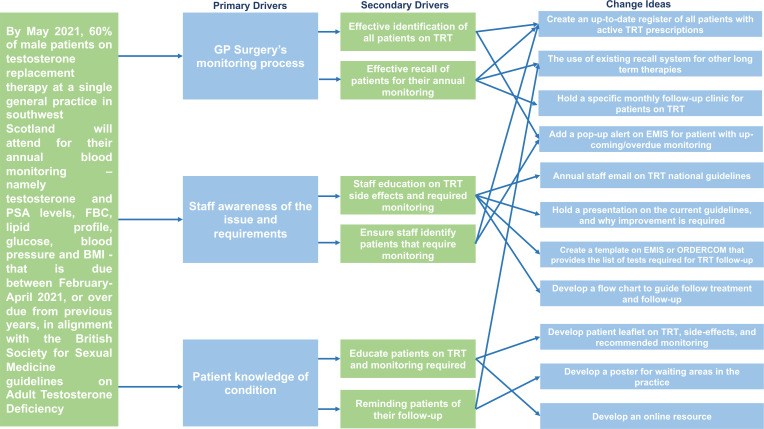
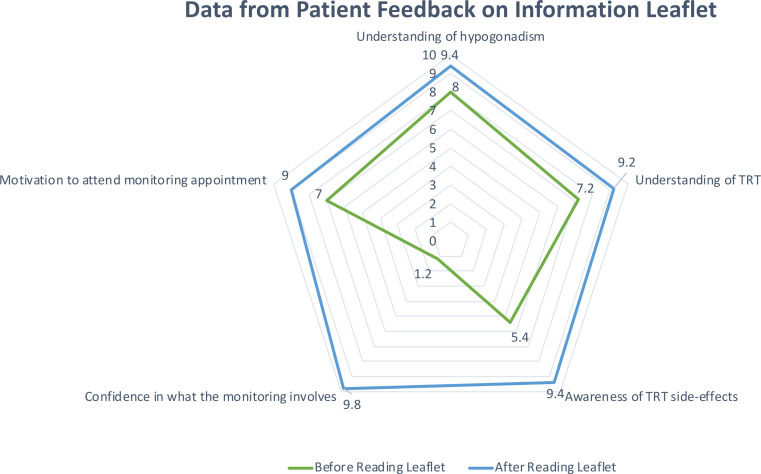
Review of the electronic patient record from a single general practice in southwest Scotland revealed that only 1 of 26 (4%) TRT patients had been monitored as per BSSM guidelines in the previous 12 months. Additionally, when monitoring was undertaken there was inconsistency in the blood tests requested. The use of quality improvement (QI) tools including process mapping and cause-and-effect diagram identified staff and patient knowledge of monitoring requirements and the lack of an effective recall system as areas for improvement. We tested three change ideas: the utilisation of an existing recall system for long-term therapies; a TRT Ordercomms blood group template (OBGT) to standardise monitoring; and a patient information leaflet (PIL) to improve patient education. The aim of this project was to achieve 60% annual monitoring rate.
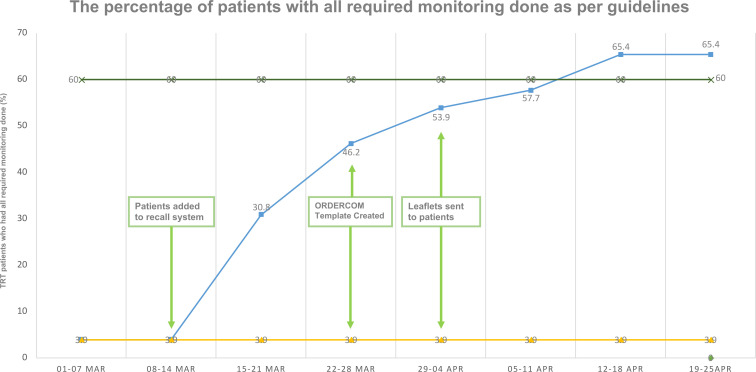
The percentage of patients monitored for testosterone levels and potential TRT complications increased from 4% (1/26) to 65% (17/26) over a 7-week test period. The utilisation of the existing recall system was a particularly effective intervention, leading to an increase from 4% (1/26) to 31% (8/26) in the first 2 weeks.
The use of QI tools was associated with over 60% of male TRT patients receiving comprehensive annual monitoring, as per BSSM guidelines. Our findings support the hypothesis that a patient recall system, combined with an OBGT and a PIL led to this increase.
睾酮替代疗法(TRT)是治疗男性性腺功能减退症的首选方法。英国性医学学会(BSSM)关于成人睾酮缺乏的指南建议,TRT 患者应每年监测其睾酮水平和治疗的潜在并发症;尽管有证据表明,大量接受 TRT 的男性未得到充分监测。
对苏格兰西南部一家综合诊所的电子患者记录进行审查,结果显示,在过去 12 个月中,只有 26 名 TRT 患者中的 1 名(4%)按照 BSSM 指南进行了监测。此外,在进行监测时,所要求的血液检测不一致。使用质量改进(QI)工具,包括流程映射和因果关系图,确定了员工和患者对监测要求的了解程度,以及缺乏有效的召回系统,这些都是需要改进的领域。我们测试了三个变更想法:利用现有的长期治疗召回系统;TRT 医嘱通讯血液组模板(OBGT)以标准化监测;以及患者信息传单(PIL)以提高患者教育。该项目的目标是实现 60%的年度监测率。
接受睾酮水平和潜在 TRT 并发症监测的患者比例从 4%(1/26)增加到 7 周测试期间的 65%(17/26)。利用现有的召回系统是一种特别有效的干预措施,在前 2 周内,监测率从 4%(1/26)增加到 31%(8/26)。
使用 QI 工具使超过 60%的男性 TRT 患者按照 BSSM 指南接受了全面的年度监测。我们的发现支持这样一种假设,即患者召回系统,结合 OBGT 和 PIL,导致了这种增加。