Elliott Jesse, Kelly Shannon E, Millar Adam C, Peterson Joan, Chen Li, Johnston Amy, Kotb Ahmed, Skidmore Becky, Bai Zemin, Mamdani Muhammad, Wells George A
Cardiovascular Research Methods Centre, University of Ottawa Heart Institute, Ottawa, Ontario, Canada.
Department of Medicine, Mount Sinai Hospital, University of Toronto, Toronto, Ontario, Canada.
BMJ Open. 2017 Nov 16;7(11):e015284. doi: 10.1136/bmjopen-2016-015284.
To assess the relative effects of individual testosterone products among hypogonadal men.
Systematic review and network meta-analysis.
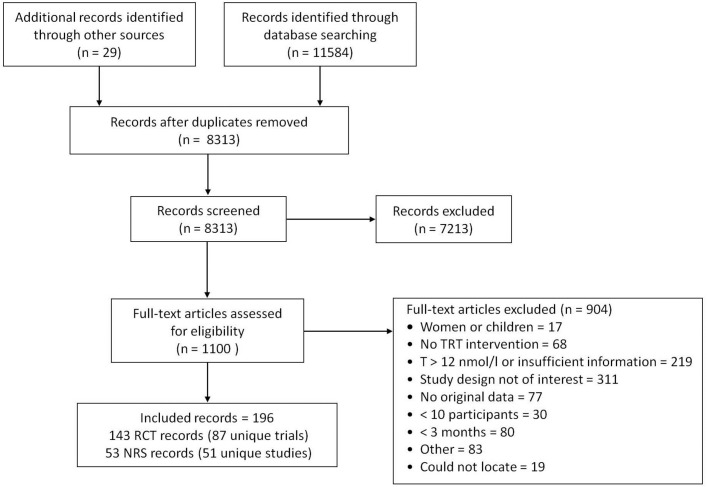
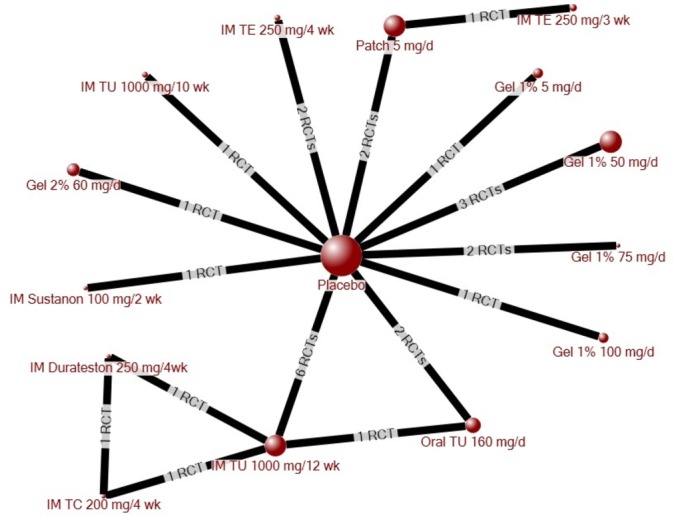
We searched MEDLINE, Embase, Cochrane CENTRAL, and grey literature (25 May 2017) for randomised-controlled trials (RCTs) and non-randomised studies (NRS) that involved hypogonadal men given testosterone replacement therapy (TRT) for ≥3 months. Comparators were placebo, another TRT, or the same product at a different dose. Outcomes were quality of life, depression, libido, erectile function, activities of daily living and testosterone levels, as well as cardiovascular death, myocardial infarction, stroke, prostate cancer, heart disease, diabetes, serious adverse events, withdrawals due to adverse events and erythrocytosis. RCT data were pooled via meta-analysis and network meta-analysis. Risk of bias was assessed using Cochrane's risk of bias tool (RCTs) andScottish Intercollegiate Guidelines Network (SIGN)50 (NRS).
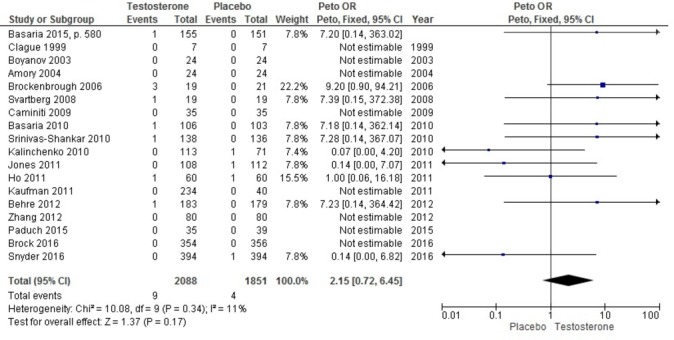
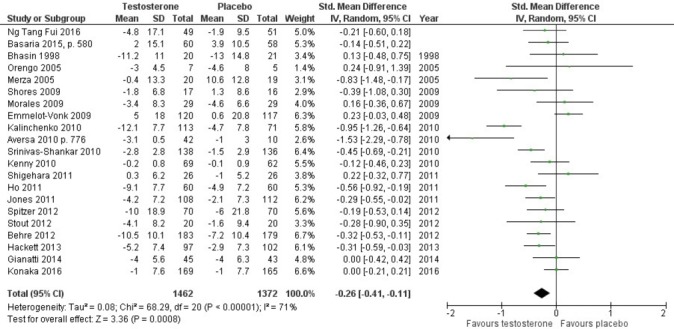
Eighty-seven RCTs and 51 NRS were included. Most were at high or unclear risk of bias, with short treatment duration and follow-up. When compared as a class against placebo, TRT improved quality of life (standardised mean difference (SMD) -0.26, 95% CI -0.41 to -0.11), libido (SMD 0.33, 95% CI 0.16 to 0.50), depression (SMD -0.23, 95% CI -0.44 to -0.01) and erectile function (SMD 0.25, 95% CI 0.10 to 0.41). Most individual TRTs were significantly better than placebo at improving libido (6/10). Only one TRT was better than placebo at improving quality of life, and no individual TRTs improved depression or erectile function. There was no increased risk of adverse events, with the exception of withdrawals due to adverse events with the use of some TRTs.
Despite a class effect of improving quality of life, depression, erectile function and libido, major improvements were not observed with the use of any individual product. We observed no statistically significant increase in the risk of adverse events; however, longer-term high-quality trials are needed to fully assess the risk of harm.
CRD42014009963.
评估性腺功能减退男性中不同睾酮产品的相对疗效。
系统评价和网状荟萃分析。
检索MEDLINE、Embase、Cochrane CENTRAL以及灰色文献(2017年5月25日),查找涉及接受睾酮替代疗法(TRT)≥3个月的性腺功能减退男性的随机对照试验(RCT)和非随机研究(NRS)。对照为安慰剂、另一种TRT或不同剂量的同一产品。结局指标包括生活质量、抑郁、性欲、勃起功能、日常生活活动能力和睾酮水平,以及心血管死亡、心肌梗死、中风、前列腺癌、心脏病、糖尿病、严重不良事件、因不良事件退出研究和红细胞增多症。通过荟萃分析和网状荟萃分析汇总RCT数据。使用Cochrane偏倚风险工具(RCT)和苏格兰校际指南网络(SIGN)50(NRS)评估偏倚风险。
纳入87项RCT和51项NRS。大多数研究存在高偏倚风险或偏倚风险不明确,治疗持续时间和随访时间较短。与安慰剂作为一组进行比较时,TRT改善了生活质量(标准化均数差(SMD)-0.26,95%CI -0.41至-0.11)、性欲(SMD 0.33,95%CI 0.16至0.50)、抑郁(SMD -0.23,95%CI -0.44至-0.01)和勃起功能(SMD 0.25,95%CI 0.10至0.41)。大多数个体TRT在改善性欲方面显著优于安慰剂(6/10)。只有一种TRT在改善生活质量方面优于安慰剂,没有个体TRT能改善抑郁或勃起功能。除了使用某些TRT因不良事件导致退出研究外,不良事件风险没有增加。
尽管在改善生活质量、抑郁、勃起功能和性欲方面有总体效果,但使用任何单个产品均未观察到显著改善。我们未观察到不良事件风险有统计学意义的增加;然而,需要长期高质量试验来全面评估危害风险。
PROSPERO注册号:CRD42014009963。