• 文献检索
  • 文档翻译
  • 深度研究
  • 学术资讯
  • Suppr Zotero 插件Zotero 插件
  • 邀请有礼
  • 套餐&价格
  • 历史记录
应用&插件
Suppr Zotero 插件Zotero 插件浏览器插件Mac 客户端Windows 客户端微信小程序
定价
高级版会员购买积分包购买API积分包
服务
文献检索文档翻译深度研究API 文档MCP 服务
关于我们
关于 Suppr公司介绍联系我们用户协议隐私条款
关注我们

Suppr 超能文献

核心技术专利:CN118964589B侵权必究
粤ICP备2023148730 号-1Suppr @ 2026

文献检索

告别复杂PubMed语法,用中文像聊天一样搜索,搜遍4000万医学文献。AI智能推荐,让科研检索更轻松。

立即免费搜索

文件翻译

保留排版,准确专业,支持PDF/Word/PPT等文件格式,支持 12+语言互译。

免费翻译文档

深度研究

AI帮你快速写综述,25分钟生成高质量综述,智能提取关键信息,辅助科研写作。

立即免费体验

新冠疫情期间美国人类活动和社会人口统计学的时空影响。

Spatiotemporal impacts of human activities and socio-demographics during the COVID-19 outbreak in the US.

机构信息

Lyles School of Civil Engineering, Purdue University, West Lafayette, USA.

Department of Civil, Construction and Environmental Engineering, The University of Alabama, Tuscaloosa, USA.

出版信息

BMC Public Health. 2022 Aug 1;22(1):1466. doi: 10.1186/s12889-022-13793-7.

DOI:10.1186/s12889-022-13793-7
PMID:35915442
原文链接:https://pmc.ncbi.nlm.nih.gov/articles/PMC9341421/
Abstract

BACKGROUND

Understanding non-epidemiological factors is essential for the surveillance and prevention of infectious diseases, and the factors are likely to vary spatially and temporally as the disease progresses. However, the impacts of these influencing factors were primarily assumed to be stationary over time and space in the existing literature. The spatiotemporal impacts of mobility-related and social-demographic factors on disease dynamics remain to be explored.

METHODS

Taking daily cases data during the coronavirus disease 2019 (COVID-19) outbreak in the US as a case study, we develop a mobility-augmented geographically and temporally weighted regression (M-GTWR) model to quantify the spatiotemporal impacts of social-demographic factors and human activities on the COVID-19 dynamics. Different from the base GTWR model, the proposed M-GTWR model incorporates a mobility-adjusted distance weight matrix where travel mobility is used in addition to the spatial adjacency to capture the correlations among local observations.

RESULTS

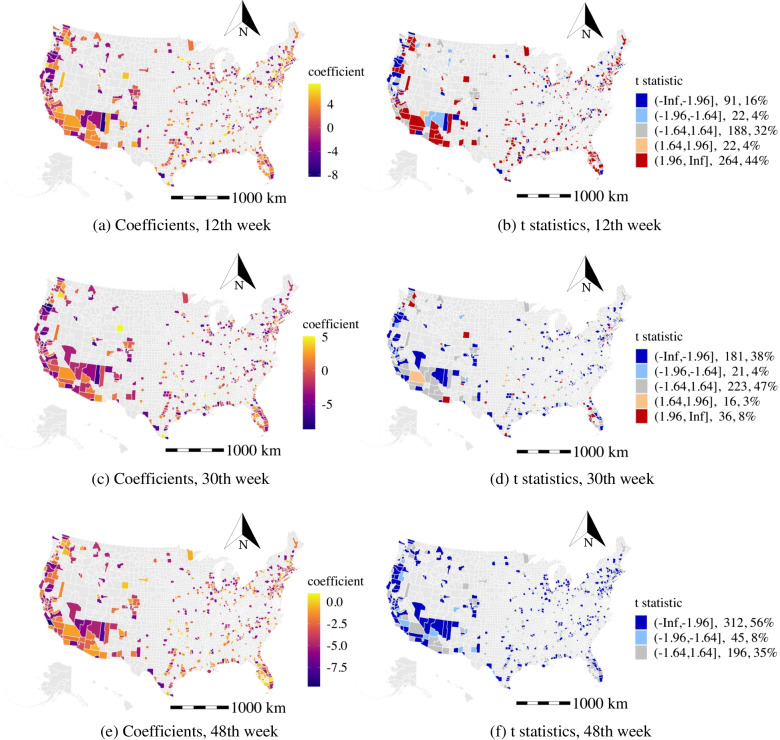
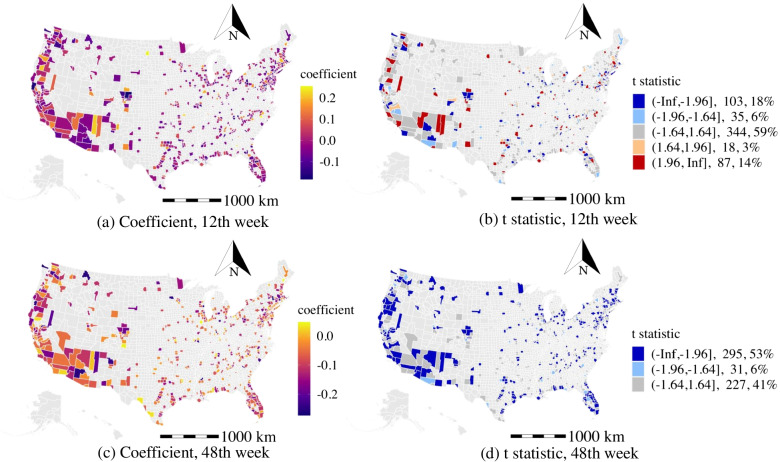
The results reveal that the impacts of social-demographic and human activity variables present significant spatiotemporal heterogeneity. In particular, a 1% increase in population density may lead to 0.63% more daily cases, and a 1% increase in the mean commuting time may result in 0.22% increases in daily cases. Although increased human activities will, in general, intensify the disease outbreak, we report that the effects of grocery and pharmacy-related activities are insignificant in areas with high population density. And activities at the workplace and public transit are found to either increase or decrease the number of cases, depending on particular locations.

CONCLUSIONS

Through a mobility-augmented spatiotemporal modeling approach, we could quantify the time and space varying impacts of non-epidemiological factors on COVID-19 cases. The results suggest that the effects of population density, socio-demographic attributes, and travel-related attributes will differ significantly depending on the time of the pandemic and the underlying location. Moreover, policy restrictions on human contact are not universally effective in preventing the spread of diseases.

摘要

背景

了解非流行病学因素对于传染病的监测和预防至关重要,并且这些因素可能随着疾病的发展在空间和时间上发生变化。然而,在现有文献中,这些影响因素的影响主要被假设为在时间和空间上是固定的。移动性相关因素和社会人口因素对疾病动态的时空影响仍有待探索。

方法

以美国 2019 年冠状病毒病(COVID-19)疫情期间的每日病例数据为例,我们开发了一种移动增强的地理和时间加权回归(M-GTWR)模型,以量化社会人口因素和人类活动对 COVID-19 动态的时空影响。与基础 GTWR 模型不同,所提出的 M-GTWR 模型包含一个经过移动调整的距离权重矩阵,其中除了空间邻接性之外,还使用出行流动性来捕捉局部观测值之间的相关性。

结果

结果表明,社会人口和人类活动变量的影响存在显著的时空异质性。具体而言,人口密度增加 1%可能导致每日病例增加 0.63%,平均通勤时间增加 1%可能导致每日病例增加 0.22%。尽管人类活动的增加通常会加剧疾病的爆发,但我们报告称,在人口密度高的地区,与杂货店和药店相关的活动的影响并不显著。并且,工作场所和公共交通的活动发现会根据特定地点的不同而增加或减少病例数。

结论

通过移动增强的时空建模方法,我们可以量化非流行病学因素对 COVID-19 病例的时变和空变影响。结果表明,人口密度、社会人口属性和与旅行相关的属性的影响在大流行的不同时间和潜在位置会有显著差异。此外,限制人类接触的政策在防止疾病传播方面并非普遍有效。

https://cdn.ncbi.nlm.nih.gov/pmc/blobs/4edb/9344639/4d95d19ea278/12889_2022_13793_Fig11_HTML.jpg
https://cdn.ncbi.nlm.nih.gov/pmc/blobs/4edb/9344639/53ca0bd4b153/12889_2022_13793_Fig1_HTML.jpg
https://cdn.ncbi.nlm.nih.gov/pmc/blobs/4edb/9344639/1a1aacd37251/12889_2022_13793_Fig2_HTML.jpg
https://cdn.ncbi.nlm.nih.gov/pmc/blobs/4edb/9344639/b9654df27744/12889_2022_13793_Fig3_HTML.jpg
https://cdn.ncbi.nlm.nih.gov/pmc/blobs/4edb/9344639/dfac1322ce8a/12889_2022_13793_Fig4_HTML.jpg
https://cdn.ncbi.nlm.nih.gov/pmc/blobs/4edb/9344639/97b9a92e679c/12889_2022_13793_Fig5_HTML.jpg
https://cdn.ncbi.nlm.nih.gov/pmc/blobs/4edb/9344639/88ad3553d45a/12889_2022_13793_Fig6_HTML.jpg
https://cdn.ncbi.nlm.nih.gov/pmc/blobs/4edb/9344639/3496e8f1f00b/12889_2022_13793_Fig7_HTML.jpg
https://cdn.ncbi.nlm.nih.gov/pmc/blobs/4edb/9344639/1e861e5cecea/12889_2022_13793_Fig8_HTML.jpg
https://cdn.ncbi.nlm.nih.gov/pmc/blobs/4edb/9344639/bcdf0e07ad04/12889_2022_13793_Fig9_HTML.jpg
https://cdn.ncbi.nlm.nih.gov/pmc/blobs/4edb/9344639/d18d43331b6a/12889_2022_13793_Fig10_HTML.jpg
https://cdn.ncbi.nlm.nih.gov/pmc/blobs/4edb/9344639/4d95d19ea278/12889_2022_13793_Fig11_HTML.jpg
https://cdn.ncbi.nlm.nih.gov/pmc/blobs/4edb/9344639/53ca0bd4b153/12889_2022_13793_Fig1_HTML.jpg
https://cdn.ncbi.nlm.nih.gov/pmc/blobs/4edb/9344639/1a1aacd37251/12889_2022_13793_Fig2_HTML.jpg
https://cdn.ncbi.nlm.nih.gov/pmc/blobs/4edb/9344639/b9654df27744/12889_2022_13793_Fig3_HTML.jpg
https://cdn.ncbi.nlm.nih.gov/pmc/blobs/4edb/9344639/dfac1322ce8a/12889_2022_13793_Fig4_HTML.jpg
https://cdn.ncbi.nlm.nih.gov/pmc/blobs/4edb/9344639/97b9a92e679c/12889_2022_13793_Fig5_HTML.jpg
https://cdn.ncbi.nlm.nih.gov/pmc/blobs/4edb/9344639/88ad3553d45a/12889_2022_13793_Fig6_HTML.jpg
https://cdn.ncbi.nlm.nih.gov/pmc/blobs/4edb/9344639/3496e8f1f00b/12889_2022_13793_Fig7_HTML.jpg
https://cdn.ncbi.nlm.nih.gov/pmc/blobs/4edb/9344639/1e861e5cecea/12889_2022_13793_Fig8_HTML.jpg
https://cdn.ncbi.nlm.nih.gov/pmc/blobs/4edb/9344639/bcdf0e07ad04/12889_2022_13793_Fig9_HTML.jpg
https://cdn.ncbi.nlm.nih.gov/pmc/blobs/4edb/9344639/d18d43331b6a/12889_2022_13793_Fig10_HTML.jpg
https://cdn.ncbi.nlm.nih.gov/pmc/blobs/4edb/9344639/4d95d19ea278/12889_2022_13793_Fig11_HTML.jpg

相似文献

1
Spatiotemporal impacts of human activities and socio-demographics during the COVID-19 outbreak in the US.新冠疫情期间美国人类活动和社会人口统计学的时空影响。
BMC Public Health. 2022 Aug 1;22(1):1466. doi: 10.1186/s12889-022-13793-7.
2
COVID-19 spread prediction using socio-demographic and mobility-related data.利用社会人口学和流动性相关数据预测新冠病毒疾病(COVID-19)的传播
Cities. 2023 Jul;138:104360. doi: 10.1016/j.cities.2023.104360. Epub 2023 May 4.
3
Modeling the Spatiotemporal Association Between COVID-19 Transmission and Population Mobility Using Geographically and Temporally Weighted Regression.使用地理和时间加权回归对COVID-19传播与人口流动之间的时空关联进行建模。
Geohealth. 2021 May 1;5(5):e2021GH000402. doi: 10.1029/2021GH000402. eCollection 2021 May.
4
Travel-related control measures to contain the COVID-19 pandemic: a rapid review.旅行相关的控制措施以遏制 COVID-19 大流行:快速综述。
Cochrane Database Syst Rev. 2020 Oct 5;10:CD013717. doi: 10.1002/14651858.CD013717.
5
Folic acid supplementation and malaria susceptibility and severity among people taking antifolate antimalarial drugs in endemic areas.在流行地区,服用抗叶酸抗疟药物的人群中,叶酸补充剂与疟疾易感性和严重程度的关系。
Cochrane Database Syst Rev. 2022 Feb 1;2(2022):CD014217. doi: 10.1002/14651858.CD014217.
6
Impact of Human Mobility on COVID-19 Transmission According to Mobility Distance, Location, and Demographic Factors in the Greater Bay Area of China: Population-Based Study.基于中国大湾区人口的移动距离、地点和人口统计因素的人类流动对 COVID-19 传播的影响:基于人群的研究。
JMIR Public Health Surveill. 2023 Apr 26;9:e39588. doi: 10.2196/39588.
7
Exploration of spatiotemporal heterogeneity and socio-demographic determinants on COVID-19 incidence rates in Sarawak, Malaysia.探讨马来西亚砂拉越州 COVID-19 发病率的时空异质性和社会人口统计学决定因素。
BMC Public Health. 2023 Jul 20;23(1):1396. doi: 10.1186/s12889-023-16300-8.
8
A Novel Predictor for Micro-Scale COVID-19 Risk Modeling: An Empirical Study from a Spatiotemporal Perspective.一种新型的 COVID-19 微观风险建模预测因子:基于时空视角的实证研究。
Int J Environ Res Public Health. 2021 Dec 16;18(24):13294. doi: 10.3390/ijerph182413294.
9
Exploring spatio-temporal impact of COVID-19 on citywide taxi demand: A case study of New York City.探究 COVID-19 对全市出租车需求的时空影响:以纽约市为例。
PLoS One. 2024 Apr 16;19(4):e0299093. doi: 10.1371/journal.pone.0299093. eCollection 2024.
10
Revealing associations between spatial time series trends of COVID-19 incidence and human mobility: an analysis of bidirectionality and spatiotemporal heterogeneity.揭示 COVID-19 发病率的空间时间序列趋势与人类流动性之间的关联:双向性和时空异质性分析。
Int J Health Geogr. 2023 Nov 27;22(1):33. doi: 10.1186/s12942-023-00357-0.

引用本文的文献

1
Spatiotemporal effect of internet use on life expectancy: cross-country insight from a geographically and temporally weighted analysis.互联网使用对预期寿命的时空效应:基于地理和时间加权分析的跨国洞察
BMC Public Health. 2025 Feb 11;25(1):569. doi: 10.1186/s12889-025-21760-1.
2
The impact of COVID-19 vaccination rate on traffic recovery.新冠疫苗接种率对交通复苏的影响。
Sci Rep. 2024 Sep 27;14(1):22066. doi: 10.1038/s41598-024-73448-y.
3
Investigating the effects of vaccine on COVID-19 disease propagation using a Bayesian approach.

本文引用的文献

1
Impact of the COVID-19 lockdown on air quality in the Delhi Metropolitan Region.新冠疫情封锁对德里大都市区空气质量的影响。
Appl Geogr. 2021 Mar;128:102418. doi: 10.1016/j.apgeog.2021.102418. Epub 2021 Mar 1.
2
Lockdowned: Everyday mobility changes in response to COVID-19.封锁之下:新冠疫情引发的日常出行变化
J Transp Geogr. 2021 Jan;90:102906. doi: 10.1016/j.jtrangeo.2020.102906. Epub 2020 Nov 11.
3
The Epidemiological Characteristics of an Outbreak of 2019 Novel Coronavirus Diseases (COVID-19) - China, 2020.2019新型冠状病毒病(COVID-19)疫情的流行病学特征 - 中国,2020年
采用贝叶斯方法研究疫苗对 COVID-19 疾病传播的影响。
Sci Rep. 2023 Aug 17;13(1):13374. doi: 10.1038/s41598-023-37972-7.
4
COVID-19 spread prediction using socio-demographic and mobility-related data.利用社会人口学和流动性相关数据预测新冠病毒疾病(COVID-19)的传播
Cities. 2023 Jul;138:104360. doi: 10.1016/j.cities.2023.104360. Epub 2023 May 4.
5
Power of Digital Economy to Drive Urban-Rural Integration: Intrinsic Mechanism and Spatial Effect, from Perspective of Multidimensional Integration.数字经济驱动城乡融合发展的多维协同效应与空间溢出效应研究
Int J Environ Res Public Health. 2022 Nov 22;19(23):15459. doi: 10.3390/ijerph192315459.
6
Global Distribution, Dispersal Patterns, and Trend of Several Omicron Subvariants of SARS-CoV-2 across the Globe.严重急性呼吸综合征冠状病毒2(SARS-CoV-2)几种奥密克戎亚变体在全球的分布、传播模式及趋势
Trop Med Infect Dis. 2022 Nov 12;7(11):373. doi: 10.3390/tropicalmed7110373.
China CDC Wkly. 2020 Feb 21;2(8):113-122.
4
Social media use informing behaviours related to physical activity, diet and quality of life during COVID-19: a mixed methods study.社交媒体在 COVID-19 期间对与身体活动、饮食和生活质量相关的行为的影响:一项混合方法研究。
BMC Public Health. 2021 Jul 6;21(1):1333. doi: 10.1186/s12889-021-11398-0.
5
Reduced level of physical activity during COVID-19 pandemic is associated with depression and anxiety levels: an internet-based survey.在 COVID-19 大流行期间,体力活动减少与抑郁和焦虑水平有关:一项基于互联网的调查。
BMC Public Health. 2021 Mar 1;21(1):425. doi: 10.1186/s12889-021-10470-z.
6
Scaling of contact networks for epidemic spreading in urban transit systems.城市交通系统中用于疫情传播的接触网络缩放
Sci Rep. 2021 Feb 23;11(1):4408. doi: 10.1038/s41598-021-83878-7.
7
Early perceptions and behavioural responses during the COVID-19 pandemic: a cross-sectional survey of UK adults.新冠疫情期间的早期认知与行为反应:一项针对英国成年人的横断面调查
BMJ Open. 2021 Jan 4;11(1):e043577. doi: 10.1136/bmjopen-2020-043577.
8
Racial Segregation, Testing Site Access, and COVID-19 Incidence Rate in Massachusetts, USA.美国马萨诸塞州的种族隔离、检测点可及性与 COVID-19 发病率
Int J Environ Res Public Health. 2020 Dec 19;17(24):9528. doi: 10.3390/ijerph17249528.
9
Non-compulsory measures sufficiently reduced human mobility in Tokyo during the COVID-19 epidemic.非强制性措施在 COVID-19 疫情期间极大地降低了东京的人员流动性。
Sci Rep. 2020 Oct 22;10(1):18053. doi: 10.1038/s41598-020-75033-5.
10
Associations between phone mobility data and COVID-19 cases.手机移动数据与新冠肺炎病例之间的关联。
Lancet Infect Dis. 2021 May;21(5):e111. doi: 10.1016/S1473-3099(20)30725-8. Epub 2020 Sep 15.