Key Laboratory of Shaanxi Province for Craniofacial Precision Medicine Research, Clinical Research Center of Shaanxi Province for Dental and Maxillofacial Diseases, College of Stomatology, Xi'an Jiaotong University, Xi'an, 710004, Shaanxi, People's Republic of China.
Department of Orthodontics, Xi'an Jiaotong University, Xi'an, People's Republic of China.
BMC Oral Health. 2022 Aug 1;22(1):320. doi: 10.1186/s12903-022-02355-3.
This study aimed to investigate whether the subjects with mouth breathing (MB) or nasal breathing (NB) with different sagittal skeletal patterns showed different maxillary arch and pharyngeal airway characteristics.
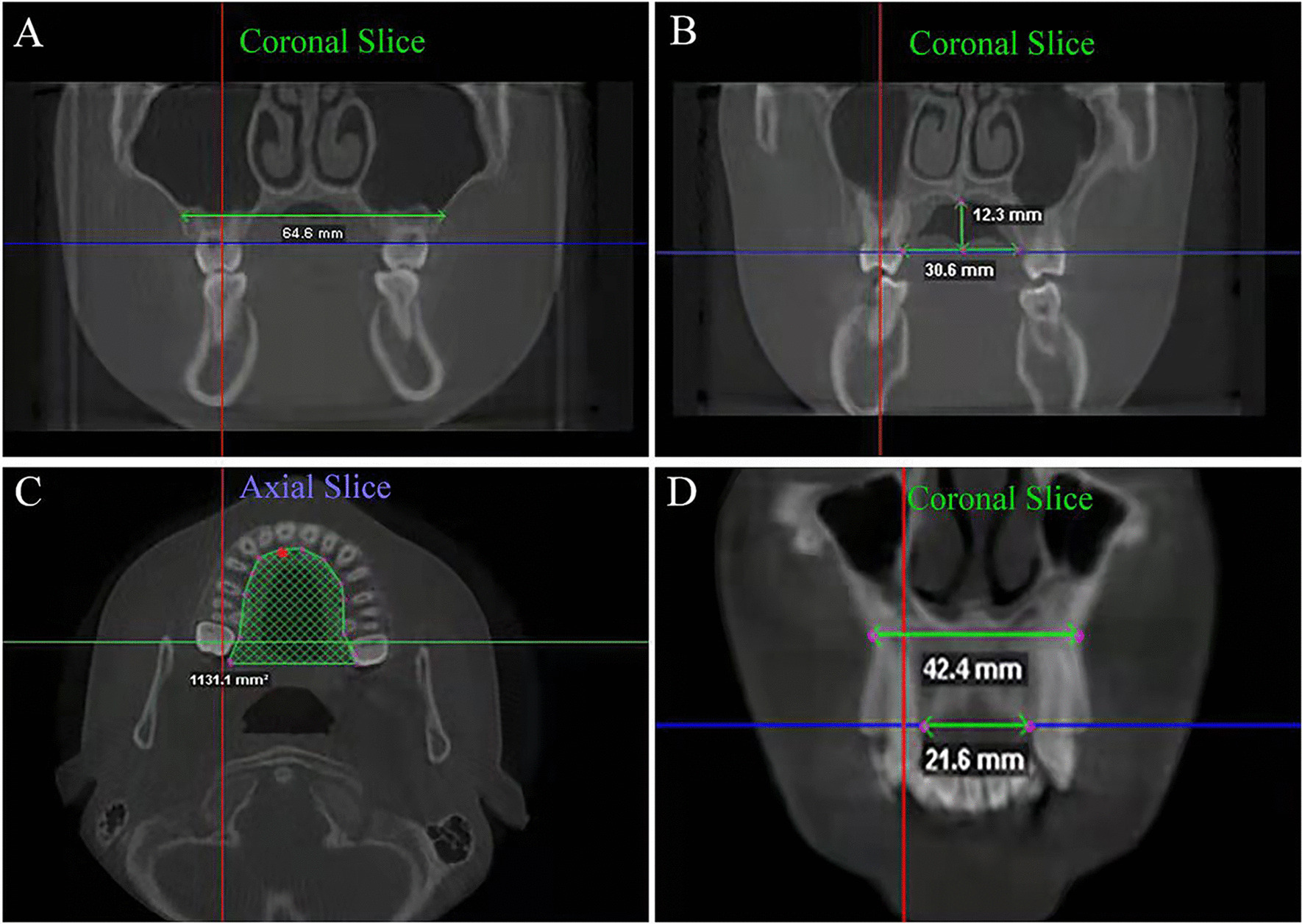
Cone-beam computed tomography scans from 70 children aged 10 to 12 years with sagittal skeletal Classes I and II were used to measure the pharyngeal airway, maxillary width, palatal area, and height. The independent t-test and the Mann-Whitney U test were used for the intragroup analysis of pharyngeal airway and maxillary arch parameters.
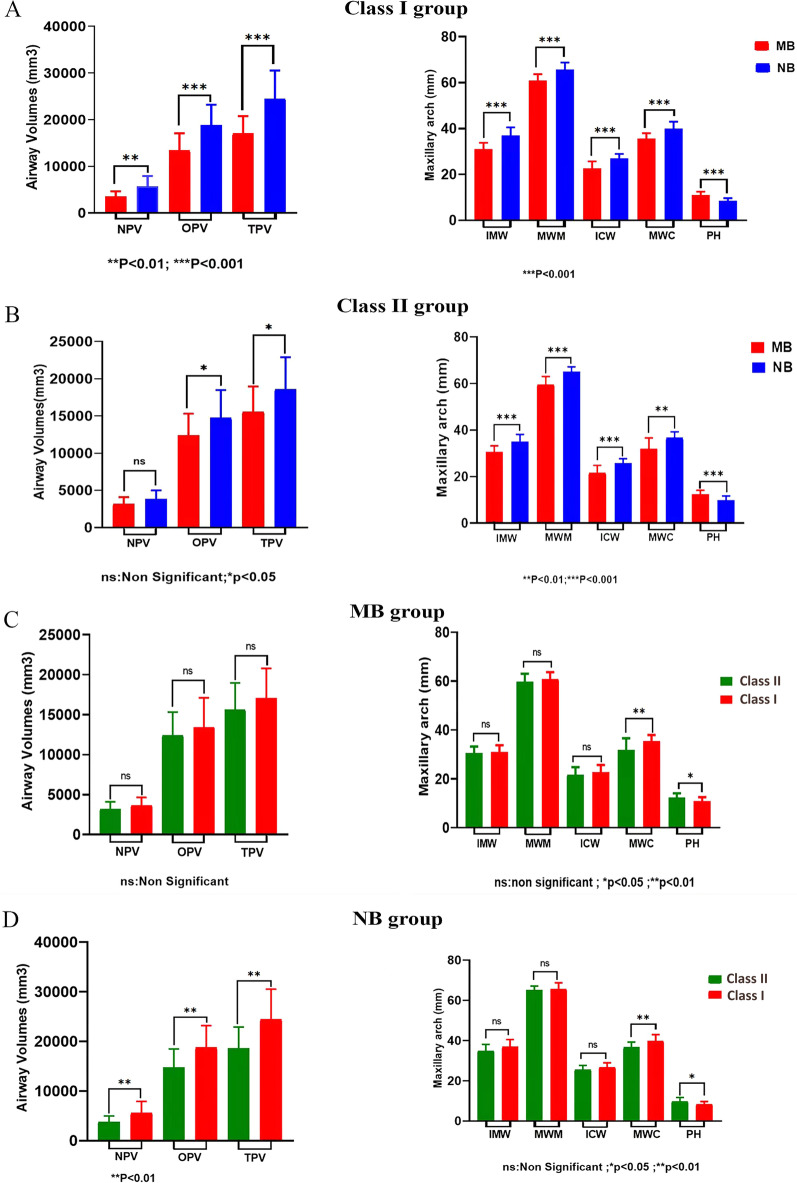
In the Skeletal Class I group, nasopharyngeal airway volume (P < 0.01), oropharyngeal airway volume (OPV), and total pharyngeal airway volume (TPV) (all P < 0.001) were significantly greater in subjects with NB than in those with MB. Furthermore, intermolar width, maxillary width at the molars, intercanine width, maxillary width at the canines, and palatal area were significantly larger in subjects with NB than in those with MB (all P < 0.001). In the Skeletal Class II group, OPV, TPV (both P < 0.05) were significantly greater in subjects with NB than in those with MB. No significant differences in pharyngeal airway parameters in the MB group between subjects with Skeletal Class I and those with Skeletal Class II.
Regardless of sagittal Skeletal Class I or II, the pharyngeal airway and maxillary arch in children with MB differ from those with NB. However, the pharyngeal airway was not significantly different between Skeletal Class I and II in children with MB.
本研究旨在探讨口呼吸(MB)或鼻呼吸(NB)的受试者在不同矢状骨型中是否表现出不同的上颌弓和咽气道特征。
使用 70 名 10 至 12 岁、矢状骨型为 I 类和 II 类的儿童的锥形束 CT 扫描来测量咽气道、上颌宽度、腭区和高度。采用独立 t 检验和曼-惠特尼 U 检验对内组咽气道和上颌弓参数进行分析。
在骨骼 I 类组中,NB 组的鼻咽气道容积(P<0.01)、口咽气道容积(OPV)和总咽气道容积(TPV)均显著大于 MB 组(均 P<0.001)。此外,NB 组的尖牙间宽度、磨牙上颌宽度、尖牙间宽度、尖牙上颌宽度和腭区均显著大于 MB 组(均 P<0.001)。在骨骼 II 类组中,NB 组的 OPV 和 TPV 均显著大于 MB 组(均 P<0.05)。MB 组中骨骼 I 类和骨骼 II 类患者的咽气道参数无显著差异。
无论矢状骨 I 类或 II 类,MB 患者的咽气道和上颌弓与 NB 患者不同。然而,MB 患者的骨骼 I 类和 II 类之间咽气道无显著差异。