School of Physical Education and Sports, Rashtriya Raksha University, Gandhinagar, India.
Exercise and Rehabilitation Sciences Laboratory, School of Physical Therapy, Faculty of Rehabilitation Sciences, Universidad Andres Bello, Santiago, Chile.
PeerJ. 2022 Jul 27;10:e13791. doi: 10.7717/peerj.13791. eCollection 2022.
Running as exercise may be performed either on an outdoor surface or treadmill surface. However, previous research has indicated that the nature of both the surfaces differ significantly and therefore the training outcomes from running in these surfaces may also vary.
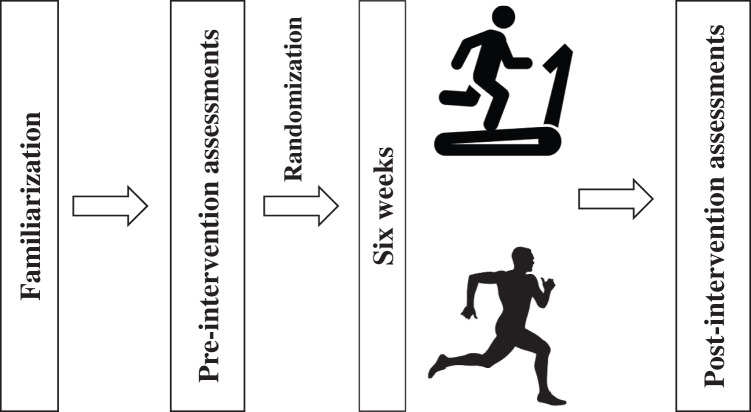
Therefore, the aim of this pilot study was to compare the effects of 6-weeks of supervised outdoor running (OT) treadmill running (TT) on physical fitness and body composition in recreationally active young males.
Participants (age: 19.82 ± 1.28 years, height: 172.6 ± 4.9 cm, body mass: 64.3 ± 8.7 kg) were randomly assigned to OT ( = 14) or TT ( = 14), and assessed for physical fitness, ., 50 m sprint, cardiorespiratory endurance (., 1,600 m run time-trial), standing long jump (SLJ), flexibility (., sit-and-reach test), and upper-body muscle endurance (., push-ups repetitions), alongside body composition, ., body mass, body mass index (BMI), fat percentage, fat free mass, and leg skeletal muscle mass (SMM). A two (pre-post intervention) by two (OT, TT) mixed ANOVA analysed exercise-specific effects. For significant group-by-time interactions, Bonferroni adjusted paired (within-group) and independent (between-group comparisons at post) t-tests were used for post-hoc analyses.
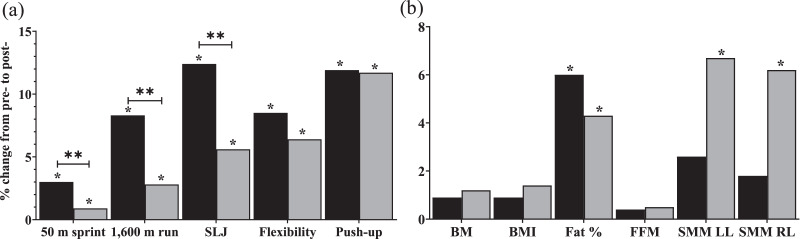
Significant time-effect was found in all physical fitness variables (all < 0.001, η = 0.67-0.91), body mass ( = 0.23, η = 0.18), BMI ( = 0.009, η = 0.24), body fat percentage ( = 0.001, η = 0.38), and leg SMM ( = 0.002-0.007, η = 0.25-0.33). Significant group-by-time interaction was found for 50 m sprint ( = < 0.001, η = 0.74), 1,600 m run ( = 0.001, η = 0.35), and SLJ ( < 0.001, η = 0.43), favouring OT. Group-specific post-hoc tests showed improvements in all physical fitness variables after OT ( = < 0.001-0.001, = 0.69-2.32, %Δ = 3.0-12.4) and TT ( = < 0.001-0.017, = 0.15-0.65, %Δ = 0.9-11.7), and fat percentage after OT and TT ( = 0.002-0.041, g = 0.14-0.26, %Δ = 4.3-6.0). However, leg SMM decreased in TT ( = 0.001-0.004, g = 0.14-0.15, %Δ = 6.2-6.7).
Both OT and TT improved physical fitness and decreased fat percentage. However, compared to TT, the OT intervention preserved leg SMM and induced greater physical fitness improvements.
跑步作为一种运动,可以在户外或跑步机上进行。然而,之前的研究表明,这两种表面的性质有很大的不同,因此在这些表面上进行的训练结果也可能不同。
因此,本初步研究的目的是比较 6 周监督下的户外跑步(OT)和跑步机跑步(TT)对有规律的年轻男性的身体素质和身体成分的影响。
参与者(年龄:19.82 ± 1.28 岁,身高:172.6 ± 4.9 cm,体重:64.3 ± 8.7 kg)被随机分配到 OT(n = 14)或 TT(n = 14)组,并评估身体素质、50 米短跑、心肺耐力(1600 米跑步时间试验)、立定跳远(SLJ)、柔韧性(坐立前屈测试)和上肢肌肉耐力(俯卧撑次数),以及身体成分,包括体重、体重指数(BMI)、体脂百分比、去脂体重、腿部骨骼肌质量(SMM)。采用双(前后干预)×双(OT、TT)混合方差分析评估运动特异性效应。对于显著的组间时间交互作用,采用 Bonferroni 调整后的配对(组内)和独立(组间比较在干预后)t 检验进行事后分析。
所有身体素质变量(均 < 0.001,η = 0.67-0.91)、体重( = 0.23,η = 0.18)、BMI( = 0.009,η = 0.24)、体脂百分比( = 0.001,η = 0.38)和腿部 SMM( = 0.002-0.007,η = 0.25-0.33)均出现显著的时间效应。50 米短跑( = < 0.001,η = 0.74)、1600 米跑步( = 0.001,η = 0.35)和 SLJ( < 0.001,η = 0.43)出现显著的组间时间交互作用,OT 组更有利。OT 组和 TT 组的特定组间事后检验显示,所有身体素质变量均有改善(均 < 0.001-0.001, = 0.69-2.32,%Δ = 3.0-12.4)和 TT( = < 0.001-0.017, = 0.15-0.65,%Δ = 0.9-11.7),以及 OT 和 TT 后体脂百分比下降( = 0.002-0.041,g = 0.14-0.26,%Δ = 4.3-6.0)。然而,TT 组腿部 SMM 下降( = 0.001-0.004,g = 0.14-0.15,%Δ = 6.2-6.7)。
OT 和 TT 都提高了身体素质并降低了体脂百分比。然而,与 TT 相比,OT 干预保留了腿部 SMM,并诱导了更大的身体素质改善。