Medical Research Council Clinical Trials Unit at University College London, London, UK.
Intensive Care National Audit and Research Centre, London, UK.
Trop Med Int Health. 2022 Sep;27(9):767-775. doi: 10.1111/tmi.13803. Epub 2022 Aug 21.
Malaria is one of the most important parasitic infectious diseases worldwide. Despite the scale-up of effective antimalarials, mortality rates from severe malaria (SM) remain significantly high; thus, numerous trials are investigating both antimalarials and adjunctive therapy. This review aimed to summarise all the outcome measures used in trials in the last 10 years to see the need for a core outcome set.
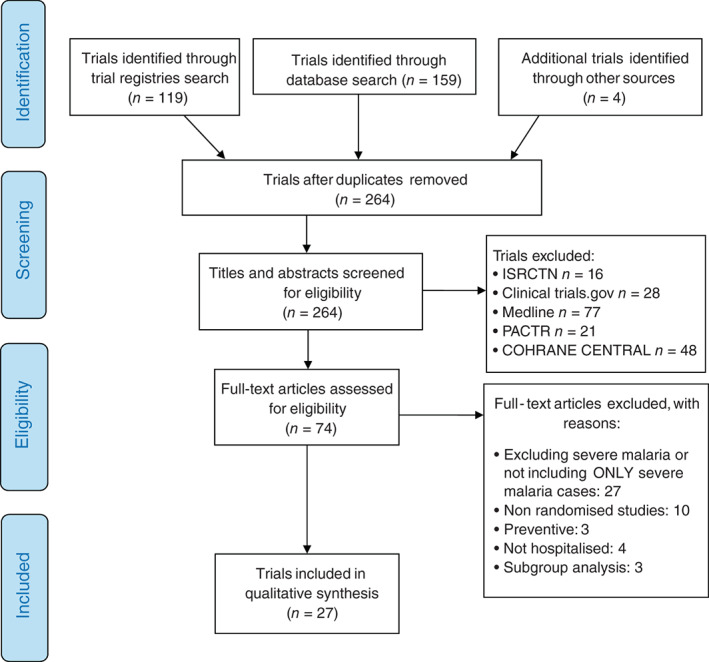
A systematic review was undertaken to summarise outcomes of individually randomised trials assessing treatments for SM in adults and children. We searched key databases and trial registries between 1 January 2010 and 30 July 2020. Non-randomised trials were excluded to allow comparison of similar trials. Trial characteristics including phase, region, population, interventions, were summarised. All primary and secondary outcomes were extracted and categorised using a taxonomy table.
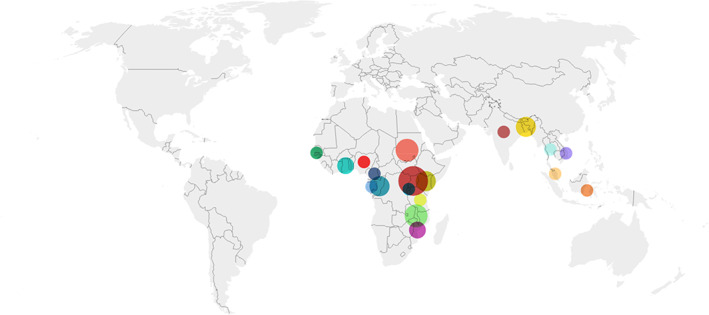
Twenty-seven of 282 screened trials met our inclusion criteria, including 10,342 patients from 19 countries: 19 (70%) trials from Africa and 8 (30%) from Asia. A large amount of heterogeneity was observed in the selection of outcomes and instruments, with 101 different outcomes measures recorded, 78/101 reported only in a single trial. Parasitological outcomes (17 studies), neurological status (14 studies), death (14 studies) and temperature (10 studies), were the most reported outcomes. Where an outcome was reported in >1 study it was often measured differently: temperature (4 different measures), renal function (7 measures), nervous system (13 measures) and parasitology (10 measures).
Outcomes used in SM trials are inconsistent and heterogeneous. Absence of consensus for outcome measures used impedes research synthesis and comparability of different interventions. This systematic review demonstrates the need to develop a standardised collection of core outcomes for clinical trials of treatments for SM and next steps to include the development of a panel of experts in the field, a Delphi process, and a consensus meeting.
疟疾是全球最重要的寄生虫传染病之一。尽管抗疟药物的规模不断扩大,但重症疟疾(SM)的死亡率仍然很高;因此,许多试验正在同时研究抗疟药物和辅助治疗。本综述旨在总结过去 10 年中所有用于评估成人和儿童 SM 治疗的试验的结局指标,以了解是否需要制定一个核心结局集。
我们进行了一项系统综述,以总结评估成人和儿童 SM 治疗的个体随机试验的结局。我们在 2010 年 1 月 1 日至 2020 年 7 月 30 日期间在主要数据库和试验注册处进行了检索。排除非随机试验以允许对类似试验进行比较。总结了试验特征,包括阶段、区域、人群、干预措施。使用分类表提取并分类所有主要和次要结局。
筛选出的 282 项试验中,有 27 项符合纳入标准,包括来自 19 个国家的 10342 名患者:19 项(70%)来自非洲,8 项(30%)来自亚洲。在结局和工具的选择上存在大量异质性,共记录了 101 种不同的结局测量方法,其中 78/101 仅在一项试验中报告。寄生虫学结局(17 项研究)、神经状态(14 项研究)、死亡(14 项研究)和体温(10 项研究)是最常报告的结局。在多项研究中报告的结局往往测量方法不同:体温(4 种不同的测量方法)、肾功能(7 种测量方法)、神经系统(13 种测量方法)和寄生虫学(10 种测量方法)。
SM 试验中使用的结局不一致且存在异质性。缺乏对使用的结局测量方法的共识,阻碍了研究综合和不同干预措施的可比性。这项系统综述表明,需要为 SM 治疗的临床试验制定一个标准化的核心结局集,并采取下一步措施,包括在该领域的专家小组、德尔菲法和共识会议中纳入发展。