Karabacak Mert, Ozkara Burak Berksu, Mordag Seren, Bisdas Sotirios
Cerrahpasa Faculty of Medicine, Istanbul University-Cerrahpasa, Cerrahpasa, Istanbul, Turkey.
Faculty of Medicine, Hacettepe University, Sihhiye, Ankara, Turkey.
Quant Imaging Med Surg. 2022 Aug;12(8):4033-4046. doi: 10.21037/qims-22-34.
Conventionally, identifying isocitrate dehydrogenase () mutation in gliomas is based on histopathological analysis of tissue specimens acquired via stereotactic biopsy or definitive resection. Accurate pre-treatment prediction of mutation status using magnetic resonance imaging (MRI) can guide clinical decision-making. We aim to evaluate the diagnostic performance of deep learning (DL) to determine mutation status in gliomas.
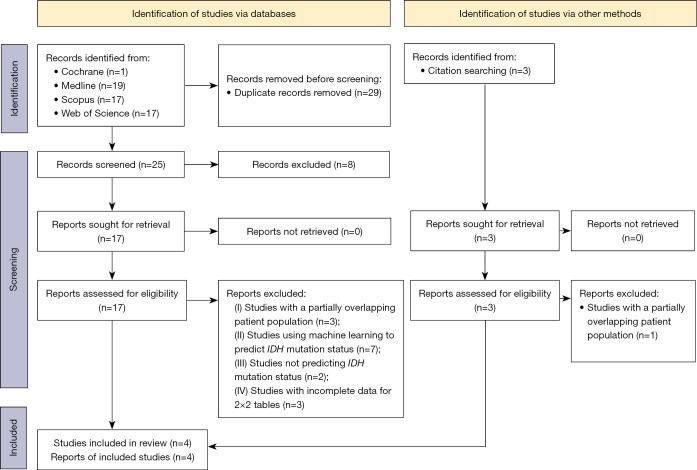
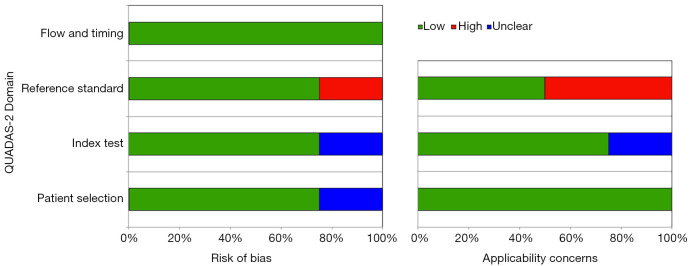
A systematic search of Cochrane Library, Web of Science, Medline, and Scopus was conducted to identify relevant publications until August 1, 2021. Articles were included if all the following criteria were met: (I) patients with histopathologically confirmed World Health Organization (WHO) grade II, III, or IV gliomas; (II) histopathological examination with the mutation; (III) DL was used to predict the mutation status; (IV) sufficient data for reconstruction of confusion matrices in terms of the diagnostic performance of the DL algorithms; and (V) original research articles. Quality Assessment of Diagnostic Accuracy Studies-2 (QUADAS-2) and Checklist for Artificial Intelligence in Medical Imaging (CLAIM) was used to assess the studies' quality. Bayes theorem was utilized to calculate the posttest probability.
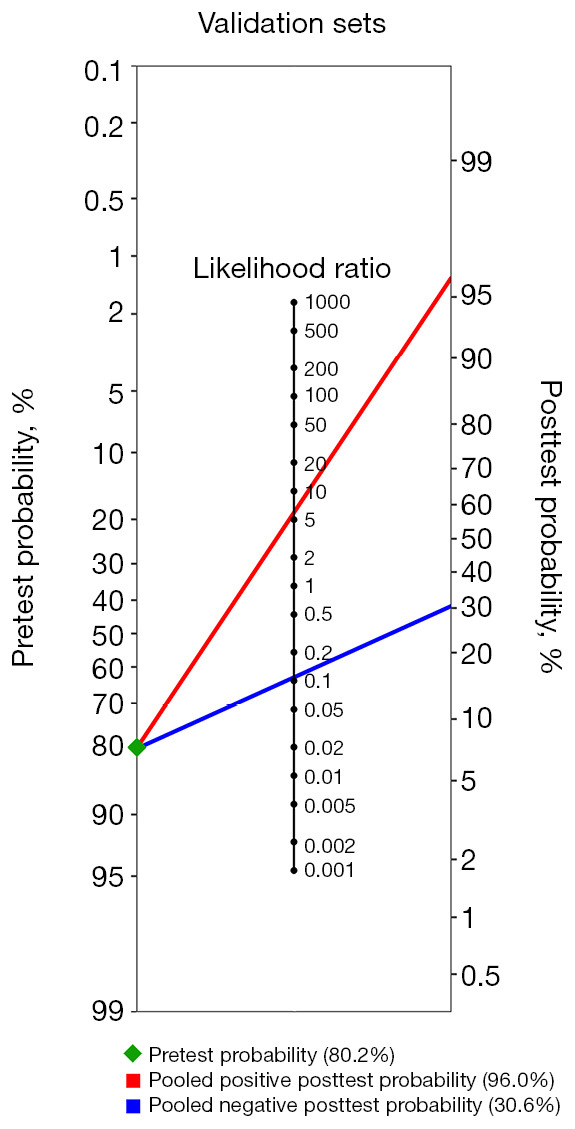
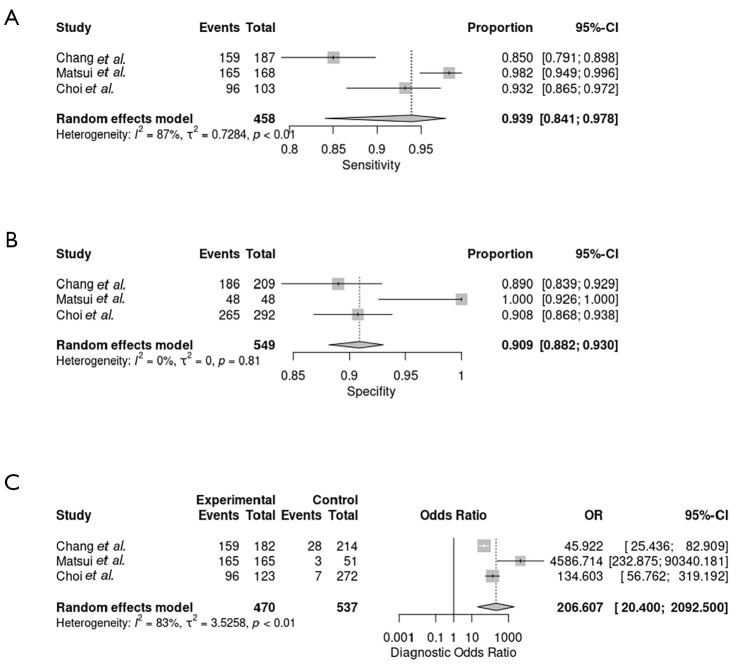
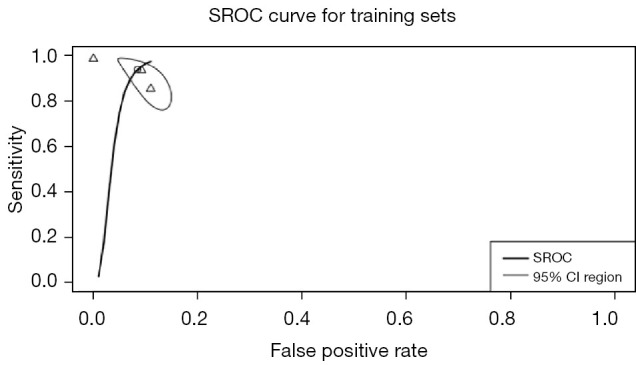
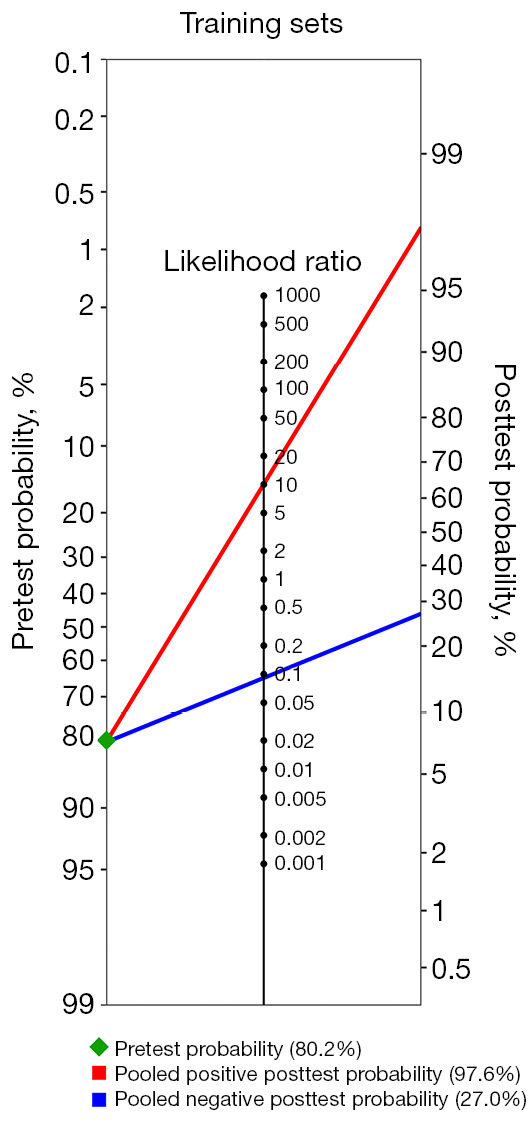
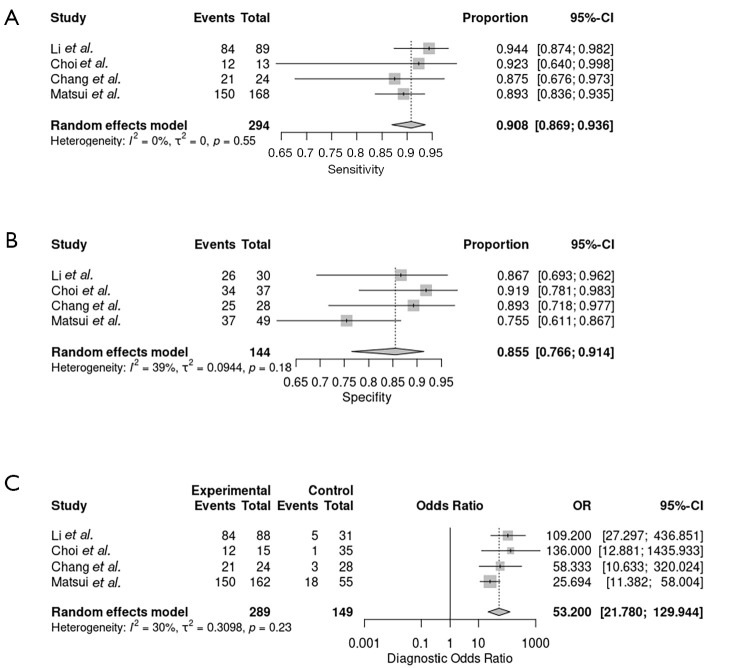
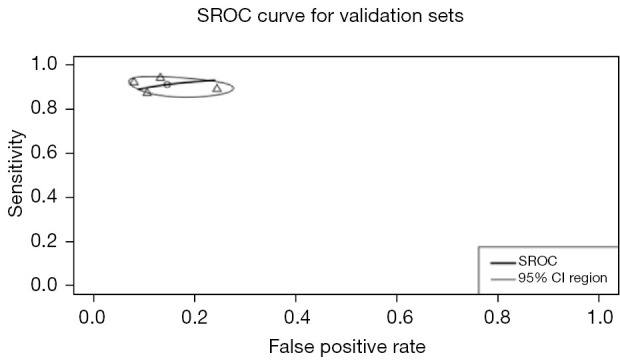
Four studies with a total of 1,295 patients were included. In the training set, the pooled sensitivity, specificity, and area under the summary receiver operating characteristic (SROC) curve were 93.9%, 90.9% and 0.958, respectively. In the validation set, the pooled sensitivity, specificity, and area under the SROC curve were 90.8%, 85.5% and 0.939, respectively. With a known pretest probability of 80.2%, the Bayes theorem yielded a posttest probability of 97.6% and 96.0% for a positive test and 27.0% and 30.6% for a negative test for training sets and validation sets, respectively.
This is the first meta-analysis that summarizes the diagnostic performance of DL in predicting mutation status in gliomas via the Bayes theorem. DL algorithms demonstrate excellent diagnostic performance in predicting mutation in gliomas. Radiomic features associated with mutation, and its underlying pathophysiology extracted from advanced MRI may improve prediction probability. However, more studies are required to optimize and increase its reliability. Limitations include obtaining some data via email and lack of training and test sets statistics.
传统上,识别胶质瘤中的异柠檬酸脱氢酶(IDH)突变是基于通过立体定向活检或根治性切除获取的组织标本的组织病理学分析。使用磁共振成像(MRI)准确预测治疗前的IDH突变状态可指导临床决策。我们旨在评估深度学习(DL)在确定胶质瘤IDH突变状态方面的诊断性能。
对Cochrane图书馆、科学网、Medline和Scopus进行系统检索,以识别截至2021年8月1日的相关出版物。如果满足以下所有标准,则纳入文章:(I)经组织病理学证实为世界卫生组织(WHO)二级、三级或四级胶质瘤的患者;(II)进行IDH突变的组织病理学检查;(III)使用DL预测IDH突变状态;(IV)就DL算法的诊断性能而言,有足够的数据重建混淆矩阵;以及(V)原始研究文章。使用诊断准确性研究质量评估-2(QUADAS-2)和医学影像人工智能检查表(CLAIM)评估研究质量。利用贝叶斯定理计算检验后概率。
纳入四项研究,共1295例患者。在训练集中,汇总敏感度、特异度和汇总受试者工作特征(SROC)曲线下面积分别为93.9%、90.9%和0.958。在验证集中,汇总敏感度、特异度和SROC曲线下面积分别为90.8%、85.5%和0.939。已知检验前概率为80.2%时,贝叶斯定理得出训练集和验证集阳性检验的检验后概率分别为97.6%和96.0%,阴性检验的检验后概率分别为27.0%和30.6%。
这是第一项通过贝叶斯定理总结DL在预测胶质瘤IDH突变状态方面诊断性能的荟萃分析。DL算法在预测胶质瘤IDH突变方面表现出优异的诊断性能。与IDH突变相关的放射组学特征及其从高级MRI中提取的潜在病理生理学可能会提高预测概率。然而,需要更多研究来优化并提高其可靠性。局限性包括通过电子邮件获取一些数据以及缺乏训练集和测试集统计数据。