Guaricci Andrea Igoren, Chiarello Giuseppina, Gherbesi Elisa, Fusini Laura, Soldato Nicolo', Siena Paola, Ursi Raffaella, Ruggieri Roberta, Guglielmo Marco, Muscogiuri Giuseppe, Baggiano Andrea, Rabbat Mark G, Memeo Riccardo, Lepera Mario, Favale Stefano, Pontone Gianluca
Department of Emergency and Organ Transplantation, University Cardiology Unit, Policlinic University Hospital, Piazza Giulio Cesare 11, Bari 70124, Italy.
Department of Clinical Sciences and Community Health, University of Milan, Milan, Italy.
Eur Heart J Open. 2022 Feb 25;2(2):oeac010. doi: 10.1093/ehjopen/oeac010. eCollection 2022 Mar.
To compare the diagnostic accuracy of speckle tracking echocardiography technique using territorial longitudinal strain (TLS) for the detection of culprit vessel vs. vessel-specific wall motion score index (WMSI) in non-ST-segment elevation-acute coronary syndrome (NSTE-ACS) patients scheduled for invasive coronary angiography (ICA).
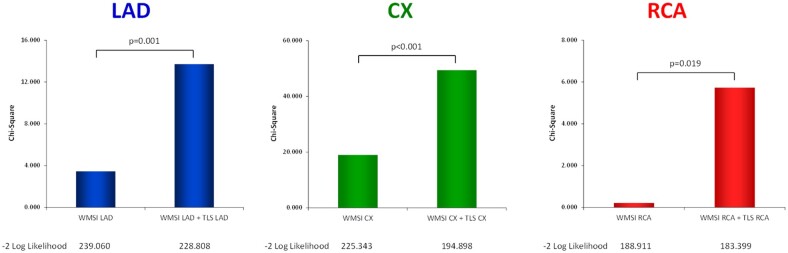
One hundred and eighty-three patients (mean age: 66 ± 12 years, male: 71%) diagnosed with NSTE-ACS underwent echocardiography evaluation at hospital admission and ICA within 24 h. Culprit vessels were left anterior descending (LAD), left circumflex (CX), and right coronary arteries (RCAs) in 38.5%, 39.6%, and 21.4%, respectively. An increase of affected vessels [1-, 2-, and 3-vessel coronary artery disease (CAD)] was associated with increased WMSI and TLS values. There was a statistically significant difference of both WMSI-LAD, WMSI-CX, WMSI-RCA and TLS-LAD, TLS-CX, TLS-RCA of myocardial segments with underlying severe CAD compared to no CAD ( = 0.001 and < 0.001, respectively). Moreover, a significant difference of TLS-LAD, TLS-CX, TLS-RCA, and WMSI-CX of myocardial segments with an underlying culprit vessel compared to non-culprit vessels ( < 0.001, < 0.001, = 0.022, and < 0.001, respectively) was identified. WMSI-LAD and WMSI-RCA did not show statistical significant differences. A regression model revealed that the combination of WMSI + TLS was more accurate compared to WMSI alone in detecting the culprit vessel (LAD, = 0.001; CX, < 0.001; and RCA, = 0.019).
Territorial longitudinal strain allows an accurate identification of the culprit vessel in NSTE-ACS patients. In addition to WMSI, TLS may be considered as part of routine echocardiography for better clinical assessment in this subset of patients.
比较在计划进行有创冠状动脉造影(ICA)的非ST段抬高型急性冠状动脉综合征(NSTE-ACS)患者中,使用区域纵向应变(TLS)的斑点追踪超声心动图技术与血管特异性壁运动评分指数(WMSI)检测罪犯血管的诊断准确性。
183例诊断为NSTE-ACS的患者(平均年龄:66±12岁,男性:71%)在入院时接受了超声心动图评估,并在24小时内进行了ICA。罪犯血管分别为左前降支(LAD)、左旋支(CX)和右冠状动脉(RCA),比例分别为38.5%、39.6%和21.4%。受累血管数量增加(单支、双支和三支冠状动脉疾病)与WMSI和TLS值升高相关。与无严重冠状动脉疾病(CAD)相比,存在潜在严重CAD的心肌节段的WMSI-LAD、WMSI-CX、WMSI-RCA以及TLS-LAD、TLS-CX、TLS-RCA均有统计学显著差异(分别为P = 0.001和P < 0.001)。此外,与非罪犯血管相比,存在潜在罪犯血管的心肌节段的TLS-LAD、TLS-CX、TLS-RCA以及WMSI-CX有显著差异(分别为P < 0.001、P < 0.001、P = 0.022和P < 0.001)。WMSI-LAD和WMSI-RCA未显示统计学显著差异。回归模型显示,在检测罪犯血管方面,WMSI + TLS组合比单独使用WMSI更准确(LAD,P = 0.001;CX,P < 0.001;RCA,P = 0.019)。
区域纵向应变能够准确识别NSTE-ACS患者中的罪犯血管。除WMSI外,TLS可被视为常规超声心动图的一部分,以便对该类患者进行更好的临床评估。