Amrani Samantha, Eveilleau Kornelia, Fassbender Verena, Obeid Hasan, Abi-Nasr Imad, Giordana Pascal, Hallab Magid, Leftheriotis Georges
University Hospital of Nice, Vascular Medicine unit, Unité de Médecine et d'Explorations Vasculaires, CHU de Nice Pasteur 1, 30 voie Romaine Nice, France.
Clinique Bizet, Cardiology unit, Paris, France.
Eur Heart J Open. 2022 Apr 28;2(3):oeac032. doi: 10.1093/ehjopen/oeac032. eCollection 2022 May.
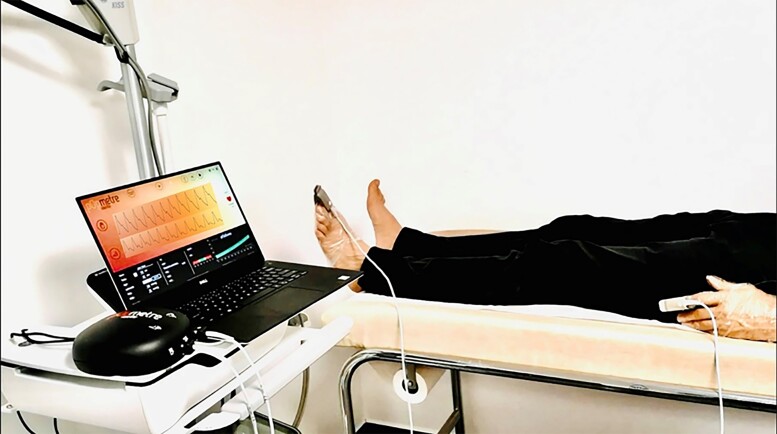
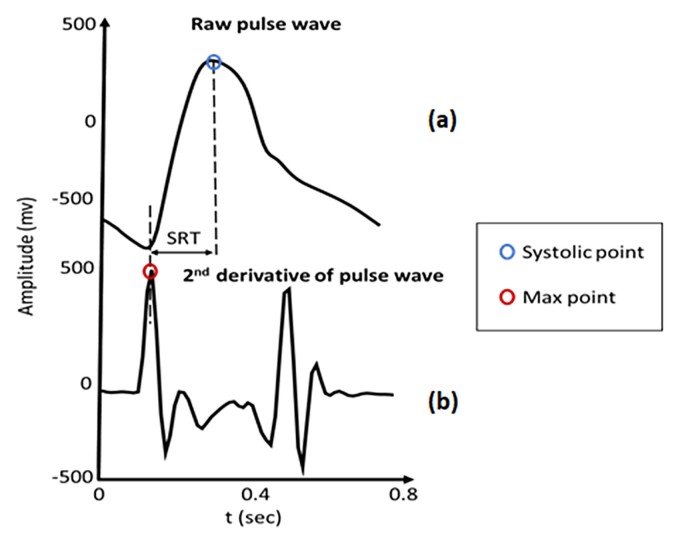
Peripheral arterial disease (PAD) is a major public health burden requiring more intensive population screening. Ankle brachial index (ABI) using arm and ankle cuffs is considered as the reference method for the detection of PAD. Although it requires a rigorous methodology by trained operators, it remains time-consuming and more technically difficult in patients with diabetes due to mediacalcosis. Techniques based on the study of hemodynamic, such as the systolic rise time (SRT), appear promising but need to be validated. We retrospectively compared the reliability and accuracy of SRT using a photoplethysmography (PPG) technique to the SRT measured by ultrasound doppler (UD) in PAD patients diagnosed with the ABI (137 patients, 200 lower limbs).
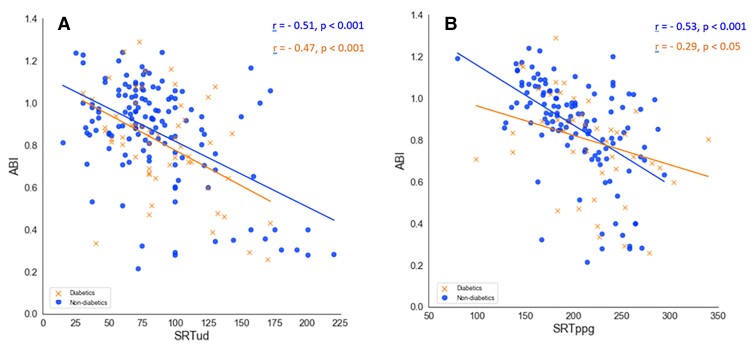
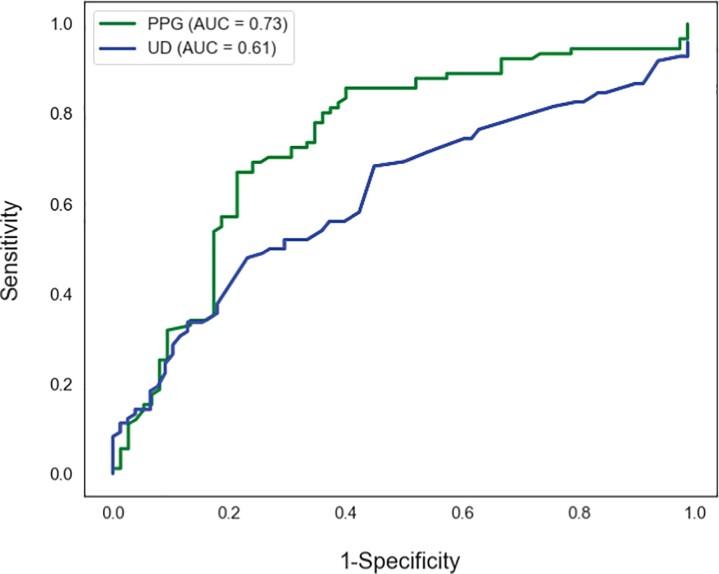
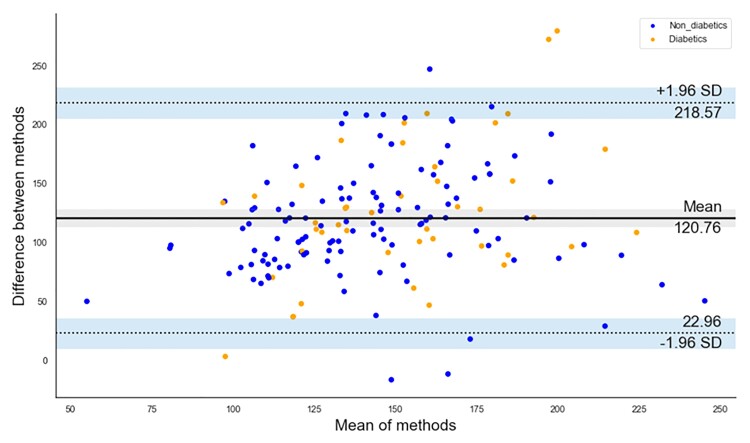
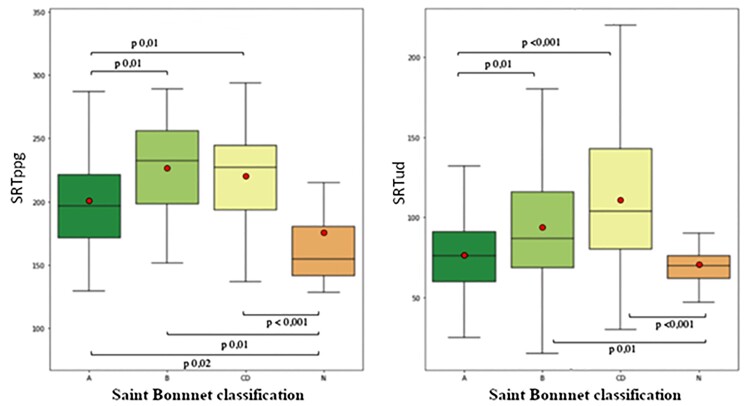
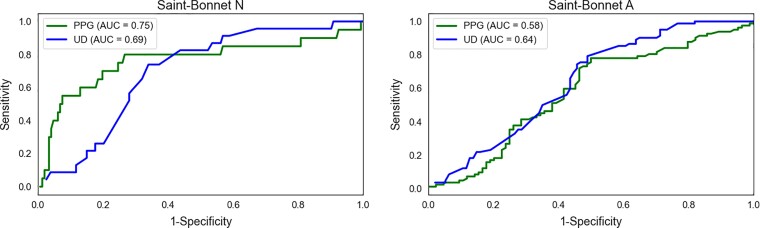
There was a significant correlation between SRT measured with UD (SRTud) compared with that with PPG (SRTppg, = 0.25; = 0.001). Best correlation was found in patients without diabetes ( = 0.40; = 0.001). Bland and Altman analysis showed a good agreement between the SRTud and SRTppg. In contrast, there was no significant correlation between UD and PPG in diabetes patients. Furthermore, patients with diabetes exhibited a significant increase of SRTppg ( = 0.02) compared with patients without diabates but not with the SRTud ( = 0.18). The SRTppg was significantly linked to the arterial velocity waveforms, the type of arterial lesion but not vascular surgery revascularization technique.
This monocentric pilot study shows that SRT measured with the PPG signal reliably correlates with SRT recorded with UD. The PPG is an easy to use technique in the hand of non-expert with a potential interest for general screening of PAD, especially in diabetes patients, due to its ease to use.
外周动脉疾病(PAD)是一项重大的公共卫生负担,需要更密集的人群筛查。使用手臂和脚踝袖带测量的踝臂指数(ABI)被视为检测PAD的参考方法。尽管它需要训练有素的操作人员采用严格的方法,但由于存在血管钙化,对于糖尿病患者而言,该方法仍然耗时且技术难度更大。基于血流动力学研究的技术,如收缩期上升时间(SRT),似乎很有前景,但需要进行验证。我们回顾性比较了采用光电容积脉搏波描记法(PPG)技术测量的SRT与通过超声多普勒(UD)测量的SRT在经ABI诊断为PAD的患者(137例患者,200条下肢)中的可靠性和准确性。
与采用PPG测量的SRT(SRTppg)相比,采用UD测量的SRT(SRTud)之间存在显著相关性(=0.25;=0.001)。在无糖尿病患者中发现了最佳相关性(=0.40;=0.001)。Bland和Altman分析表明SRTud与SRTppg之间具有良好的一致性。相比之下,糖尿病患者中UD与PPG之间无显著相关性。此外,与无糖尿病患者相比,糖尿病患者的SRTppg显著升高(=0.02),但与SRTud无关(=0.18)。SRTppg与动脉速度波形、动脉病变类型显著相关,但与血管外科血运重建技术无关。
这项单中心前瞻性研究表明,采用PPG信号测量的SRT与采用UD记录的SRT可靠相关。PPG是一种非专业人员也易于使用的技术,由于其易于使用,对PAD进行一般筛查具有潜在价值,尤其是在糖尿病患者中。