Charité - Universitätsmedizin Berlin, Corporate Member of Freie Universität Berlin, Humboldt-Universität zu Berlin and Berlin Institute of Health, Berlin, Germany.
Department of Gastroenterology, Infectious Diseases and Rheumatology, Campus Benjamin Franklin, Berlin, Germany.
EMBO Mol Med. 2022 Sep 7;14(9):e15687. doi: 10.15252/emmm.202215687. Epub 2022 Aug 2.
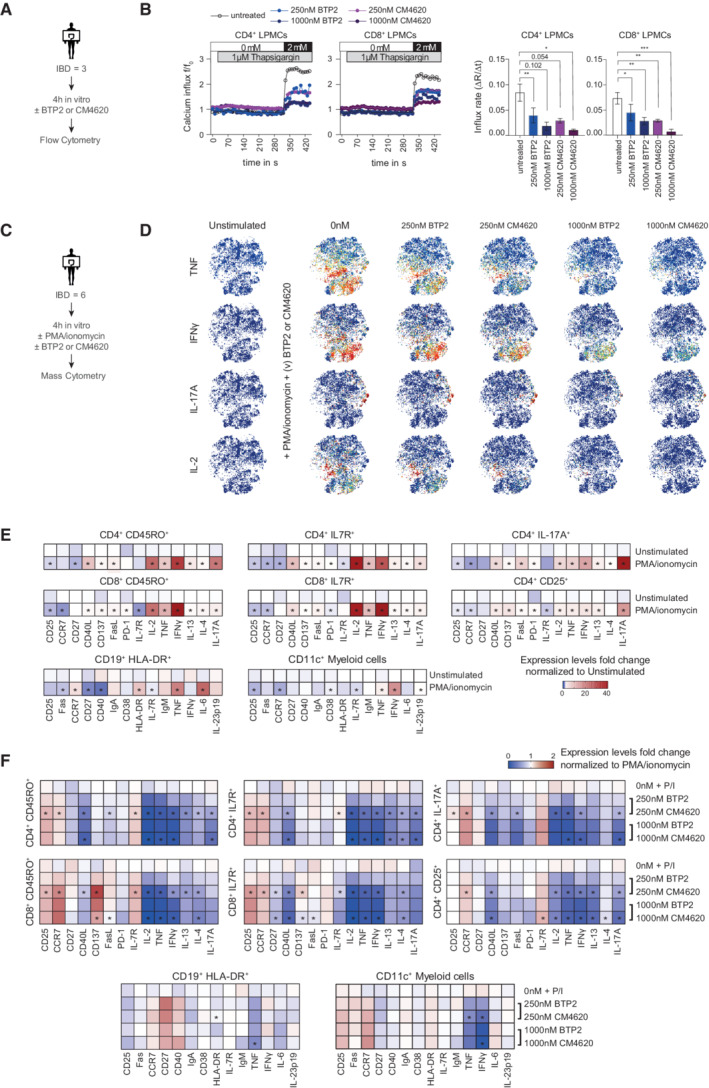
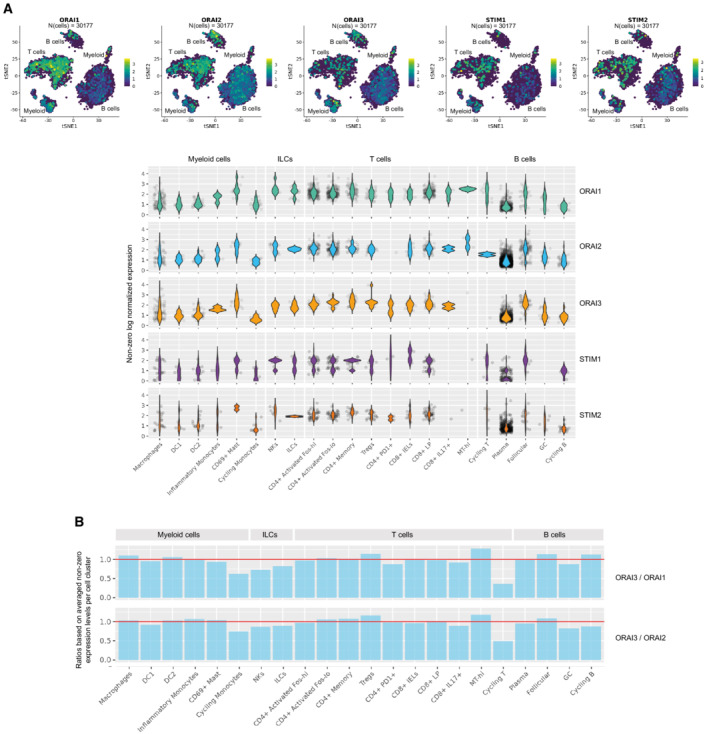
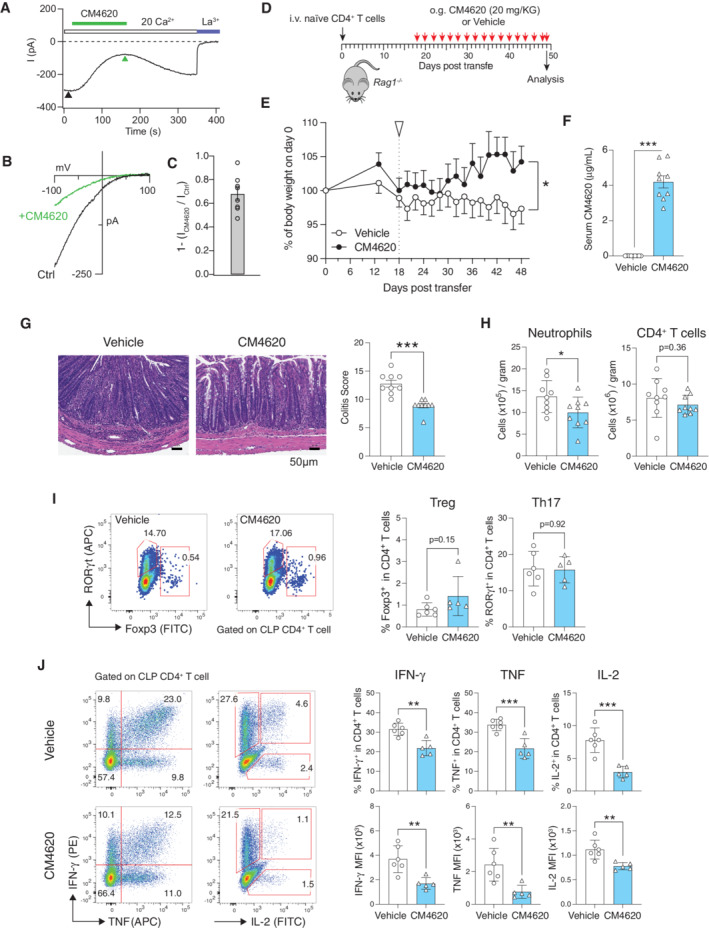
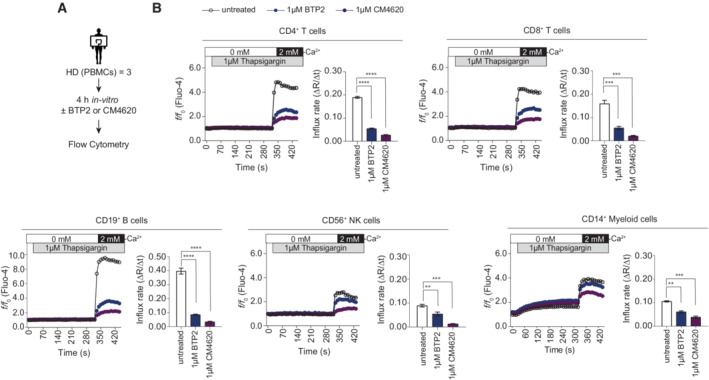
Inflammatory bowel disease (IBD) is characterized by dysregulated intestinal immune responses. Using mass cytometry (CyTOF) to analyze the immune cell composition in the lamina propria (LP) of patients with ulcerative colitis (UC) and Crohn's disease (CD), we observed an enrichment of CD4 effector T cells producing IL-17A and TNF, CD8 T cells producing IFNγ, T regulatory (Treg) cells, and innate lymphoid cells (ILC). The function of these immune cells is regulated by store-operated Ca entry (SOCE), which results from the opening of Ca release-activated Ca (CRAC) channels formed by ORAI and STIM proteins. We observed that the pharmacologic inhibition of SOCE attenuated the production of proinflammatory cytokines including IL-2, IL-4, IL-6, IL-17A, TNF, and IFNγ by human colonic T cells and ILCs, reduced the production of IL-6 by B cells and the production of IFNγ by myeloid cells, but had no effect on the viability, differentiation, and function of intestinal epithelial cells. T cell-specific deletion of CRAC channel genes in mice showed that Orai1, Stim1, and Stim2-deficient T cells have quantitatively distinct defects in SOCE, which correlate with gradually more pronounced impairment of cytokine production by Th1 and Th17 cells and the severity of IBD. Moreover, the pharmacologic inhibition of SOCE with a selective CRAC channel inhibitor attenuated IBD severity and colitogenic T cell function in mice. Our data indicate that SOCE inhibition may be a suitable new approach for the treatment of IBD.
炎症性肠病(IBD)的特征是肠道免疫反应失调。我们使用质谱流式细胞术(CyTOF)分析溃疡性结肠炎(UC)和克罗恩病(CD)患者的固有层(LP)中的免疫细胞组成,观察到产生 IL-17A 和 TNF 的 CD4 效应 T 细胞、产生 IFNγ 的 CD8 T 细胞、调节性 T(Treg)细胞和先天淋巴细胞(ILC)的富集。这些免疫细胞的功能受储存操作钙进入(SOCE)调节,这是由 ORAI 和 STIM 蛋白形成的钙释放激活钙(CRAC)通道开放引起的。我们观察到 SOCE 的药理抑制减弱了包括 IL-2、IL-4、IL-6、IL-17A、TNF 和 IFNγ 在内的促炎细胞因子的产生,减少了 B 细胞产生的 IL-6 和髓样细胞产生的 IFNγ,但对肠道上皮细胞的活力、分化和功能没有影响。在小鼠中特异性敲除 T 细胞的 CRAC 通道基因表明,Orai1、Stim1 和 Stim2 缺陷的 T 细胞在 SOCE 中具有定量不同的缺陷,这与 Th1 和 Th17 细胞产生细胞因子的能力逐渐受到更严重的损害以及 IBD 的严重程度相关。此外,用选择性 CRAC 通道抑制剂抑制 SOCE 可减轻小鼠 IBD 的严重程度和致结肠炎 T 细胞功能。我们的数据表明,SOCE 抑制可能是治疗 IBD 的一种合适的新方法。