Liu Fuyan, Liang Yan, Sun Ruolan, Yang Weicheng, Liang Zhongqing, Gu Junfei, Zhao Fan, Tang Decai
School of Traditional Chinese Medicine and School of Integrated Chinese and Western Medicine, Nanjing University of Chinese Medicine, Nanjing, China.
School of Chinese Materia Medica, Nanjing University of Chinese Medicine, Nanjing, China.
Chin Med. 2022 Aug 3;17(1):91. doi: 10.1186/s13020-022-00641-4.
One of the most challenging aspects of colon cancer (CC) prognosis and treatment is liver-tropic metastasis. Astragalus mongholicus Bunge-Curcuma aromatica Salisb. (AC) is a typical medication combination for the therapy of many malignancies. Our previous studies found that AC intervention inhibits liver metastasis of colon cancer (LMCC). Nevertheless, the comprehensive anti-metastasis mechanisms of AC have not been uncovered.
In bioinformatics analysis, RNA-seq data of CC and LMCC patients were collected from TCGA and GEO databases, and differentially expressed genes (DEGs) were identified. The biological processes and signaling pathways involved in DEGs were enriched by GO and KEGG. The protein-protein interaction (PPI) network of DEGs was established and visualized using the Cytocape software, followed by screening Hub genes in the PPI network using Degree value as the criterion. Subsequently, the expression and survival relevance of Hub gene in COAD patients were verified. In the experimental study, the effects of AC on the inhibition of colon cancer growth and liver metastasis were comprehensively evaluated by cellular and animal models. Finally, based on the results of bioinformatics analysis, the possible mechanisms of AC inhibition of colon cancer EMT and liver metastasis were explored by in vivo and in vitro pharmacological experiments.
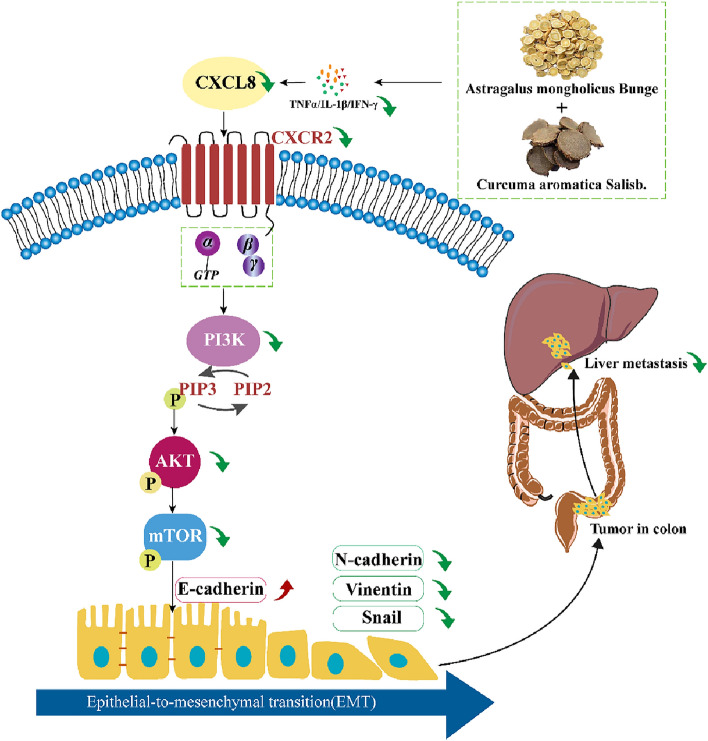
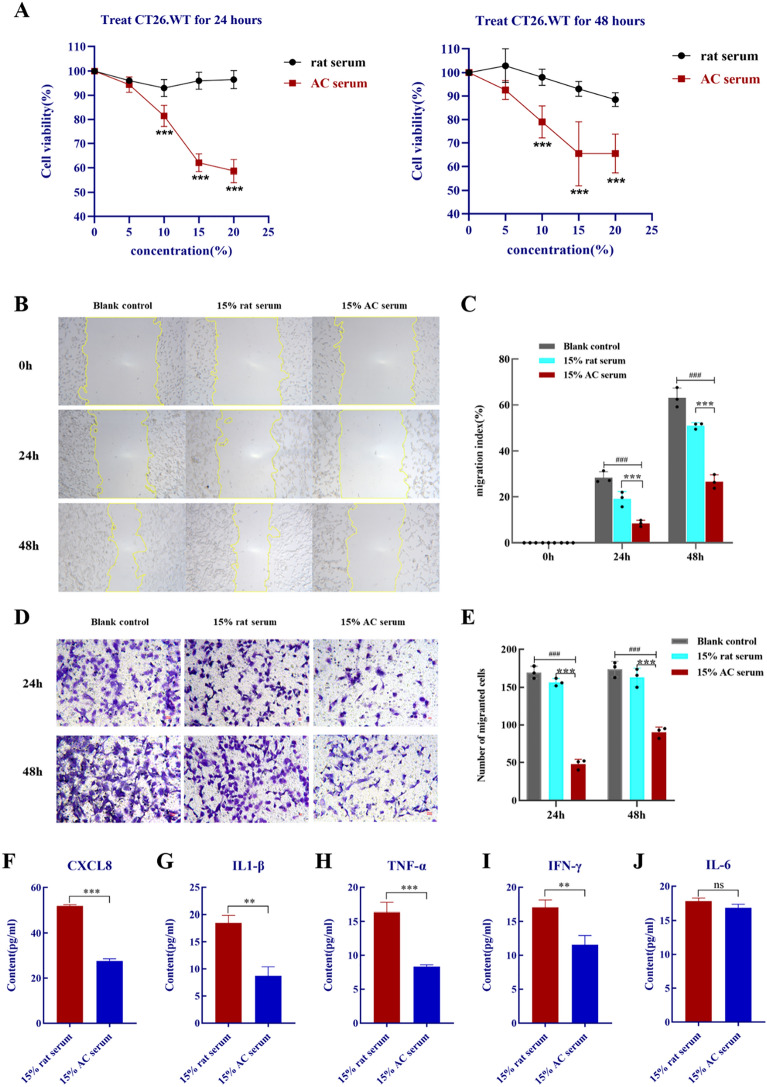
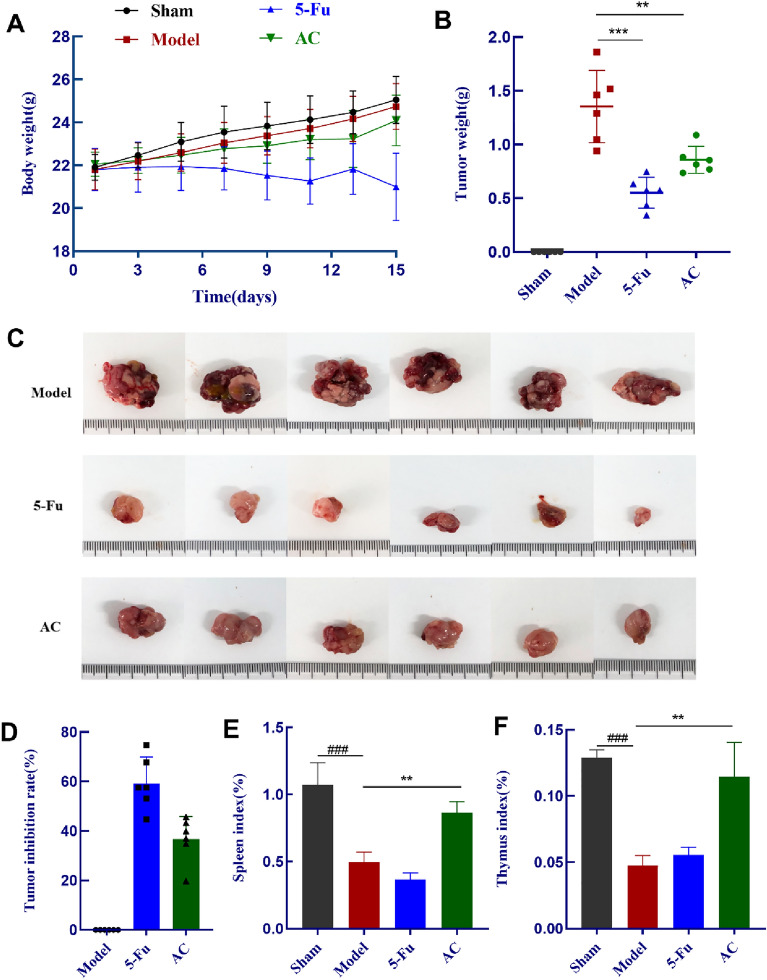
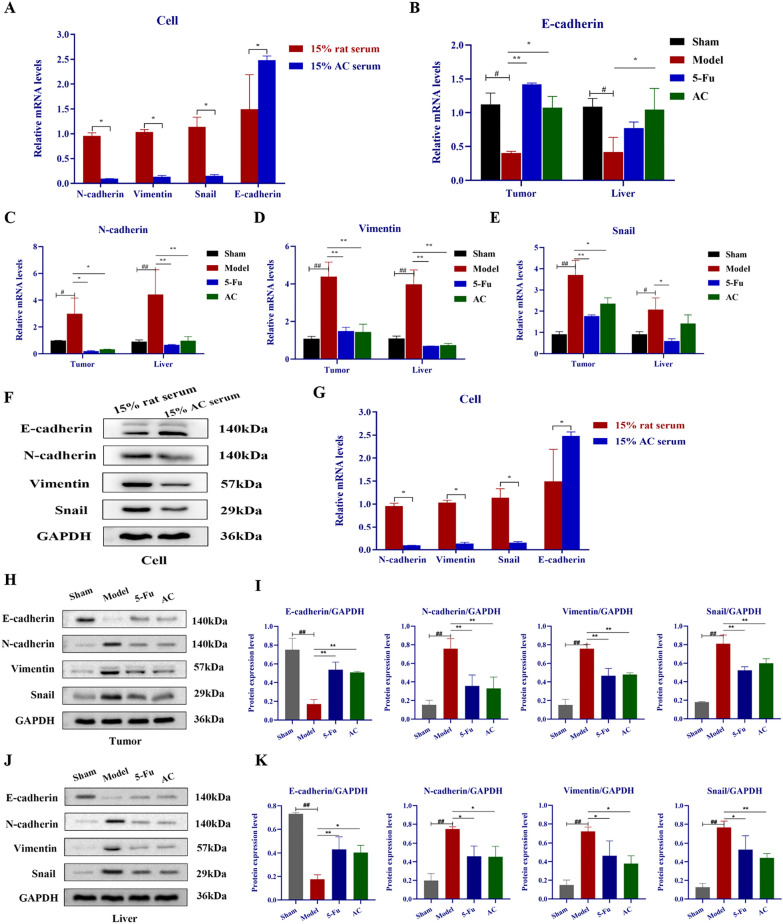
In this study, we obtained 2386 DEGs relevant to LMCC from the COAD (colon adenocarcinoma) and GSE38174 datasets. Results of GO gene function and KEGG signaling pathway enrichment analysis suggested that cellular EMT (Epithelial-mesenchymal transition) biological processes, Cytokine-cytokine receptor interaction and PI3K/Akt signaling pathways might be closely related to LMCC mechanism. We then screened for CXCL8, the core hub gene with the highest centrality within the PPI network of DEGs, and discovered that CXCL8 expression was negatively correlated with the prognosis of COAD patients. In vitro and in vivo experimental evidence presented that AC significantly inhibited colon cancer cell proliferation, migration and invasion ability, and suppressed tumor growth and liver metastasis in colon cancer orthotopic transplantation mice models. Concomitantly, AC significantly reduced CXCL8 expression levels in cell supernatants and serum. Moreover, AC reduced the expression and transcription of genes related to the PI3K/AKT pathway while suppressing the EMT process in colon cancer cells and model mice.
In summary, our research predicted the potential targets and pathways of LMCC, and experimentally demonstrated that AC might inhibit the growth and liver metastasis in colon cancer by regulating EMT via the CXCL8/CXCR2 axis and PI3K/AKT/mTOR signaling pathway, which may facilitate the discovery of mechanisms and new therapeutic strategies for LMCC.
结肠癌(CC)预后和治疗中最具挑战性的方面之一是肝向性转移。黄芪-郁金(AC)是治疗多种恶性肿瘤的典型药物组合。我们之前的研究发现,AC干预可抑制结肠癌肝转移(LMCC)。然而,AC的综合抗转移机制尚未被揭示。
在生物信息学分析中,从TCGA和GEO数据库收集CC和LMCC患者的RNA-seq数据,鉴定差异表达基因(DEG)。通过GO和KEGG对DEG涉及的生物学过程和信号通路进行富集。使用Cytocape软件建立并可视化DEG的蛋白质-蛋白质相互作用(PPI)网络,随后以度值为标准在PPI网络中筛选枢纽基因。随后,验证枢纽基因在COAD患者中的表达与生存相关性。在实验研究中,通过细胞和动物模型全面评估AC对抑制结肠癌生长和肝转移的作用。最后,基于生物信息学分析结果,通过体内和体外药理学实验探索AC抑制结肠癌上皮-间质转化(EMT)和肝转移的可能机制。
在本研究中,我们从COAD(结肠腺癌)和GSE38174数据集中获得了2386个与LMCC相关的DEG。GO基因功能和KEGG信号通路富集分析结果表明,细胞EMT(上皮-间质转化)生物学过程、细胞因子-细胞因子受体相互作用和PI3K/Akt信号通路可能与LMCC机制密切相关。然后,我们筛选出DEG的PPI网络中中心性最高的核心枢纽基因CXCL8,并发现CXCL8表达与COAD患者的预后呈负相关。体外和体内实验证据表明,AC显著抑制结肠癌细胞的增殖、迁移和侵袭能力,并抑制结肠癌原位移植小鼠模型中的肿瘤生长和肝转移。同时,AC显著降低细胞上清液和血清中CXCL8的表达水平。此外,AC降低了与PI3K/AKT通路相关基因的表达和转录,同时抑制了结肠癌细胞和模型小鼠中的EMT过程。
总之,我们的研究预测了LMCC的潜在靶点和通路,并通过实验证明AC可能通过CXCL8/CXCR2轴和PI3K/AKT/mTOR信号通路调节EMT来抑制结肠癌的生长和肝转移,这可能有助于发现LMCC的机制和新的治疗策略。