Department of Economics and Health Care Management, Labovitz School of Business and Economics, University of Minnesota Duluth, Duluth, MN, United States.
Front Public Health. 2022 Jul 18;10:947569. doi: 10.3389/fpubh.2022.947569. eCollection 2022.
Social capital is a well-known health determinant with both relational and geographic aspects. It can help mitigate adverse events and has been shown to impact behaviors and responses during the COVID-19 pandemic. Mental health has declined during the COVID-19 pandemic, and social capital, may serve to buffer those declines.
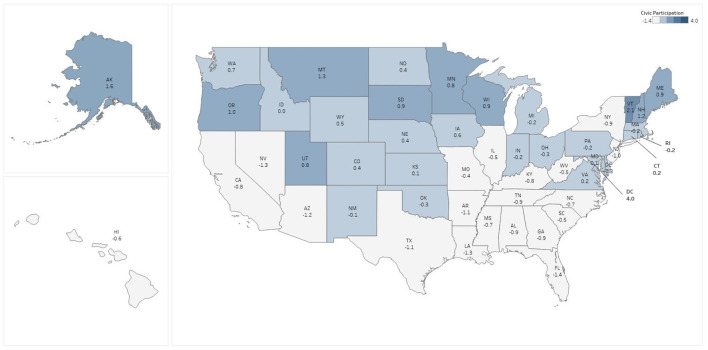
Building from this, we assessed whether pre-pandemic social capital and contemporaneous social policy, which included indicators of social trust, civic participation, and presence of mask mandates, affected pandemic mental health, measured as the percent of the population experiencing symptoms of depression and anxiety at the state level.
Generalized social trust and state mask mandates were significantly associated with lower levels of depression and anxiety. Conversely, states with greater civic engagement prior to the pandemic experienced more anxiety and depression.
Findings suggest that existing social capital, particularly social trust, may protect against anxiety and depression and contribute to community resilience during times of adversity. States should invest in policies and programs that increase social trust.
社会资本是一个众所周知的健康决定因素,具有关系和地理两个方面。它可以帮助减轻不良事件的影响,并且已经证明它会影响 COVID-19 大流行期间的行为和反应。在 COVID-19 大流行期间,心理健康状况有所下降,而社会资本可能有助于缓冲这些下降。
在此基础上,我们评估了大流行前的社会资本和同期的社会政策(包括社会信任、公民参与和口罩强制令的指标)是否会影响大流行期间的心理健康,这是通过州一级经历抑郁和焦虑症状的人口百分比来衡量的。
普遍的社会信任和州口罩强制令与较低水平的抑郁和焦虑显著相关。相反,在大流行之前,公民参与度较高的州则经历了更多的焦虑和抑郁。
研究结果表明,现有的社会资本,特别是社会信任,可能有助于预防焦虑和抑郁,并在逆境中促进社区的恢复力。各州应投资于增加社会信任的政策和方案。