Department of Infectious Diseases, The Third Affiliated Hospital of Hebei Medical University, Shijiazhuang, China.
Department of Infectious Diseases, The Affiliated Hospital of Chengde Medical University, Chengde, China.
Front Public Health. 2022 Jul 18;10:911551. doi: 10.3389/fpubh.2022.911551. eCollection 2022.
Increased interferon (IFN)-gamma inducible protein-10 (IP-10) level has been shown to be associated with sustained virologic responses (SVRs) to pegylated interferon-alpha 2a/ribavirin-based therapy in patients with chronic hepatitis C (CHC). We investigated the relationship between IP-10 and treatment response in patients with CHC treated with direct-acting antiviral agents (DAAs) therapy.
We measured the dynamic changes of IP-10 in samples from 90 patients with CHC. The serum IP-10 levels, intrahepatic expressions of IP-10 mRNA, and protein were determined, respectively. For the experiments, the expression changes of IP-10 in hepatitis C virus (HCV)-replicating Huh-7 cells with or without non-structural protein 5A (NS5A) inhibitor were analyzed using real-time reverse transcription-polymerase chain reaction and Western blotting.
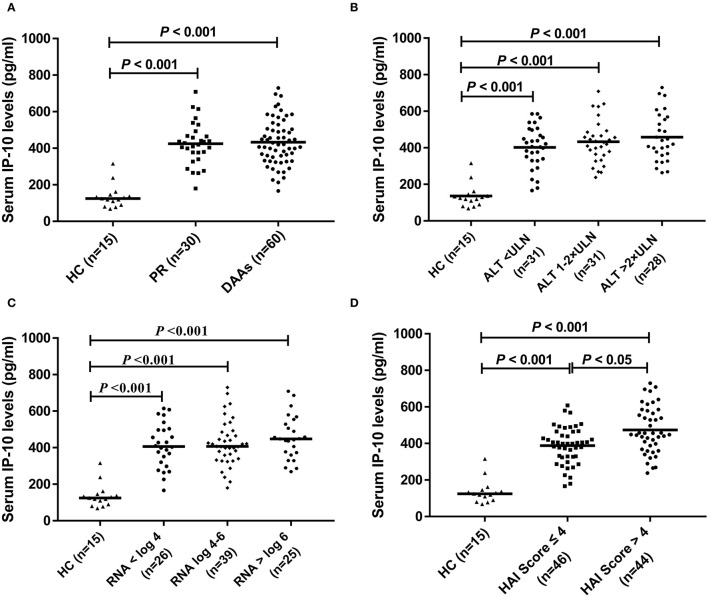
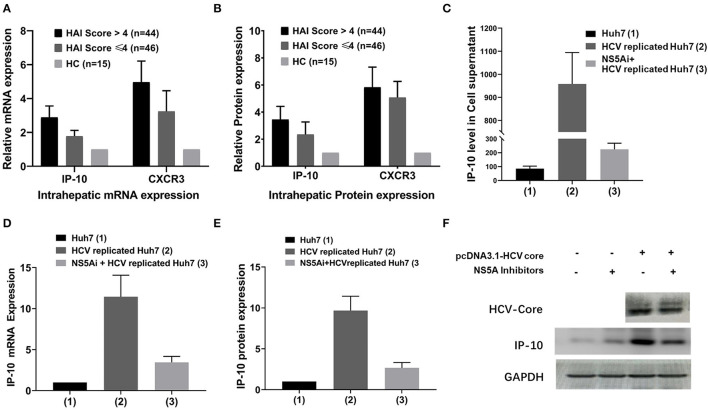
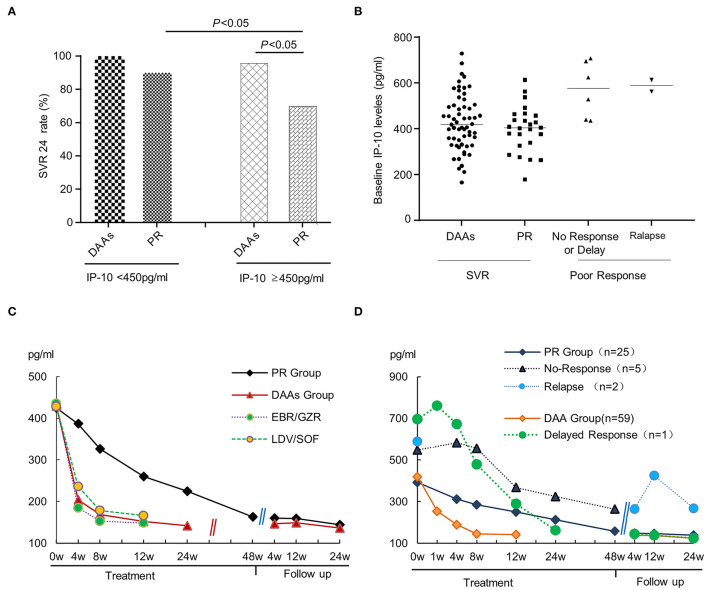
Patients with chronic hepatitis C had increased baseline IP-10 levels, intrahepatic IP-10 mRNA, and protein expression. After initiating DAAs therapy, serum IP-10 levels decreased gradually in patients who achieved cure, whereas in patients who failed the therapy, IP-10 levels did not change significantly or recovered from the initial decline. Multivariate logistic regression analysis confirmed that baseline IP-10 level ≤ 450 pg/ml and decline >30% at 12 weeks independently predicted the SVR in patients with CHC who received DAAs. , the expression of IP-10 mRNA and protein in HCV-replicating Huh-7 cells increased significantly. However, such activities were downregulated by NS5A inhibitor, followed by the reduction of HCV RNA levels and a decline in IP-10 levels.
IP-10 interfered with HCV replication in hepatocytes and the dynamic decline in IP-10 levels during DAA treatment predicted the SVR in patients with CHC.
干扰素(IFN)-γ诱导蛋白-10(IP-10)水平升高与慢性丙型肝炎(CHC)患者聚乙二醇干扰素-α 2a/利巴韦林治疗的持续病毒学应答(SVR)有关。我们研究了直接作用抗病毒药物(DAA)治疗 CHC 患者中 IP-10 与治疗反应之间的关系。
我们测量了 90 例 CHC 患者样本中 IP-10 的动态变化。分别测定血清 IP-10 水平、肝内 IP-10 mRNA 和蛋白表达。通过实时逆转录聚合酶链反应和 Western blot 分析,检测有无非结构蛋白 5A(NS5A)抑制剂的 HCV 复制 Huh-7 细胞中 IP-10 的表达变化。
慢性丙型肝炎患者基线 IP-10 水平、肝内 IP-10 mRNA 和蛋白表达升高。开始 DAA 治疗后,治愈患者的血清 IP-10 水平逐渐下降,而治疗失败的患者 IP-10 水平无明显变化或从初始下降中恢复。多变量 logistic 回归分析证实,基线 IP-10 水平≤450pg/ml 和 12 周时下降>30%独立预测接受 DAA 的 CHC 患者的 SVR。此外,HCV 复制 Huh-7 细胞中 IP-10 mRNA 和蛋白的表达显著增加。然而,NS5A 抑制剂可下调其活性,随后 HCV RNA 水平降低,IP-10 水平下降。
IP-10 干扰肝细胞中的 HCV 复制,DAA 治疗期间 IP-10 水平的动态下降预测 CHC 患者的 SVR。