Department of Dermatology, George Washington University School of Medicine and Health Sciences, Washington, DC, United States of America.
Department of Pediatrics, NYU Langone Medical Center, New York, NY, United States of America.
PLoS One. 2022 Aug 4;17(8):e0271310. doi: 10.1371/journal.pone.0271310. eCollection 2022.
COVID-19 can cause some individuals to experience chronic symptoms. Rates and predictors of chronic COVID-19 symptoms are not fully elucidated.
To examine occurrence and patterns of post-acute sequelae of SARS-CoV2 infection (PASC) symptomatology and their relationship with demographics, acute COVID-19 symptoms and anti-SARS-CoV-2 IgG antibody responses.
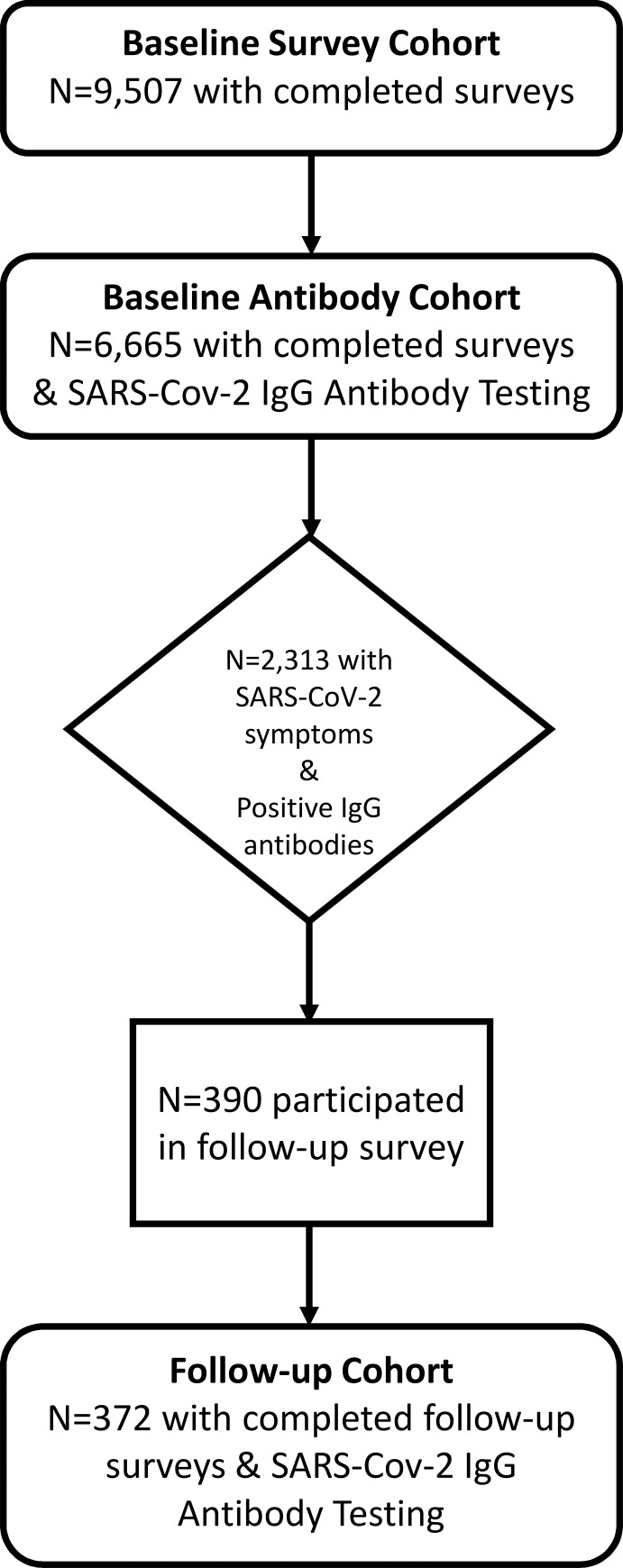
A multi-stage observational study was performed of adults (≥18 years) from 5 US states. Participants completed two rounds of electronic surveys (May-July 2020; April-May 2021) and underwent testing to anti-SARS-CoV-2 nucleocapsid protein IgG antibody testing. Latent Class Analysis was used to identify clusters of chronic COVID-19 symptoms.
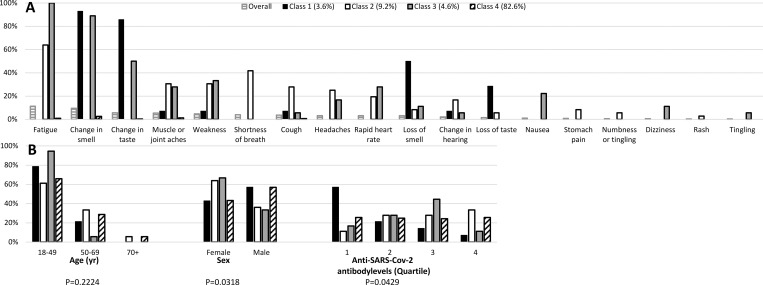
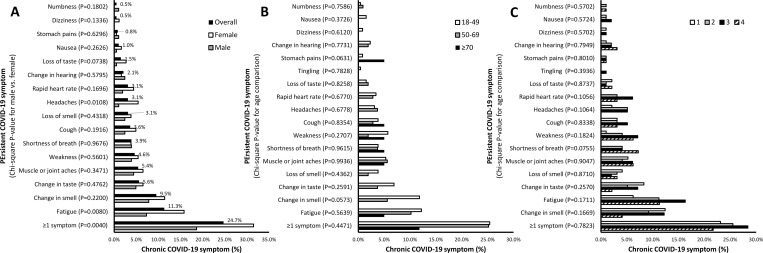
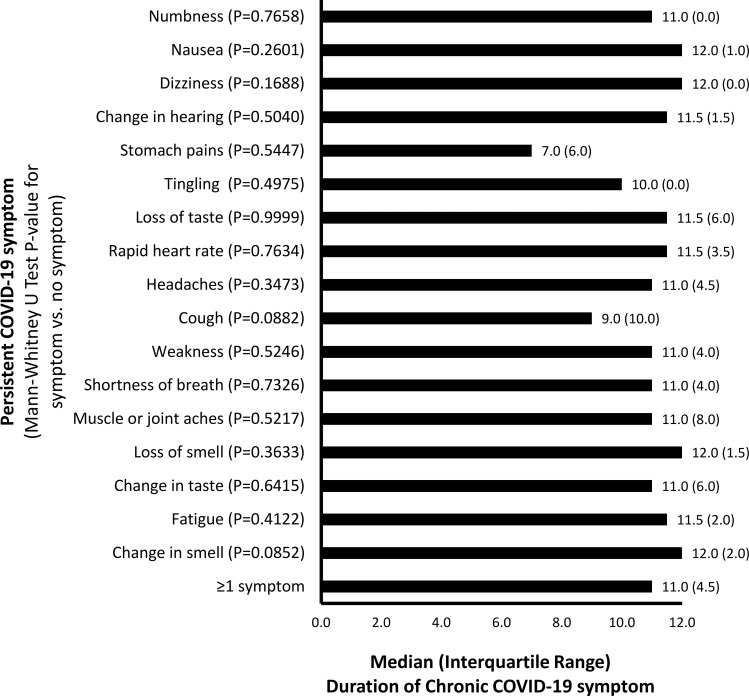
Overall, 390 adults (median [25%ile, 75%ile] age: 42 [31, 54] years) with positive SARS-CoV-2 antibodies completed the follow-up survey; 92 (24.7%) had ≥1 chronic COVID-19 symptom, with 11-month median duration of persistent symptoms (range: 1-12 months). The most common chronic COVID-19 symptoms were fatigue (11.3%), change in smell (9.5%) or taste (5.6%), muscle or joint aches (5.4%) and weakness (4.6%). There were significantly higher proportions of ≥1 persistent COVID-19 symptom (31.5% vs. 18.6%; Chi-square, P = 0.004), and particularly fatigue (15.8% vs. 7.3%, P = 0.008) and headaches (5.4% vs. 1.0%, P = 0.011) in females compared to males. Chronic COVID-19 symptoms were also increased in individuals with ≥6 acute COVID-19 symptoms, Latent class analysis revealed 4 classes of symptoms. Latent class-1 (change of smell and taste) was associated with lower anti-SARS-CoV-2 antibody levels; class-2 and 3 (multiple chronic symptoms) were associated with higher anti-SARS-CoV-2 antibody levels and more severe acute COVID-19 infection.
Ambulatory cohort with less severe acute disease.
Individuals with SARS-CoV-2 infection commonly experience chronic symptoms, most commonly fatigue, changes in smell or taste and muscle/joint aches. Female sex, severity of acute COVID-19 infection, and higher anti-SARS-CoV-2 IgG levels were associated with the highest risk of having chronic COVID-19 symptoms.
COVID-19 可能导致一些人出现慢性症状。慢性 COVID-19 症状的发生率和预测因素尚未完全阐明。
研究 SARS-CoV2 感染后急性后遗症(PASC)症状的发生和模式及其与人口统计学、急性 COVID-19 症状和抗 SARS-CoV-2 IgG 抗体反应的关系。
对来自美国 5 个州的成年人(≥18 岁)进行了多阶段观察性研究。参与者完成了两轮电子调查(2020 年 5 月至 7 月;2021 年 4 月至 5 月),并接受了抗 SARS-CoV-2 核衣壳蛋白 IgG 抗体检测。潜在类别分析用于确定慢性 COVID-19 症状的聚类。
共有 390 名(中位[25%ile,75%ile]年龄:42[31,54]岁)SARS-CoV-2 抗体阳性的成年人完成了随访调查;92 名(24.7%)有≥1 种慢性 COVID-19 症状,持续症状的中位持续时间为 11 个月(范围:1-12 个月)。最常见的慢性 COVID-19 症状是疲劳(11.3%)、嗅觉或味觉改变(9.5%)、肌肉或关节疼痛(5.4%)和虚弱(4.6%)。女性慢性 COVID-19 症状≥1 种的比例明显更高(31.5%比 18.6%;卡方检验,P=0.004),尤其是疲劳(15.8%比 7.3%,P=0.008)和头痛(5.4%比 1.0%,P=0.011)比男性更常见。女性慢性 COVID-19 症状也与≥6 种急性 COVID-19 症状有关。潜在类别分析显示有 4 种症状类别。类别 1(嗅觉和味觉改变)与 SARS-CoV-2 抗体水平较低有关;类别 2 和 3(多种慢性症状)与 SARS-CoV-2 抗体水平较高和更严重的急性 COVID-19 感染有关。
门诊队列,急性疾病程度较轻。
SARS-CoV-2 感染的个体常出现慢性症状,最常见的是疲劳、嗅觉或味觉改变以及肌肉/关节疼痛。女性、急性 COVID-19 感染的严重程度和较高的抗 SARS-CoV-2 IgG 水平与发生慢性 COVID-19 症状的风险最高有关。