Folkhälsan Research Center, Helsinki, Finland.
Department of Food and Nutrition, University of Helsinki, Helsinki, Finland.
PLoS One. 2022 Aug 4;17(8):e0270869. doi: 10.1371/journal.pone.0270869. eCollection 2022.
Many instruments for assessing general parenting have been reported as burdensome and are thus seldom used in studies exploring children's energy balance-related behaviors or weight. This study evaluates the factorial structure of the item-reduced version of the Comprehensive General Parenting Questionnaire (CGPQ), which assesses five constructs of general parenting.
The study uses data from two cross-sectional studies: Study 1 in 2014 (n = 173) and Study 2 in 2015-16 (n = 805). Parents of children aged three to six answered the CGPQ; in Study 1 the 69-item version, and in Study 2 the 29-item version. The reduction was based on the results of the confirmatory factor analyses (CFA) in Study 1. In both datasets, internal consistency, as Cronbach's alphas and intraclass correlations between the items of each construct, was tested. A combined assessment of the CFA and items response theory evaluated the construct validity and the item importance for the 29-item version, and a further the reduced 22-item version.
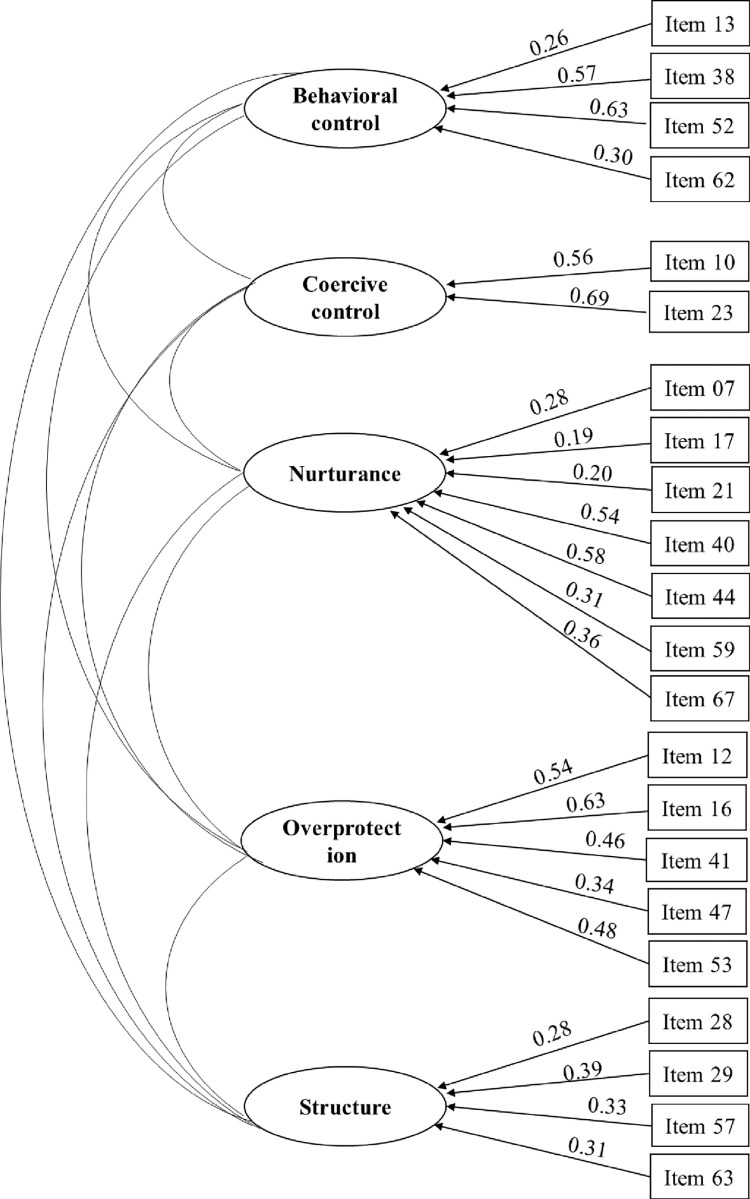
In Study 1, the highest Cronbach's alphas were shown for the five constructs in the 69-item version. A higher intraclass correlation was found between the constructs in the 69- and 29-item versions, than between the 69- and the 22-item version. However, a high concordance was found between the constructs in the 29- and 22-item versions in both Study 1 and in Study 2 (0.76-1.00). Testing the goodness-of-fit of the CFA models revealed that the 22-item model fulfilled all the criteria, showing that it had a better factorial structure than the 29-item model. Standard estimations ranged from 0.20 to 0.76 in the 22-item version.
The reduced 22- and 29-item versions of the 69-item CGPQ showed good model fit, the 22-item version the better of the two. These short versions can be used to assess general parenting without overburdening the respondents.
许多评估一般育儿的工具都被报道为繁琐,因此很少在研究儿童能量平衡相关行为或体重的研究中使用。本研究评估了综合一般育儿问卷(CGPQ)简化版的因子结构,该问卷评估了一般育儿的五个结构。
本研究使用了两项横断面研究的数据:研究 1 于 2014 年进行(n=173),研究 2 于 2015-16 年进行(n=805)。3 至 6 岁儿童的父母回答了 CGPQ;在研究 1 中回答了 69 项版本,在研究 2 中回答了 29 项版本。减少的依据是研究 1 中验证性因子分析(CFA)的结果。在两个数据集,内部一致性,即每个结构的项目的 Cronbach 的 alpha 和组内相关,进行了测试。对 CFA 和项目反应理论的综合评估评估了 29 项版本的结构效度和项目重要性,以及进一步的简化 22 项版本。
在研究 1 中,69 项版本的五个结构显示出最高的 Cronbach 的 alpha。在 69-和 29-项版本之间,结构之间的组内相关性高于 69-和 22-项版本之间。然而,在研究 1 和研究 2 中,29-和 22-项版本的结构之间发现了高度一致性(0.76-1.00)。测试 CFA 模型的拟合优度表明,22-项模型符合所有标准,表明它具有比 29-项模型更好的因子结构。标准估计值在 22-项版本中从 0.20 到 0.76 不等。
69 项 CGPQ 的简化 22-和 29-项版本显示出良好的模型拟合,22-项版本更好。这些简短版本可以用于评估一般育儿,而不会给受访者带来过重的负担。