Sleddens Ester F C, O'Connor Teresia M, Watson Kathleen B, Hughes Sheryl O, Power Thomas G, Thijs Carel, De Vries Nanne K, Kremers Stef P J
Maastricht University, Department of Health Promotion, NUTRIM School for Nutrition, Toxicology and Metabolism, Maastricht University Medical Center+, P,O, Box 616, 6200, MD Maastricht, The Netherlands.
Int J Behav Nutr Phys Act. 2014 Feb 10;11:15. doi: 10.1186/1479-5868-11-15.
Despite the large number of parenting questionnaires, considerable disagreement exists about how to best assess parenting. Most of the instruments only assess limited aspects of parenting. To overcome this shortcoming, the "Comprehensive General Parenting Questionnaire" (CGPQ) was systematically developed. Such a measure is frequently requested in the area of childhood overweight.
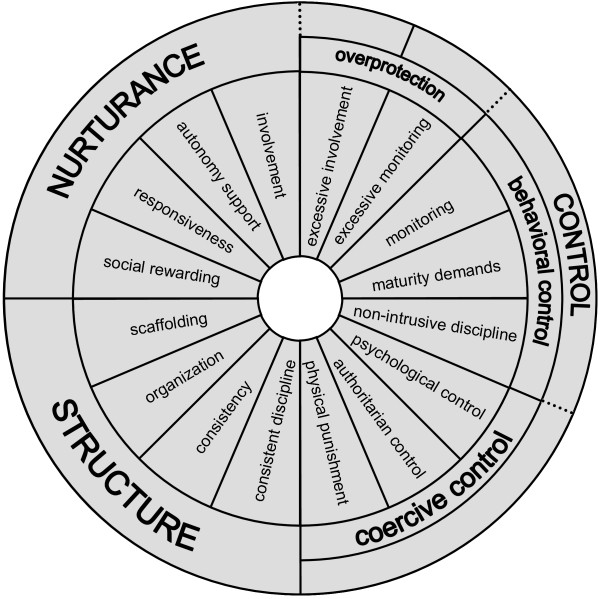
First, an item bank of existing parenting measures was created assessing five key parenting constructs that have been identified across multiple theoretical approaches to parenting (Nurturance, Overprotection, Coercive control, Behavioral control, and Structure). Caregivers of 5- to 13-year-olds were asked to complete the online survey in the Netherlands (N = 821), Belgium (N = 435) and the United States (N = 241). In addition, a questionnaire regarding personality characteristics ("Big Five") of the caregiver was administered and parents were asked to report about their child's height and weight. Factor analyses and Item-Response Modeling (IRM) techniques were used to assess the underlying parenting constructs and for item reduction. Correlation analyses were performed to assess the relations between general parenting and personality of the caregivers, adjusting for socio-economic status (SES) indicators, to establish criterion validity. Multivariate linear regressions were performed to examine the associations of SES indicators and parenting with child BMI z-scores. Additionally, we assessed whether scores on the parenting constructs and child BMI z-scores differed depending on SES indicators.
The reduced questionnaire (62 items) revealed acceptable fit of our parenting model and acceptable IRM item fit statistics. Caregiver personality was related as hypothesized with the GCPQ parenting constructs. While correcting for SES, overprotection was positively related to child BMI. The negative relationship between structure and BMI was borderline significant. Parents with a high level of education were less likely to use overly forms of controlling parenting (i.e., coercive control and overprotection) and more likely to have children with lower BMI. Based on several author review meetings and cognitive interviews the questionnaire was further modified to an 85-item questionnaire.
The GCPQ may facilitate research exploring how parenting influences children's weight-related behaviors. The contextual influence of general parenting is likely to be more profound than its direct relationship with weight status.
尽管育儿问卷数量众多,但对于如何最好地评估育儿方式仍存在相当大的分歧。大多数工具仅评估育儿的有限方面。为克服这一缺点,系统开发了“综合通用育儿问卷”(CGPQ)。在儿童超重领域经常需要这样一种测量工具。
首先,创建了一个现有育儿测量工具的项目库,评估从多种育儿理论方法中确定的五个关键育儿结构(养育、过度保护、强制控制、行为控制和结构)。要求5至13岁儿童的照顾者在荷兰(N = 821)、比利时(N = 435)和美国(N = 241)完成在线调查。此外,还发放了一份关于照顾者人格特征(“大五人格”)的问卷,并要求父母报告孩子的身高和体重。使用因素分析和项目反应建模(IRM)技术来评估潜在的育儿结构并进行项目精简。进行相关分析以评估一般育儿与照顾者人格之间的关系,并根据社会经济地位(SES)指标进行调整,以建立效标效度。进行多元线性回归以检验SES指标和育儿与儿童BMI z评分之间的关联。此外,我们评估了育儿结构得分和儿童BMI z评分是否因SES指标而异。
精简后的问卷(62个项目)显示我们的育儿模型拟合度可接受,IRM项目拟合统计数据也可接受。照顾者人格与假设的GCPQ育儿结构相关。在校正SES时,过度保护与儿童BMI呈正相关。结构与BMI之间的负相关接近显著。受过高等教育的父母不太可能采用过度控制的育儿方式(即强制控制和过度保护),并且更有可能生育BMI较低的孩子。基于几次作者评审会议和认知访谈,问卷进一步修改为85个项目的问卷。
GCPQ可能有助于探索育儿方式如何影响儿童与体重相关行为的研究。一般育儿的背景影响可能比其与体重状况的直接关系更为深远。