Department of Experimental Psychology, Heinrich Heine University Düsseldorf, Düsseldorf, Germany.
Sci Rep. 2022 Aug 4;12(1):13379. doi: 10.1038/s41598-022-17400-y.
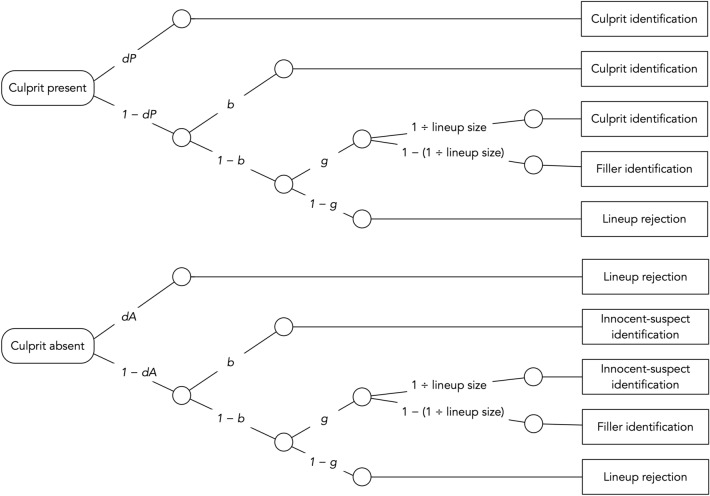
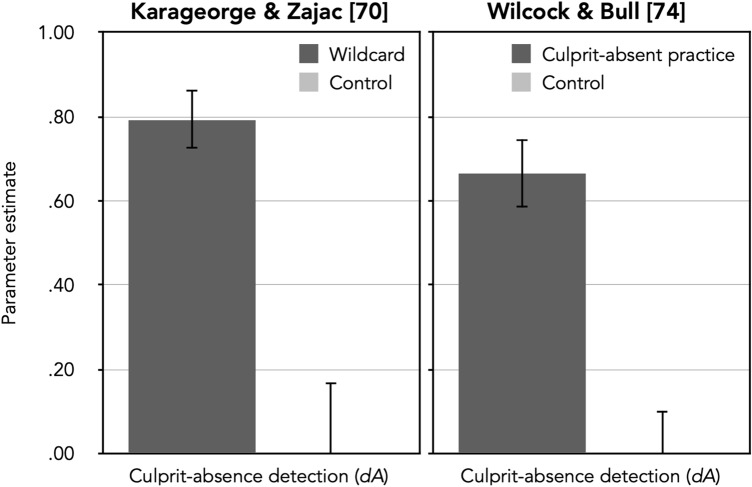
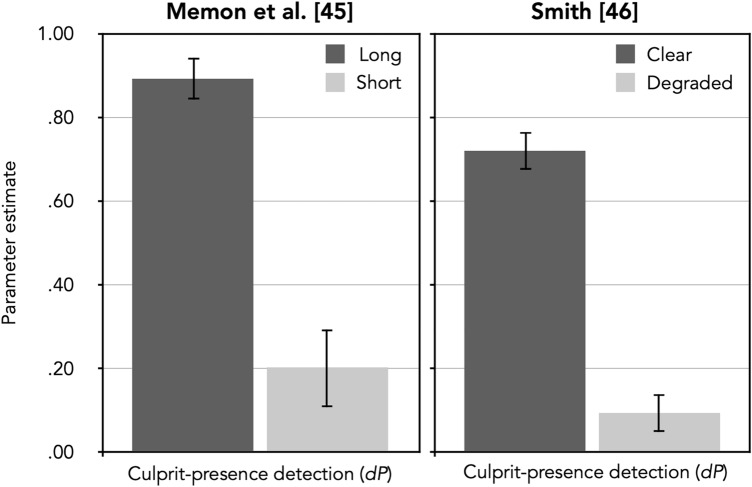
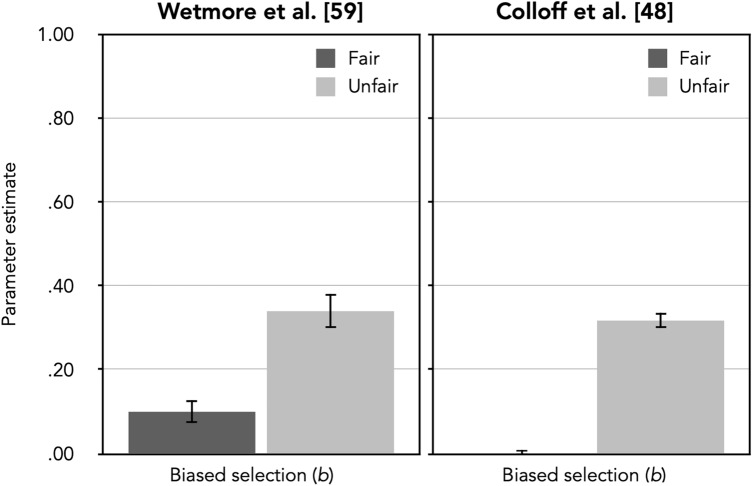
The two-high threshold (2-HT) eyewitness identification model serves as a new measurement tool to measure the latent cognitive processes underlying eyewitness identification performance. By simultaneously taking into account correct culprit identifications, false innocent-suspect identifications, false filler identifications in culprit-present and culprit-absent lineups as well as correct and false lineup rejections, the model capitalizes on the full range of data categories that are observed when measuring eyewitness identification performance. Thereby, the model is able to shed light on detection-based and non-detection-based processes underlying eyewitness identification performance. Specifically, the model incorporates parameters for the detection of culprit presence and absence, biased selection of the suspect and guessing-based selection among the lineup members. Here, we provide evidence of the validity of each of the four model parameters by applying the model to eight published data sets. The data sets come from studies with experimental manipulations that target one of the underlying processes specified by the model. Manipulations of encoding difficulty, lineup fairness and pre-lineup instructions were sensitively reflected in the parameters reflecting culprit-presence detection, biased selection and guessing-based selection, respectively. Manipulations designed to facilitate the rejection of culprit-absent lineups affected the parameter for culprit-absence detection. The reanalyses of published results thus suggest that the parameters sensitively reflect the manipulations of the processes they were designed to measure, providing support of the validity of the 2-HT eyewitness identification model.
双阈限(2-HT)证人识别模型是一种新的测量工具,用于测量证人识别表现背后的潜在认知过程。该模型同时考虑了正确识别犯罪嫌疑人、错误识别无辜嫌疑人、在有犯罪嫌疑人组和无犯罪嫌疑人组中错误识别填充项,以及正确和错误的排除情况,充分利用了测量证人识别表现时观察到的所有数据类别。因此,该模型能够揭示证人识别表现背后基于检测和非基于检测的过程。具体来说,该模型包含了用于检测犯罪嫌疑人存在和不存在、嫌疑人有偏选择以及在候选组中进行猜测选择的参数。在这里,我们通过将模型应用于八个已发表的数据集,为每个模型参数的有效性提供了证据。这些数据集来自于实验操纵的研究,这些研究针对模型指定的一个潜在过程。在反映犯罪嫌疑人存在检测、有偏选择和基于猜测选择的参数中,分别灵敏地反映了编码难度、候选组公平性和预候选组指示的操纵。旨在促进排除无犯罪嫌疑人候选组的操纵则影响了用于检测犯罪嫌疑人不存在的参数。因此,对已发表结果的重新分析表明,这些参数灵敏地反映了它们旨在测量的过程的操纵,为 2-HT 证人识别模型的有效性提供了支持。