The George Institute for Global Health University of New South Wales Sydney New South Wales Australia.
The University of Central Lancashire Preston Lancashire United Kingdom.
J Am Heart Assoc. 2022 Aug 16;11(16):e025425. doi: 10.1161/JAHA.121.025425. Epub 2022 Aug 5.
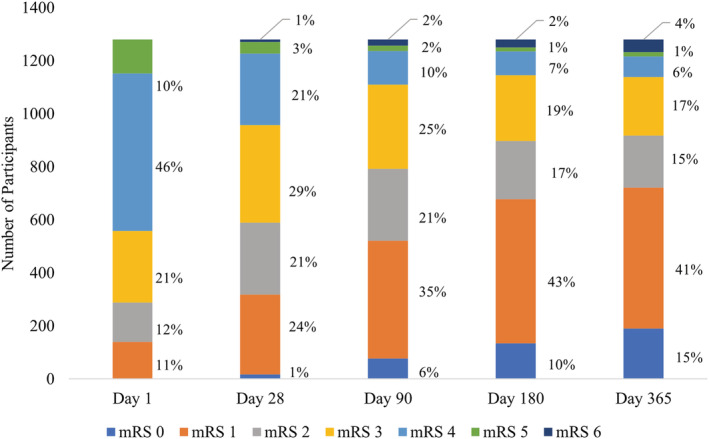
Background Function after acute stroke using the modified Rankin Scale (mRS) is usually assessed at a point in time. The analytical implications of serial mRS measurements to evaluate functional recovery over time is not completely understood. We compare repeated-measures and single-measure analyses of the mRS from a randomized clinical trial. Methods and Results Serial mRS data from AFFINITY (Assessment of Fluoxetine in Stroke Recovery), a double-blind placebo randomized clinical trial of fluoxetine following stroke (n=1280) were analyzed to identify demographic and clinical associations with functional recovery (reduction in mRS) over 12 months. Associations were identified using single-measure (day 365) and repeated-measures (days 28, 90, 180, and 365) partial proportional odds logistic regression. Ninety-five percent of participants experienced a reduction in mRS after 12 months. Functional recovery was associated with age at stroke <70 years; no prestroke history of diabetes, coronary heart disease, or ischemic stroke; prestroke history of depression, a relationship partner, living with others, independence, or paid employment; no fluoxetine intervention; ischemic stroke (compared with hemorrhagic); stroke treatment in Vietnam (compared with Australia or New Zealand); longer time since current stroke; and lower baseline National Institutes of Health Stroke Scale & Patient Health Questionnaire-9 scores. Direction of associations was largely concordant between single-measure and repeated-measures models. Association strength and variance was generally smaller in the repeated-measures model compared with the single-measure model. Conclusions Repeated-measures may improve trial precision in identifying trial associations and effects. Further repeated-measures stroke analyses are required to prove methodological value. Registration URL: http://www.anzctr.org.au; Unique identifier: ACTRN12611000774921.
背景 使用改良 Rankin 量表(mRS)评估急性脑卒中后的功能通常是在某一时间点进行的。mRS 多次测量评估随时间推移的功能恢复的分析意义尚不完全清楚。我们比较了来自一项随机临床试验的 mRS 重复测量和单次测量分析。
方法和结果 对 AFFINITY(评估氟西汀对脑卒中后的影响)的 mRS 进行了重复测量数据分析,这是一项氟西汀治疗脑卒中的双盲安慰剂随机临床试验(n=1280),旨在确定人口统计学和临床因素与 12 个月内功能恢复(mRS 降低)的关系。使用单次测量(第 365 天)和重复测量(第 28、90、180 和 365 天)部分比例优势逻辑回归确定关联。95%的参与者在 12 个月后 mRS 降低。功能恢复与脑卒中时年龄<70 岁;无脑卒中前糖尿病、冠心病或缺血性脑卒中史;脑卒中前有抑郁史、有伴侣、与他人同住、独立或有薪工作;无氟西汀干预;缺血性脑卒中(与出血性脑卒中相比);在越南接受的脑卒中治疗(与澳大利亚或新西兰相比);当前脑卒中后时间较长;以及基线 NIHSS 和 PHQ-9 评分较低有关。在单次测量和重复测量模型中,关联的方向基本一致。与单次测量模型相比,重复测量模型中的关联强度和方差通常较小。
结论 重复测量可能会提高识别试验关联和效果的试验精度。需要进一步进行重复测量脑卒中分析以证明其方法学价值。 注册网址:http://www.anzctr.org.au;独特标识符:ACTRN12611000774921。