Enteric Diseases and Vaccines Research Unit, Centre for Infectious Disease Research in Zambia, Lusaka, Zambia.
Department of Biomedical Sciences, School of Health Sciences, University of Zambia, Lusaka, Zambia.
PLoS Negl Trop Dis. 2022 Aug 5;16(8):e0010207. doi: 10.1371/journal.pntd.0010207. eCollection 2022 Aug.
Enterotoxigenic Escherichia coli (ETEC) is one of the top aetiologic agents of diarrhea in children under the age of 5 in low-middle income countries (LMICs). The lack of point of care diagnostic tools for routine ETEC diagnosis results in limited data regarding the actual burden and epidemiology in the endemic areas. We evaluated performance of the novel Rapid LAMP based Diagnostic Test (RLDT) for detection of ETEC in stool as a point of care diagnostic assay in a resource-limited setting.
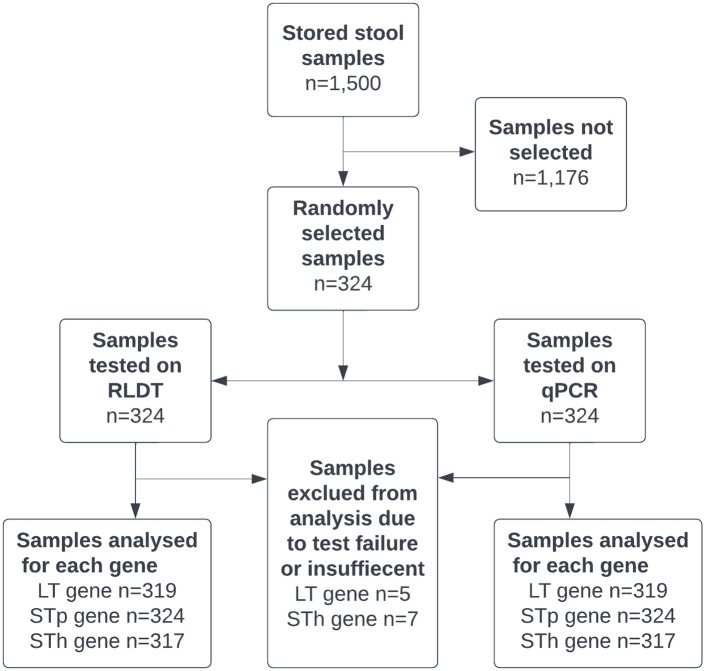
We conducted a cross-sectional study of 324 randomly selected stool samples from children under 5 presenting with moderate to severe diarrhea (MSD). The samples were collected between November 2012 to September 2013 at selected health facilities in Zambia. The RLDT was evaluated by targeting three ETEC toxin genes [heat labile toxin (LT) and heat stable toxins (STh and STp)]. Quantitative PCR was used as the "gold standard" to evaluate the diagnostic sensitivity and specificity of RLDT for detection of ETEC. We additionally described the prevalence and seasonality of ETEC.
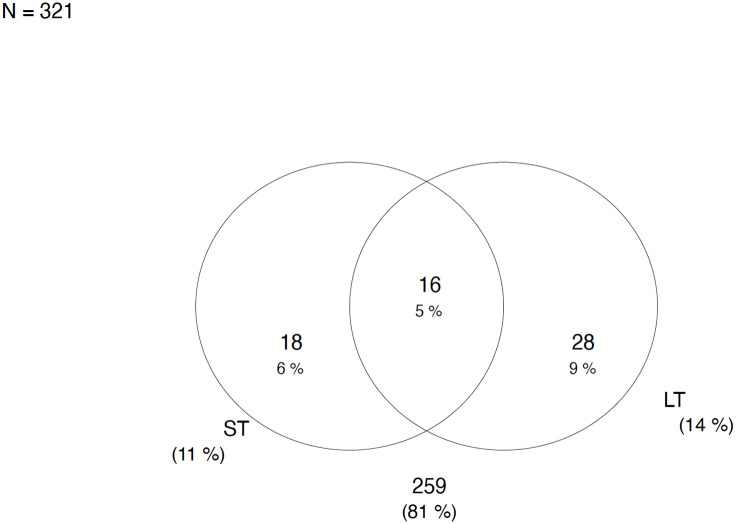
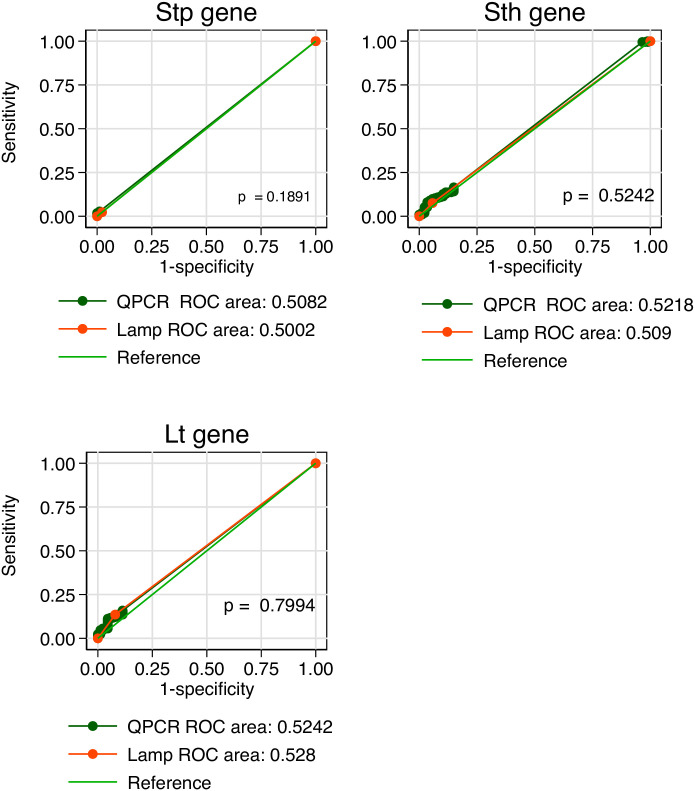
The study included 324 participants, 50.6% of which were female. The overall prevalence of ETEC was 19.8% by qPCR and 19.4% by RLDT. The children between 12 to 59 months had the highest prevalence of 22%. The study determined ETEC toxin distribution was LT 28/321(9%), ST 18/321(6%) and LT/ST 16/321(5%). The sensitivity and specificity of the RLDT compared to qPCR using a Ct 35 as the cut-off, were 90.7% and 97.5% for LT, 85.2% and 99.3% for STh and 100% and 99.7% for STp, respectively.
The results of this study suggest that RLDT is sufficiently sensitive and specific and easy to implement in the endemic countries. Being rapid and simple, the RLDT also presents as an attractive tool for point-of-care testing at the health facilities and laboratories in the resource-limited settings.
产肠毒素性大肠杆菌(ETEC)是中低收入国家(LMICs)5 岁以下儿童腹泻的主要病因之一。由于缺乏用于常规 ETEC 诊断的即时检测工具,因此有关流行地区实际负担和流行病学的数据有限。我们评估了新型基于快速环介导等温扩增(Rapid LAMP)的诊断检测试验(RLDT)作为一种在资源有限环境下的即时检测诊断方法,用于检测粪便中的 ETEC 的性能。
我们对 2012 年 11 月至 2013 年 9 月期间在赞比亚选定的卫生机构就诊的 324 名 5 岁以下出现中度至重度腹泻(MSD)的儿童随机抽取的 324 份粪便样本进行了横断面研究。RLDT 通过针对三种 ETEC 毒素基因[不耐热毒素(LT)和耐热毒素(STh 和 STp)]进行评估。实时定量 PCR 被用作“金标准”来评估 RLDT 检测 ETEC 的诊断敏感性和特异性。我们还描述了 ETEC 的流行率和季节性。
本研究包括 324 名参与者,其中 50.6%为女性。qPCR 检测的 ETEC 总流行率为 19.8%,RLDT 检测的 ETEC 总流行率为 19.4%。12 至 59 个月的儿童 ETEC 流行率最高,为 22%。研究确定 ETEC 毒素分布为 LT 28/321(9%),ST 18/321(6%)和 LT/ST 16/321(5%)。RLDT 与 qPCR 相比,以 Ct 35 作为截断值时,LT 的敏感性和特异性分别为 90.7%和 97.5%,STh 的敏感性和特异性分别为 85.2%和 99.3%,STp 的敏感性和特异性均为 100%和 99.7%。
本研究结果表明,RLDT 具有足够的敏感性和特异性,并且易于在流行国家实施。由于其快速简单,RLDT 也可作为资源有限环境下卫生机构和实验室即时检测的有吸引力的工具。