College of Law, University of Iowa, Iowa City, Iowa, USA.
GW Law, The George Washington University, Washington, District of Columbia, USA.
J Genet Couns. 2022 Dec;31(6):1383-1393. doi: 10.1002/jgc4.1613. Epub 2022 Aug 5.
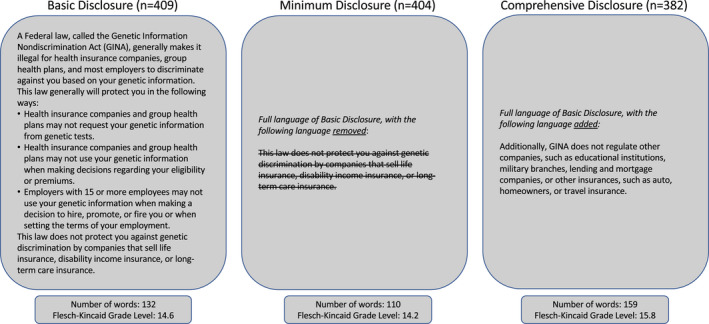
Informed consent is a foundational ethical and legal principle in human subjects research and clinical care. Yet, there is extensive debate over how much information must be disclosed to meet ethical goals and legal requirements, especially about non-medical risks. In this online, survey-based experiment of a diverse sample of the US general population, we explored one aspect of this debate by testing whether the level of detail included in informed consent regarding genetic anti-discrimination protections alters individuals' willingness to participate in a hypothetical research study and their concerns regarding genetic discrimination. Participants were randomized to receive sample informed consent language with one of three levels of disclosure regarding the protections and limitations of the Genetic Information Nondiscrimination Act (GINA). Our sample (n = 1,195) had a mean age of 45.9 (SD = 17.9) years and 40% with ≤high school education. Participants were 51.3% female and 36.7% non-Hispanic White. On average, those who received consent language with none of GINA's limitations highlighted were more willing to participate than those who were warned about various gaps in GINA. They also had significantly lower perceived risk of discrimination than those presented with the most information about limitations. Our study found that providing more comprehensive information about GINA notably lessened willingness to participate in the hypothetical studies, highlighting the need for clinicians and researchers to thoughtfully consider how to disclose anti-discrimination risks in informed consent.
知情同意是人体研究和临床护理中一项基础的伦理和法律原则。然而,对于为了达到伦理目标和法律要求必须披露多少信息,尤其是关于非医疗风险的信息,存在广泛的争议。在这项针对美国普通人群的多样化样本的在线调查实验中,我们通过测试在遗传反歧视保护方面的知情同意书中包含的详细信息水平是否会改变个人参与假设研究的意愿以及他们对遗传歧视的担忧,来探讨这一争议的一个方面。参与者被随机分配到三种不同的样本中,分别收到关于《遗传信息非歧视法案》(GINA)的保护和限制的知情同意书,其中披露的详细程度各有不同。我们的样本(n=1195)的平均年龄为 45.9 岁(标准差=17.9),其中 40%的人仅受过高中教育。参与者中 51.3%为女性,36.7%为非西班牙裔白人。平均而言,那些收到没有突出 GINA 限制的知情同意书的人比那些收到关于 GINA 各种缺陷的警告的人更愿意参与研究。他们对歧视的感知风险也明显低于那些获得最多限制信息的人。我们的研究发现,提供关于 GINA 的更全面信息显著降低了参与假设研究的意愿,这凸显了临床医生和研究人员在知情同意书中披露反歧视风险时需要深思熟虑。