Department of Pediatrics, The First Affiliated Hospital of Guangzhou Medical University, Guangzhou, China; State Key Laboratory of Respiratory Disease, National Clinical Research Center for Respiratory Disease, Guangzhou Institute of Respiratory Health, The First Affiliated Hospital of Guangzhou Medical University, Guangzhou Medical University, Guangzhou, China; State Key Laboratory of Respiratory Disease, Guangdong-Hong Kong-Macao Joint Laboratory of Respiratory Infectious Disease, Guangzhou Medical University, Guangzhou, China.
Department of Pediatrics, The First Affiliated Hospital of Guangzhou Medical University, Guangzhou, China; State Key Laboratory of Respiratory Disease, National Clinical Research Center for Respiratory Disease, Guangzhou Institute of Respiratory Health, The First Affiliated Hospital of Guangzhou Medical University, Guangzhou Medical University, Guangzhou, China; State Key Laboratory of Respiratory Disease, Guangdong-Hong Kong-Macao Joint Laboratory of Respiratory Infectious Disease, Guangzhou Medical University, Guangzhou, China.
J Clin Virol. 2022 Oct;155:105246. doi: 10.1016/j.jcv.2022.105246. Epub 2022 Jul 21.
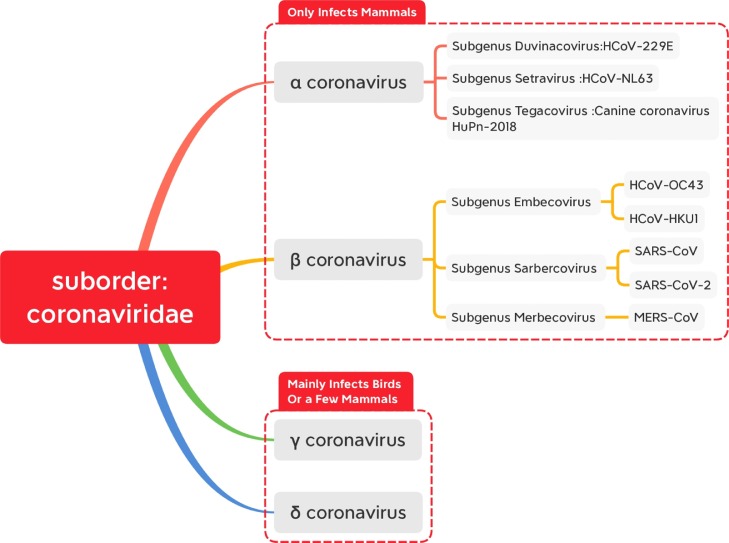
Coronavirus is a type of RNA-positive single-stranded virus with an envelope, and the spines on its surface derived its official name. Seven human coronaviruses 229E, OC43, SARS, NL63, HKU1, MERS, SARS-CoV-2 can cause both a mild cold and an epidemic of large-scale deaths and injuries. Although their clinical manifestations and many other pathogens that cause human colds are similar, studying the relationship between their evolutionary history and the receptors that infect the host can provide important insights into the natural history of human epidemics in the past and future. In this review, we describe the basic virology of these seven coronaviruses, their partial genome characteristics, and emphasize the function of receptors. We summarize the current understanding of these viruses and discuss the potential host of wild animals of these coronaviruses and the origin of zoonotic diseases.
冠状病毒是一种带有包膜的 RNA 阳性单链病毒,其表面的刺突蛋白赋予了它官方名称。七种人类冠状病毒(229E、OC43、SARS、NL63、HKU1、MERS、SARS-CoV-2)既可以引起轻微感冒,也可以引起大规模伤亡的流行。尽管它们的临床表现与引起人类感冒的许多其他病原体相似,但研究它们的进化历史和感染宿主的受体之间的关系,可以为过去和未来人类流行病的自然史提供重要的见解。在这篇综述中,我们描述了这七种冠状病毒的基本病毒学、它们部分基因组的特征,并强调了受体的功能。我们总结了目前对这些病毒的认识,并讨论了这些冠状病毒野生动物宿主的潜在性和人畜共患病的起源。