Instituto de Ciencias Médicas, PO Box 0710-00043, Las Tablas, Los Santos, Panamá.
Unidad de Hemodiálisis, Departamento de Nefrología, Hospital Dr. Gustavo N. Collado, Caja de Seguro Social, Chitré, Herrera, Panamá.
BMC Nephrol. 2022 Aug 5;23(1):275. doi: 10.1186/s12882-022-02907-3.
Over the last three decades, the mesoamerican region has seen an increase in the frequency of patients diagnosed with Chronic Kidney Disease of nontraditional causes (CKDnt) also known as Meso-American Nephropathy (MeN). A region with an increased frequency of patients with Chronic Kidney Disease (CKD) has been identified in central Panama. The present study aims to characterize the clinical presentation of patients with CKDnt in an understudied population of the central region of Panama and to compare them with patients with traditional chronic kidney disease (CKDt).
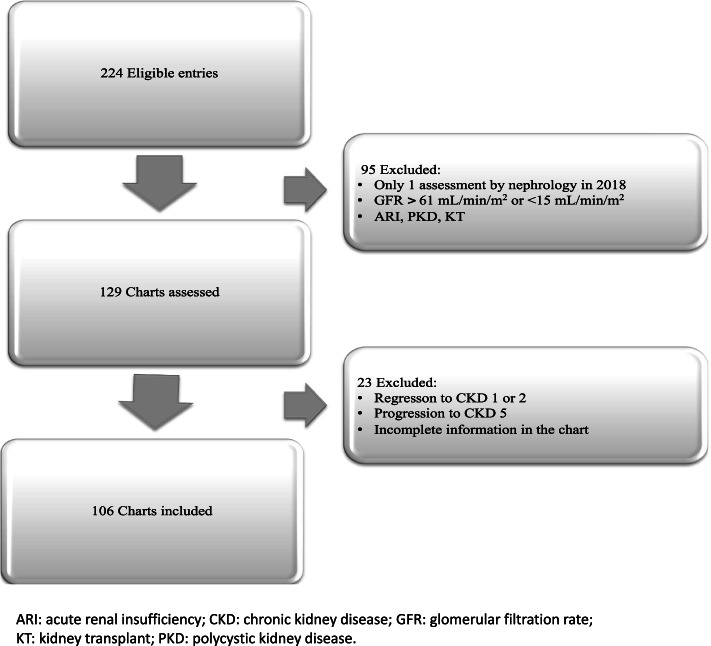
A retrospective descriptive study was conducted in a nephrology reference hospital in the central provinces of Herrera and Los Santos, comparing a group of 15 patients with CKDnt to 91 patients with CKDt. Sociodemographic variables, personal history, laboratory parameters, and of renal ultrasound were compared.
Patients with CKDnt had a median age of 58 years (IQR: 52-61), significantly lower (P < 0.001) than patients with CKDt with a median age of 71 years (IQR: 64-78). Patients with CKDnt had a history of being agricultural (60%) and transportation (20%) workers, significantly higher than patients with CKDt (15%, P < 0.001 and 0%, P < 0.01 respectively). Renal atrophy and hyperuricemia are significant clinical markers of CKDnt (P < 0.001 and P < 0.05 respectively).
To our knowledge, this is the first study in Panama to investigate the clinical presentation of patients with CKDnt and one of the few in Central America and the world that compares them with patients with CKDt. In central Panama the typical CKDnt patient is a male in his 50 s who is primarily engaged in agriculture or as a public transport driver. Renal atrophy and hyperuricemia are significant clinical markers of CKDnt. Further studies are needed to help understand the common determinants and risk factors for CKDnt development in Panama and Mesoamerica.
在过去的三十年中,中美洲地区被诊断患有非传统病因的慢性肾脏病(CKDnt)的患者的频率增加,也称为中美洲肾病(MeN)。在巴拿马中部发现了一个慢性肾脏病(CKD)患者频率增加的地区。本研究旨在描述巴拿马中部一个研究较少的地区 CKDnt 患者的临床表现,并将其与传统慢性肾脏病(CKDt)患者进行比较。
在中美洲的埃雷拉省和洛斯桑托斯省的一家肾病学参考医院进行了回顾性描述性研究,将一组 15 例 CKDnt 患者与 91 例 CKDt 患者进行了比较。比较了社会人口统计学变量、个人病史、实验室参数和肾脏超声。
CKDnt 患者的中位年龄为 58 岁(IQR:52-61),明显低于 CKDt 患者的中位年龄 71 岁(IQR:64-78)(P < 0.001)。CKDnt 患者有农业(60%)和交通(20%)工人的病史,明显高于 CKDt 患者(15%,P < 0.001 和 0%,P < 0.01 分别)。肾脏萎缩和高尿酸血症是 CKDnt 的重要临床标志物(P < 0.001 和 P < 0.05 分别)。
据我们所知,这是巴拿马首例研究 CKDnt 患者临床表现的研究,也是中美洲和世界上为数不多的将其与 CKDt 患者进行比较的研究之一。在巴拿马中部,典型的 CKDnt 患者是 50 多岁的男性,主要从事农业或公共交通工作。肾脏萎缩和高尿酸血症是 CKDnt 的重要临床标志物。需要进一步研究以帮助了解巴拿马和中美洲 CKDnt 发展的共同决定因素和危险因素。