1Department of Neurological Surgery, University of California, San Francisco, School of Medicine, San Francisco, California; and.
2Department of Hearing and Speech Sciences, Vanderbilt University Medical Center, Nashville, Tennessee.
J Neurosurg. 2022 Aug 5;138(3):847-857. doi: 10.3171/2022.6.JNS2297. Print 2023 Mar 1.
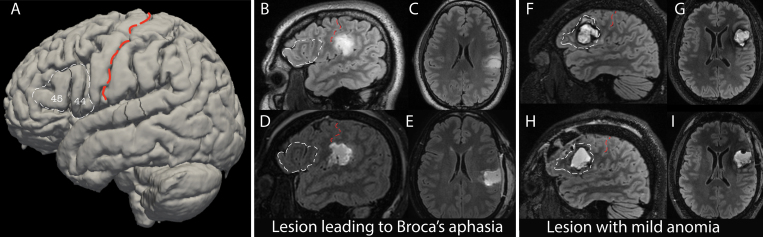
Broca's aphasia is a syndrome of impaired fluency with retained comprehension. The authors used an unbiased algorithm to examine which neuroanatomical areas are most likely to result in Broca's aphasia following surgical lesions.
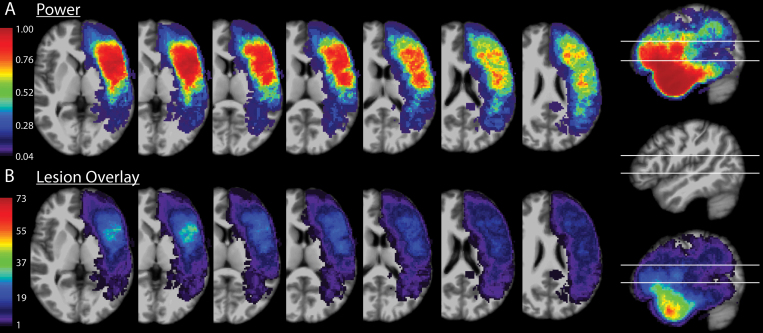
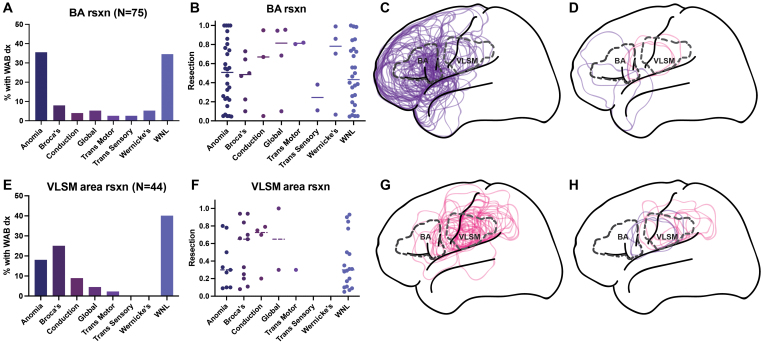
Patients were prospectively evaluated with standardized language batteries before and after surgery. Broca's area was defined anatomically as the pars opercularis and triangularis of the inferior frontal gyrus. Broca's aphasia was defined by the Western Aphasia Battery language assessment. Resections were outlined from MRI scans to construct 3D volumes of interest. These were aligned using a nonlinear transformation to Montreal Neurological Institute brain space. A voxel-based lesion-symptom mapping (VLSM) algorithm was used to test for areas statistically associated with Broca's aphasia when incorporated into a resection, as well as areas associated with deficits in fluency independent of Western Aphasia Battery classification. Postoperative MRI scans were reviewed in blinded fashion to estimate the percentage resection of Broca's area compared to areas identified using the VLSM algorithm.
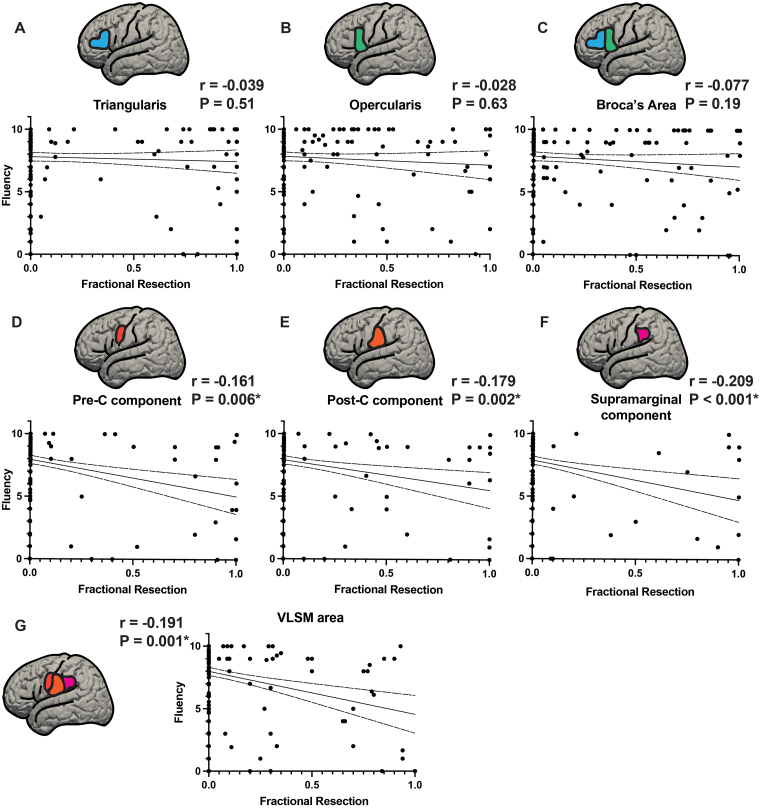
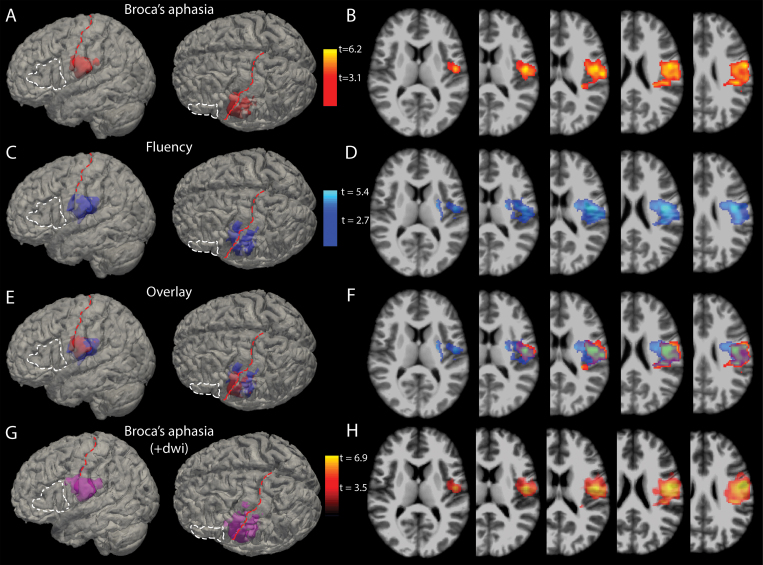
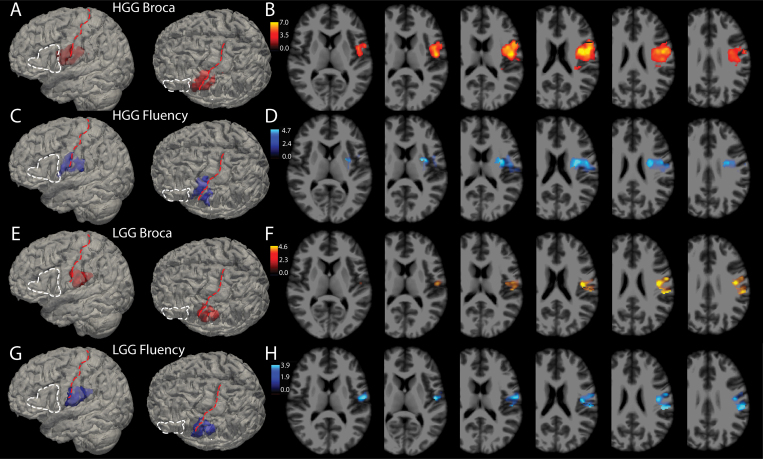
A total of 289 patients had early language evaluations, of whom 19 had postoperative Broca's aphasia. VLSM analysis revealed an area that was highly correlated (p < 0.001) with Broca's aphasia, spanning ventral sensorimotor cortex and supramarginal gyri, as well as extending into subcortical white matter tracts. Reduced fluency scores were significantly associated with an overlapping region of interest. The fluency score was negatively correlated with fraction of resected precentral, postcentral, and supramarginal components of the VLSM area.
Broca's aphasia does not typically arise from neurosurgical resections in Broca's area. When Broca's aphasia does occur after surgery, it is typically in the early postoperative period, improves by 1 month, and is associated with resections of ventral sensorimotor cortex and supramarginal gyri.
布罗卡失语症是一种以流畅性受损为特征、但保留理解能力的综合征。作者采用一种无偏算法来研究在外科手术损伤后,哪些神经解剖区域最有可能导致布罗卡失语症。
前瞻性地对患者进行标准语言测试,在术前和术后进行评估。布罗卡区被定义为下额下回的岛盖部和三角部。布罗卡失语症则通过西方失语症成套测验来定义。从 MRI 扫描中勾勒出切除范围,以构建感兴趣的 3D 体积。使用非线性变换将这些体积对齐到蒙特利尔神经学研究所脑空间。采用基于体素的病变-症状映射(VLSM)算法来测试在将其纳入切除范围时与布罗卡失语症相关的区域,以及与西方失语症成套测验分类无关的流畅性缺陷相关的区域。对术后 MRI 扫描进行盲法评估,以估计布罗卡区切除面积与 VLSM 算法确定的面积的百分比。
共有 289 例患者进行了早期语言评估,其中 19 例患者术后出现布罗卡失语症。VLSM 分析显示,一个与布罗卡失语症高度相关(p < 0.001)的区域,横跨腹侧感觉运动皮质和缘上回,以及延伸至皮质下白质束。流畅性评分降低与重叠的感兴趣区域显著相关。流畅性评分与 VLSM 区域的中央前回、中央后回和缘上回切除部分的分数呈负相关。
布罗卡失语症通常不是神经外科手术切除布罗卡区引起的。当手术后确实出现布罗卡失语症时,通常发生在术后早期,1 个月后会改善,并且与腹侧感觉运动皮质和缘上回的切除有关。