Division of Tuberculosis Elimination, National Center for HIV, Viral Hepatitis, STD, and TB Prevention, US Centers for Disease Control and Prevention, Atlanta, GA, USA; Epidemic Intelligence Service, US Centers for Disease Control and Prevention, Atlanta, GA, USA.
Epidemic Intelligence Service, US Centers for Disease Control and Prevention, Atlanta, GA, USA; Division of Healthcare Quality Promotion, National Center for Emerging and Zoonotic Infectious Diseases, US Centers for Disease Control and Prevention, Atlanta, GA, USA.
Lancet Infect Dis. 2022 Nov;22(11):1617-1625. doi: 10.1016/S1473-3099(22)00425-X. Epub 2022 Aug 4.
Mycobacterium tuberculosis transmission through solid organ transplantation has been well described, but transmission through transplanted tissues is rare. We investigated a tuberculosis outbreak in the USA linked to a bone graft product containing live cells derived from a single deceased donor.
In this outbreak report, we describe the management and severity of the outbreak and identify opportunities to improve tissue transplant safety in the USA. During early June, 2021, the US Centers for Disease Control and Prevention (CDC) worked with state and local health departments and health-care facilities to locate and sequester unused units from the recalled lot and notify, evaluate, and treat all identified product recipients. Investigators from CDC and the US Food and Drug Administration (FDA) reviewed donor screening and tissue processing. Unused product units from the recalled and other donor lots were tested for the presence of M tuberculosis using real-time PCR (rt PCR) assays and culture. M tuberculosis isolates from unused product and recipients were compared using phylogenetic analysis.
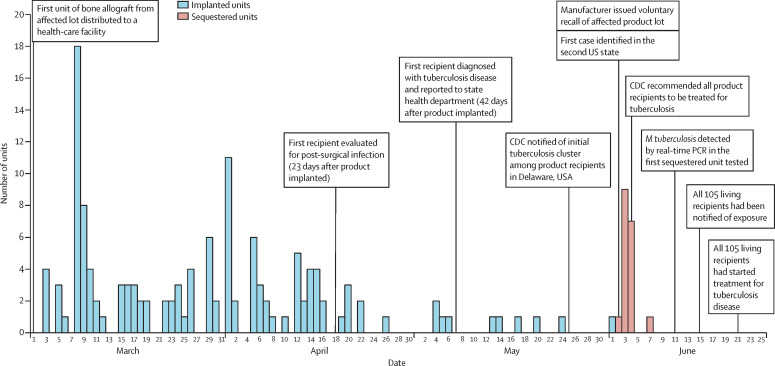
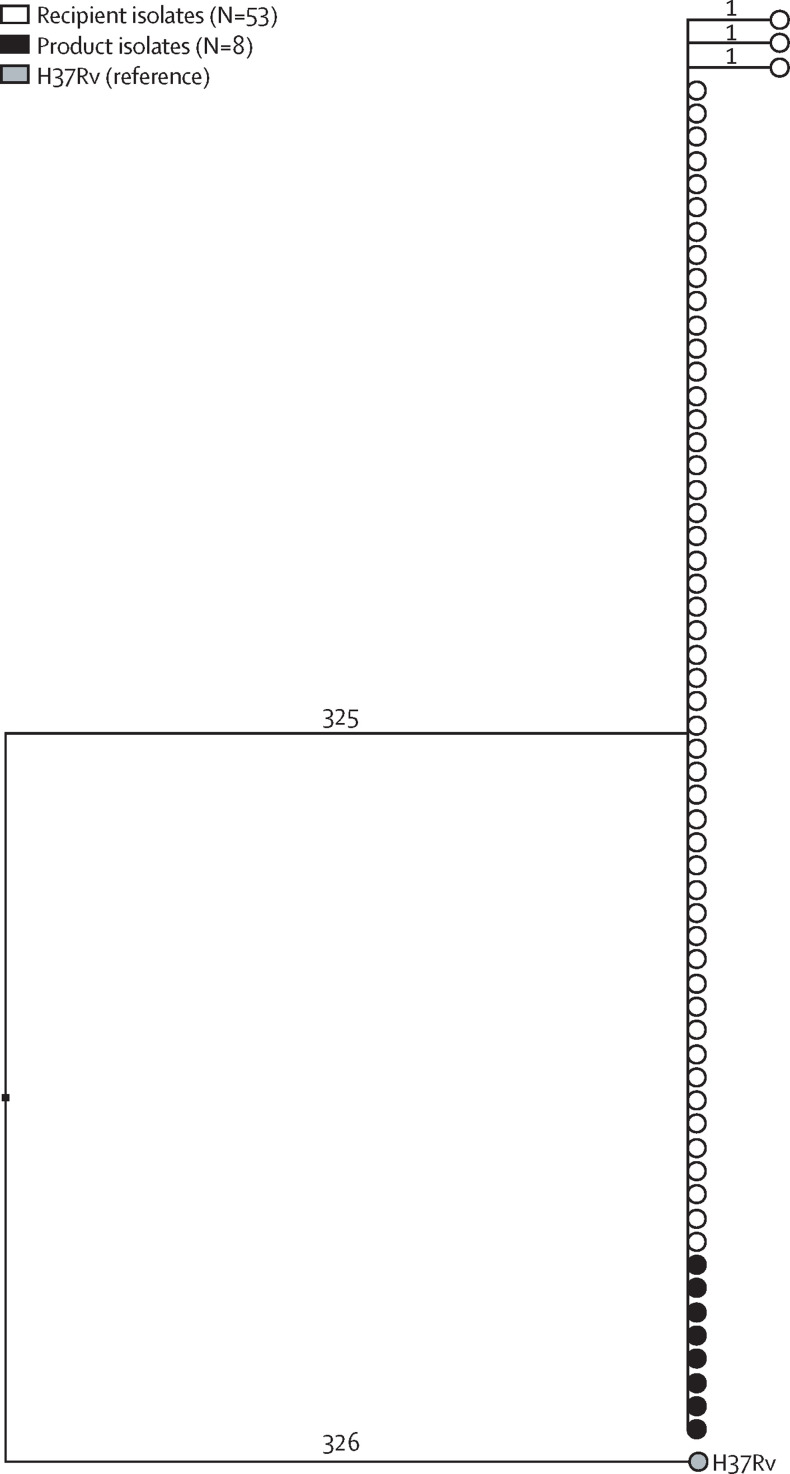
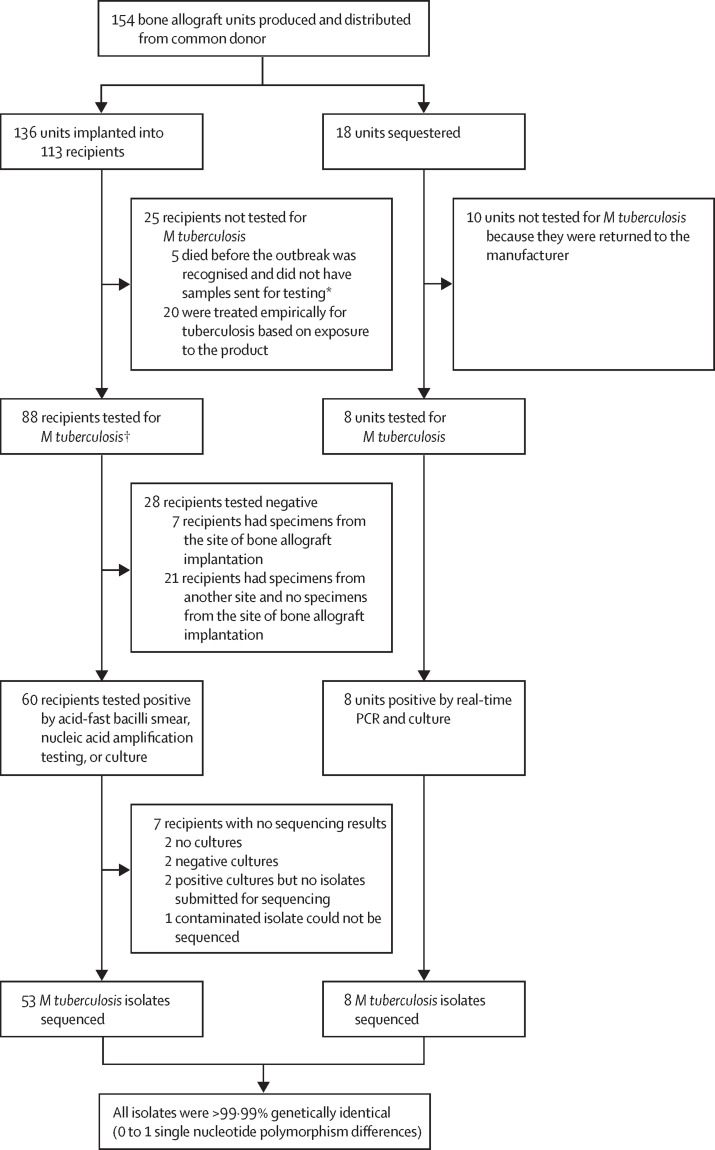
The tissue donor (a man aged 80 years) had unrecognised risk factors, symptoms, and signs consistent with tuberculosis. Bone was procured from the deceased donor and processed into 154 units of bone allograft product containing live cells, which were distributed to 37 hospitals and ambulatory surgical centres in 20 US states between March 1 and April 2, 2021. From March 3 to June 1, 2021, 136 (88%) units were implanted into 113 recipients aged 24-87 years in 18 states (some individuals received multiple units). The remaining 18 units (12%) were located and sequestered. 87 (77%) of 113 identified product recipients had microbiological or imaging evidence of tuberculosis disease. Eight product recipients died 8-99 days after product implantation (three deaths were attributed to tuberculosis after recognition of the outbreak). All 105 living recipients started treatment for tuberculosis disease at a median of 69 days (IQR 56-81) after product implantation. M tuberculosis was detected in all eight sequestered unused units tested from the recalled donor lot, but not in lots from other donors. M tuberculosis isolates from unused product and recipients were more than 99·99% genetically identical.
Donor-derived transmission of M tuberculosis via bone allograft resulted in substantial morbidity and mortality. All prospective tissue and organ donors should be routinely assessed for tuberculosis risk factors and clinical findings. When these are present, laboratory testing for M tuberculosis should be strongly considered.
None.
分枝杆菌通过实体器官移植传播的情况已有充分描述,但通过移植组织传播的情况较为罕见。我们调查了美国一起与含有源自单一已故供体活细胞的骨移植物产品相关的结核病暴发事件。
在本起暴发报告中,我们描述了该暴发的管理和严重程度,并确定了提高美国组织移植安全性的机会。2021 年 6 月初,美国疾病控制与预防中心(CDC)与州和地方卫生部门以及卫生保健机构合作,寻找并隔离召回批次中未使用的单位,并通知、评估和治疗所有确定的产品受者。CDC 和美国食品和药物管理局(FDA)的调查人员审查了供者筛查和组织处理情况。使用实时 PCR(rtPCR)检测和培养法,对来自召回批次和其他供者批次的未使用产品单位进行了结核分枝杆菌存在情况的检测。对未使用的产品和受者分离株进行了系统发育分析。
该组织供者(一名 80 岁男性)存在未被识别的结核病风险因素、症状和体征。从死者供者获取骨头,加工成含有活细胞的 154 个骨移植物产品单位,这些单位于 2021 年 3 月 1 日至 4 月 2 日分发至美国 20 个州的 37 家医院和门诊手术中心。2021 年 3 月 3 日至 6 月 1 日,136 个(88%)单位植入 18 个州的 113 名年龄为 24-87 岁的受者体内(部分受者接受了多个单位)。其余 18 个单位(12%)被找到并封存。113 名确定的产品受者中有 87 名(77%)有结核病的微生物学或影像学证据。8 名产品受者在产品植入后 8-99 天死亡(在认识到暴发后,有 3 人死亡归因于结核病)。所有 105 名存活的受者在产品植入后中位 69 天(IQR 56-81)开始接受结核病治疗。在从召回供者批次中测试的所有 8 个封存的未使用单位中均检测到结核分枝杆菌,但在其他供者批次中未检测到。未使用产品和受者分离株的结核分枝杆菌的基因相似度超过 99.99%。
通过骨移植物供体传播的分枝杆菌导致了严重的发病率和死亡率。所有拟行组织和器官移植的供者都应常规评估结核病风险因素和临床发现。如果存在这些因素,应强烈考虑对结核分枝杆菌进行实验室检测。
无。