Bor Alexander, Jørgensen Frederik, Lindholt Marie Fly, Petersen Michael Bang
Aarhus University.
Polit Psychol. 2022 May 6. doi: 10.1111/pops.12835.
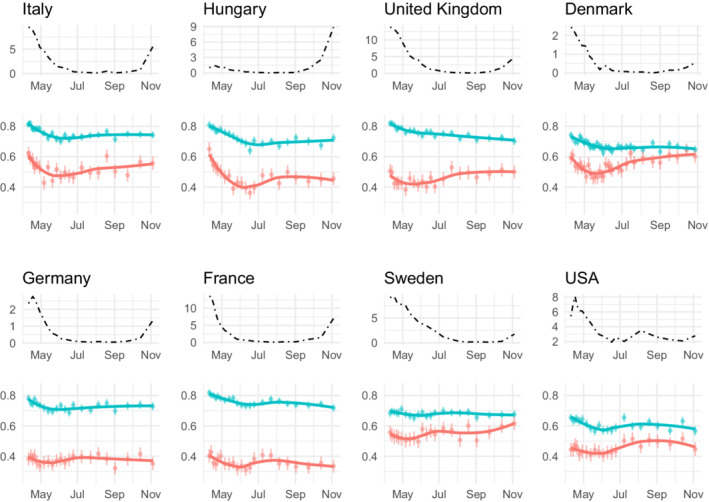
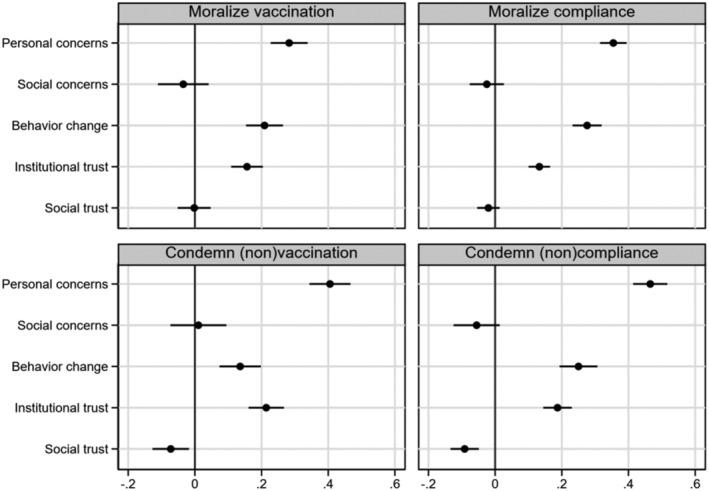
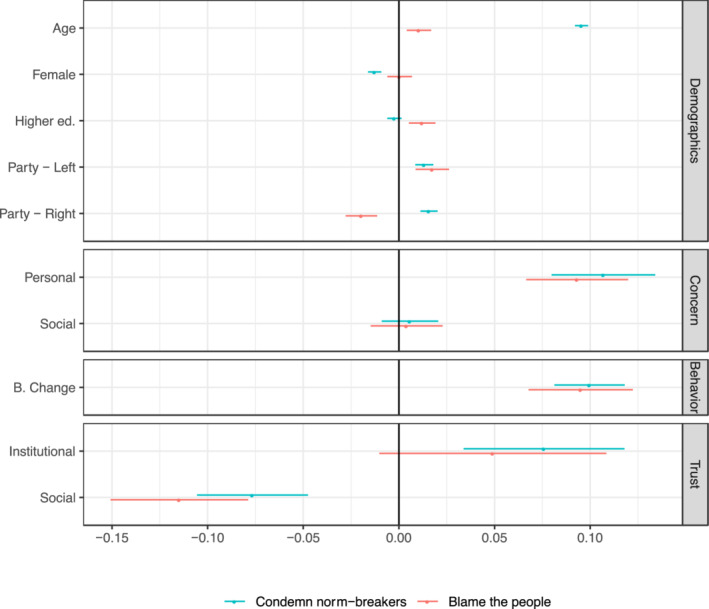
The emergence of the novel coronavirus has put societies under tremendous pressure to instigate massive and rapid behavior change. Throughout history, an effective strategy to facilitate novel behaviors has been to morally condemn those who do not behave in an appropriate way. Accordingly, here, we investigate if complying with the advice of health authorities-for example, to physically distance or vaccinate-has emerged as a moralized issue during the COVID-19 pandemic. In Study 1, we rely on data ( = 94K) from quota-sampled rolling cross-sectional online surveys from eight countries (Denmark, Sweden, Germany, France, Italy, Hungary, the United Kingdom, and the United States). We find that large majorities find it justified to condemn those who do not keep a distance to others in public and around half of respondents blame ordinary citizens for the severity of the pandemic. Furthermore, we identify the most important predictors of condemnation to be behavior change and personal concern, while institutional trust and social distrust also play large but less consistent roles. Study 2 offers a registered replication of our findings on a representative sample of Britons ( = 1.5K). It shows that both moralization and condemnation of both vaccination and general compliance are best predicted by self-interested considerations.
新型冠状病毒的出现给社会带来了巨大压力,促使人们大规模迅速改变行为。纵观历史,促进新行为的一个有效策略是从道德上谴责那些行为不当的人。因此,在此我们调查在新冠疫情期间,遵守卫生当局的建议(例如保持身体距离或接种疫苗)是否已成为一个道德化问题。在研究1中,我们依赖于来自八个国家(丹麦、瑞典、德国、法国、意大利、匈牙利、英国和美国)的配额抽样滚动横截面在线调查数据(n = 94000)。我们发现,绝大多数人认为谴责那些在公共场合不与他人保持距离的人是合理的,约一半的受访者将疫情的严重程度归咎于普通公民。此外,我们确定谴责的最重要预测因素是行为改变和个人担忧,而机构信任和社会不信任也发挥了很大但不太一致的作用。研究2对我们在英国代表性样本(n = 1500)上的研究结果进行了注册复制。结果表明,对疫苗接种和普遍遵守行为的道德化和谴责,最能由利己考虑因素预测。