Wageningen University & Research, Wageningen, The Netherlands.
Oxford-Johns Hopkins Global Infectious Disease Ethics Collaborative, Johns Hopkins University, Baltimore, United States.
Med Health Care Philos. 2022 Dec;25(4):655-669. doi: 10.1007/s11019-022-10103-1. Epub 2022 Aug 31.
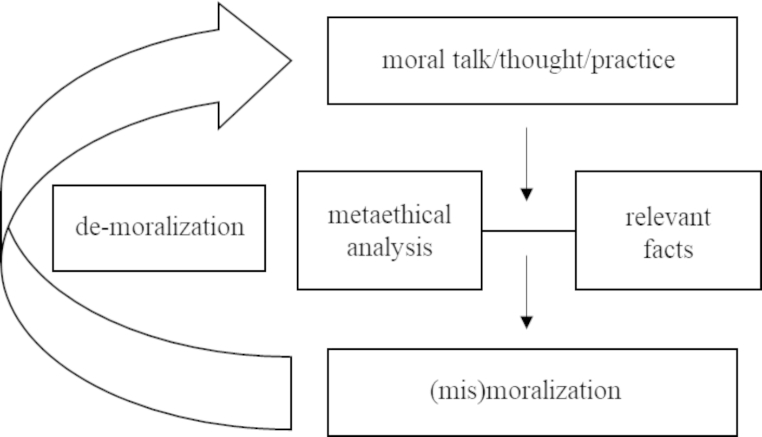
Moralization is a social-psychological process through which morally neutral issues take on moral significance. Often linked to health and disease, moralization may sometimes lead to good outcomes; yet moralization is often detrimental to individuals and to society as a whole. It is therefore important to be able to identify when moralization is inappropriate. In this paper, we offer a systematic normative approach to the evaluation of moralization. We introduce and develop the concept of 'mismoralization', which is when moralization is metaethically unjustified. In order to identify mismoralization, we argue that one must engage in metaethical analysis of moralization processes while paying close attention to the relevant facts. We briefly discuss one historical example (tuberculosis) and two contemporary cases related to COVID-19 (infection and vaccination status) that we contend to have been mismoralized in public health. We propose a remedy of de-moralization that begins by identifying mismoralization and that proceeds by neutralizing inapt moral content. De-moralization calls for epistemic and moral humility. It should lead us to pull away from our tendency to moralize-as individuals and as social groups-whenever and wherever moralization is unjustified.
道德化是一个社会心理学过程,通过这个过程,原本中性的问题具有了道德意义。道德化通常与健康和疾病有关,有时可能会带来好的结果;但道德化往往对个人和整个社会都有害。因此,能够识别何时道德化不恰当是很重要的。在本文中,我们提供了一种系统的规范方法来评估道德化。我们引入并发展了“不道德化”的概念,即道德化在元伦理学上是没有正当理由的。为了识别不道德化,我们认为必须对道德化过程进行元伦理分析,同时密切关注相关事实。我们简要讨论了一个历史例子(结核病)和两个与 COVID-19 相关的当代案例(感染和疫苗接种状况),我们认为这些案例在公共卫生领域被不道德化了。我们提出了一种去道德化的补救措施,首先要识别不道德化,然后通过中和不适当的道德内容来进行。去道德化需要知识和道德上的谦逊。它应该促使我们摆脱个人和社会群体在任何时候、任何地点对不恰当的道德化的倾向。